

If you are planning a house, boundary wall, shop, warehouse, or commercial building, knowing the hollow block quantity per 100 sq ft wall in Pakistan makes material planning easier. For the common 16 × 8 inch block face, you need about 113 hollow concrete blocks for 100 sq ft of wall before wastage. With an 8% to 10% allowance for cutting, breakage, corners, and handling, the practical quantity becomes about 122 to 124 blocks, often rounded to 125 blocks per 100 sq ft.
This estimate applies when the block face is 16 inches long and 8 inches high. If the face size stays the same, a 4-inch, 6-inch, or 8-inch thick block covers the same wall area.
Quick Answer: How Many Hollow Blocks Are Needed for 100 Sq Ft?
For a standard 16 × 8 inch block face:
- Wall area = 100 sq ft
- Block face area = 16 × 8 = 128 square inches
- Block face area = 128 ÷ 144 = about 0.89 sq ft
- Blocks required = 100 ÷ 0.89 = about 112.5 blocks
- Rounded quantity = 113 blocks
- With 8% wastage = about 122 blocks
- With 10% wastage = about 124 blocks
For easy purchasing, plan around 125 hollow blocks per 100 sq ft wall, then adjust the order according to actual wall dimensions.
Hollow Block Quantity Formula for Any Wall Size
Use this formula:
Number of blocks = Net wall area ÷ face area of one block
A 16 × 8 inch block has a face area of about 0.89 sq ft. That means approximately 1.125 blocks per sq ft of wall.
Example for a 200 Sq Ft Wall
200 × 1.125 = 225 blocks
With 10% wastage:
225 + 22.5 = about 248 blocks
A practical order would be around 245 to 250 blocks, depending on wall shape and cutting.
Does Block Thickness Change the Quantity?
Usually, no. A 16 × 8 × 4 inch block and a 16 × 8 × 8 inch block both have the same 16 × 8 inch visible face when laid in a wall. Both therefore require about 113 blocks per 100 sq ft before wastage.
Thickness affects wall width, weight, strength, insulation, and application, but not the number of blocks needed to cover the same face area. For structural or external walls, use the thickness and grade specified by the project engineer.
Subtract Doors and Windows Before Calculating
Do not calculate blocks from the full wall area when the wall contains openings.
A wall that is 20 feet long and 10 feet high has a gross area of 200 sq ft. If it contains a 3 × 7 ft door and a 4 × 4 ft window, the openings total 37 sq ft.
Net wall area = 200 − 37 = 163 sq ft
163 × 1.125 = about 183 blocks
With 10% wastage, the order becomes about 202 blocks. This gives a more realistic hollow block quantity and helps control material cost.
How Much Wastage Should You Add?
For normal construction work in Pakistan, an 8% to 10% wastage allowance is practical. Waste can come from transportation damage, corner cuts, door and window jambs, service openings, and accidental breakage.
When More Wastage May Be Needed
Use a higher allowance for walls with many short sections, unusual angles, frequent openings, or decorative details. Straight walls built with uniform machine-made blocks generally create less waste.
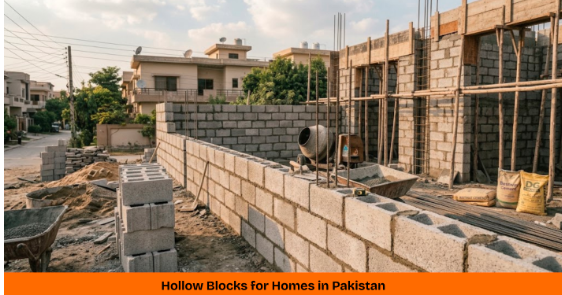
Hollow Blocks for Homes in Pakistan
Hollow concrete masonry is widely used in residential, commercial, and industrial projects because the units are easy to handle and can speed up wall construction. Different thicknesses may be used for external walls, partitions, and boundary walls according to the approved design.
If you are estimating an entire home, PrimeCrete’s calculating hollow blocks for a 5 Marla house in Pakistan guide explains how storeys, wall height, partitions, openings, and bounHollow Block Quantity per 100 Sq Ft Wall in Pakistan
If you are planning a house, boundary wall, shop, warehouse, or commercial building, knowing the hollow block quantity per 100 sq ft wall in Pakistan makes material planning easier. For the common 16 × 8 inch block face, you need about 113 hollow concrete blocks for 100 sq ft of wall before wastage. With an 8% to 10% allowance for cutting, breakage, corners, and handling, the practical quantity becomes about 122 to 124 blocks, often rounded to 125 blocks per 100 sq ft.
This estimate applies when the block face is 16 inches long and 8 inches high. If the face size stays the same, a 4-inch, 6-inch, or 8-inch thick block covers the same wall area.
Quick Answer: How Many Hollow Blocks Are Needed for 100 Sq Ft?
For a standard 16 × 8 inch block face:
- Wall area = 100 sq ft
- Block face area = 16 × 8 = 128 square inches
- Block face area = 128 ÷ 144 = about 0.89 sq ft
- Blocks required = 100 ÷ 0.89 = about 112.5 blocks
- Rounded quantity = 113 blocks
- With 8% wastage = about 122 blocks
- With 10% wastage = about 124 blocks
For easy purchasing, plan around 125 hollow blocks per 100 sq ft wall, then adjust the order according to actual wall dimensions.
Hollow Block Quantity Formula for Any Wall Size
Use this formula:
Number of blocks = Net wall area ÷ face area of one block
A 16 × 8 inch block has a face area of about 0.89 sq ft. That means approximately 1.125 blocks per sq ft of wall.
Example for a 200 Sq Ft Wall
200 × 1.125 = 225 blocks
With 10% wastage:
225 + 22.5 = about 248 blocks
A practical order would be around 245 to 250 blocks, depending on wall shape and cutting.
Does Block Thickness Change the Quantity?
Usually, no. A 16 × 8 × 4 inch block and a 16 × 8 × 8 inch block both have the same 16 × 8 inch visible face when laid in a wall. Both therefore require about 113 blocks per 100 sq ft before wastage.
Thickness affects wall width, weight, strength, insulation, and application, but not the number of blocks needed to cover the same face area. For structural or external walls, use the thickness and grade specified by the project engineer.
Subtract Doors and Windows Before Calculating
Do not calculate blocks from the full wall area when the wall contains openings.
A wall that is 20 feet long and 10 feet high has a gross area of 200 sq ft. If it contains a 3 × 7 ft door and a 4 × 4 ft window, the openings total 37 sq ft.
Net wall area = 200 − 37 = 163 sq ft
163 × 1.125 = about 183 blocks
With 10% wastage, the order becomes about 202 blocks. This gives a more realistic hollow block quantity and helps control material cost.
How Much Wastage Should You Add?
For normal construction work in Pakistan, an 8% to 10% wastage allowance is practical. Waste can come from transportation damage, corner cuts, door and window jambs, service openings, and accidental breakage.
When More Wastage May Be Needed
Use a higher allowance for walls with many short sections, unusual angles, frequent openings, or decorative details. Straight walls built with uniform machine-made blocks generally create less waste.
Hollow Blocks for Homes in Pakistan
Hollow concrete masonry is widely used in residential, commercial, and industrial projects because the units are easy to handle and can speed up wall construction. Different thicknesses may be used for external walls, partitions, and boundary walls according to the approved design.
If you are estimating an entire home, PrimeCrete’s calculating hollow blocks for a 5 Marla house in Pakistan guide explains how storeys, wall height, partitions, openings, and boundary walls affect the total.
When a wall needs higher density or another structural solution, the engineer may specify solid concrete blocks. PrimeCrete’s guide to solid concrete blocks in Pakistan also explains common sizes, strength considerations, and uses.
What Quality Should You Check Before Ordering?
A correct quantity matters only when the blocks are suitable for the project. Check:
- Uniform length, height, and thickness
- Clean edges with minimal cracks
- Consistent finish and compaction
- Required compressive strength
- Proper curing and production control
- Test information when required
ASTM C90 concrete masonry standard covers dry-cast loadbearing concrete masonry units, including hollow and solid units. Pakistani projects may also follow other standards or engineer-defined requirements, so approved drawings and specifications should remain the final reference.
How to Order the Right Hollow Block Quantity
Measure each wall, multiply length by height, subtract door and window openings, and multiply the net wall area by 1.125 blocks per sq ft. Then add wastage.
For a quick site estimate:
100 sq ft wall = 113 blocks before wastage
100 sq ft wall = about 122–124 blocks with 8%–10% wastage
Safe rounded estimate = about 125 blocks
For larger projects, keep 4-inch, 6-inch, and 8-inch blocks separate on the purchase list. Mixing thicknesses into one total can cause shortages in one wall type and excess stock in another.
Frequently Asked Questions
How many 16 × 8 hollow blocks are needed for 100 sq ft?
About 113 blocks are required before wastage. With 10% extra, plan around 124 to 125 blocks.
How many hollow blocks are needed per square foot?
A 16 × 8 inch block requires about 1.125 blocks per sq ft of wall area.
Do 4-inch and 8-inch hollow blocks need different quantities?
Not if both have the same 16 × 8 inch face. The count remains about 113 blocks per 100 sq ft before wastage.
Should Mortar Joints Be Included?
For a quick estimate, the 1.125 blocks per sq ft method is simple and conservative. For a detailed takeoff, use the manufacturer’s actual block dimensions and specified mortar joint thickness.
Final Estimate for Pakistani Construction
For the common 16 × 8 inch hollow concrete block used in Pakistan, a practical planning figure is about 125 blocks per 100 sq ft of wall including normal wastage. For accurate purchasing, calculate net wall area, subtract openings, separate block thicknesses, and confirm actual block dimensions before ordering.dary walls affect the total.
When a wall needs higher density or another structural solution, the engineer may specify solid concrete blocks. PrimeCrete’s guide to solid concrete blocks in Pakistan also explains common sizes, strength considerations, and uses.

[…] you need roughly 1.125 blocks per sq ft of wall. PrimeCrete’s own quantity guide uses the same figure. It runs slightly conservative because it ignores mortar joints, which works […]