

Choosing the correct hollow block mortar ratio is important for wall strength, neat joints, lower material waste, and cost control. For block masonry in Pakistan, a cement-to-sand ratio between 1:4 and 1:6 by volume is commonly used, depending on wall type, engineering requirements, block quality, and exposure.
For standard 16 × 8 × 8 inch hollow blocks with about 10 mm mortar joints, a useful estimate is 0.7 to 1.0 cement bag per 100 blocks using 50 kg cement bags. A richer 1:4 mix uses close to one bag, while a 1:6 mix uses less. Site conditions can increase consumption, so keep a reasonable allowance.
What Is the Best Hollow Block Mortar Ratio?
The mortar ratio for hollow blocks is the proportion of cement to sand measured by volume. A 1:4 mix means one part cement to four parts clean sand.
1:4 Cement to Sand Mortar
A 1:4 mortar ratio is a rich mix used where better bond strength or weather resistance is required. It is often selected for external walls, boundary walls, or work where the project specification requires stronger mortar.
Because it contains more cement, it costs more than leaner mixes. The engineer’s specification should control the final ratio for structural work.
1:5 Cement to Sand Mortar
A 1:5 mortar ratio balances strength, workability, and cost. It suits many general masonry applications when approved by the project engineer and can provide reliable bonding without unnecessary cement use.
1:6 Cement to Sand Mortar
A 1:6 mortar ratio is more economical and may suit lighter-duty or non-load-bearing masonry where the design permits it. Clean, properly graded sand is essential because excessive silt or clay can weaken mortar.
For formal masonry requirements, consultants can also review the ASTM C270 mortar standard, which covers proportion and property specifications for masonry mortar.
How Many Cement Bags Are Needed for 100 Hollow Blocks?
Assume standard 16 × 8 inch block faces, 10 mm joints, clean sand, and 50 kg cement bags. One hundred blocks cover about 89 square feet of wall face. For 8-inch hollow block masonry, wet mortar requirement is roughly 0.11 to 0.12 cubic metre per 100 blocks under these assumptions.
Estimated Cement Bags per 100 8-Inch Blocks
| Mortar Mix | Approx. Cement | Practical Allowance |
| 1:4 | 0.85–0.90 bag | About 1 bag |
| 1:5 | 0.70–0.75 bag | About 0.8–1 bag |
| 1:6 | 0.60–0.65 bag | About 0.7–0.8 bag |
These are planning estimates. Thick joints, damaged edges, uneven blocks, mortar dropping, and rework can raise consumption by 10% to 20%.
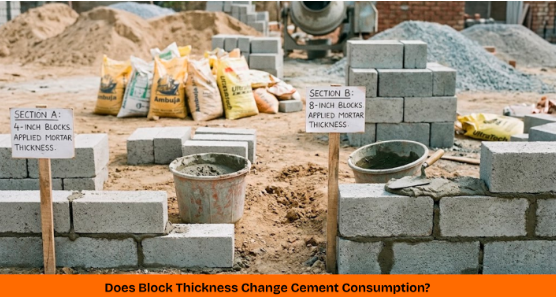
Does Block Thickness Change Cement Consumption?
Yes. A wider block generally needs more mortar across bed and vertical joints. An 8-inch wall uses more mortar than a 4-inch partition wall when block length and height are the same.
As a simple guide, 100 standard 4-inch hollow blocks may need around half the mortar used by 100 standard 8-inch blocks. With a 1:4 mix, this can be roughly 0.4 to 0.5 bag of cement before wastage. Six-inch blocks normally fall between the two.
For product selection, review Primecrete’s hollow concrete blocks for suitable wall applications. Where a denser unit is required, compare Primecrete solid concrete blocks before finalizing the specification.
Simple Formula for Cement Bags per 100 Blocks
Use this four-step method:
- Calculate wet mortar volume for the blockwork.
- Allow for dry material volume, compaction, and voids.
- Divide dry volume according to the selected cement-to-sand ratio.
- Convert cement volume into 50 kg bags and add site wastage.
If 100 blocks need about 0.115 m³ of wet mortar, dry material volume is roughly 0.15 m³. At a 1:4 ratio, cement is about one-fifth of that volume, giving close to 0.9 of a 50 kg bag. On site, one full bag per 100 8-inch blocks is a practical starting allowance.
What Makes Mortar Consumption Increase?
Joint Thickness and Block Accuracy
A 10 mm joint is a common estimating assumption. Joints of 12 to 15 mm increase cement and sand use. Uniform blocks also reduce corrective mortar needed to keep courses level.
Sand, Water, and Workmanship
Use clean masonry sand and enough water to make mortar workable without making it soupy. Skilled masons spread mortar evenly and avoid dropping excessive material into hollow cores or onto the floor.
Planning Hollow Block Masonry in Pakistan
For projects in Islamabad, Rawalpindi, Lahore, Haripur, and other Pakistani cities, calculate quantities from the latest drawings rather than plot size alone. Doors, windows, wall height, boundary walls, storeys, and internal partitions all affect the count.
Primecrete’s guide on calculating hollow concrete blocks for a 5 Marla house explains how wall area, openings, storeys, and block sizes change requirements. For heavier masonry, the solid concrete block size and strength guide helps compare block types before ordering.
Frequently Asked Questions About Hollow Block Mortar
What is the recommended mortar ratio for hollow blocks?
A 1:4 to 1:6 cement-sand ratio is commonly used, but the correct ratio depends on wall design, exposure, block strength, and project specifications. Engineer instructions should take priority.
How many cement bags are required for 100 hollow blocks?
For standard 16 × 8 × 8 inch blocks with 10 mm joints, roughly 0.7 to 1.0 bag of 50 kg cement per 100 blocks is a useful planning range. A 1:4 mix is close to one bag.
How much sand is needed for 100 blocks?
For 8-inch blocks, around 0.12 m³ of dry sand is a useful estimate for a 1:4 mortar mix. Actual use changes with joint thickness, dimensions, and wastage.
Is 1:6 mortar suitable for hollow blocks?
It can suit some non-load-bearing or light-duty work where design allows it. External, structural, or heavily exposed walls may require a richer or specifically designed mortar.
Getting the Hollow Block Mortar Ratio Right
The best hollow block mortar ratio should match the block type, wall function, engineering requirements, and site conditions. For budgeting, about one 50 kg cement bag per 100 standard 8-inch hollow blocks using a 1:4 mix is a sensible starting estimate, with extra allowance for thicker joints or site wastage.
