
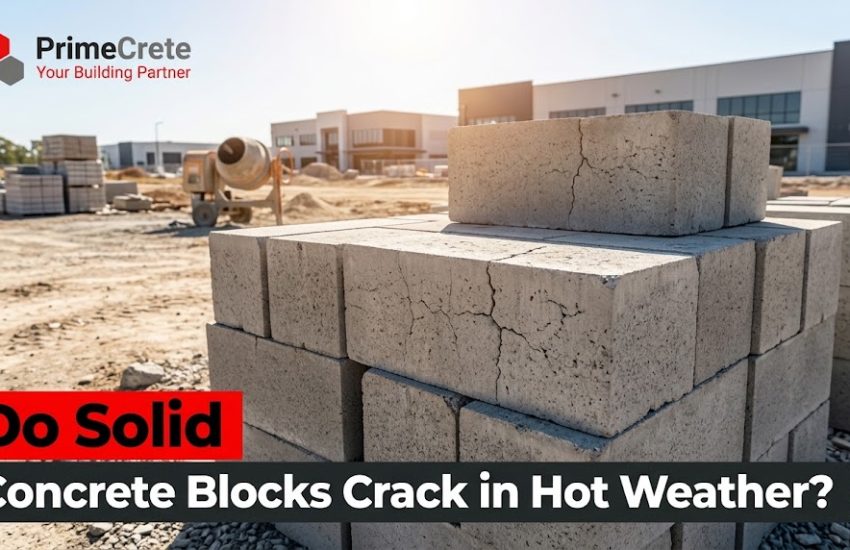
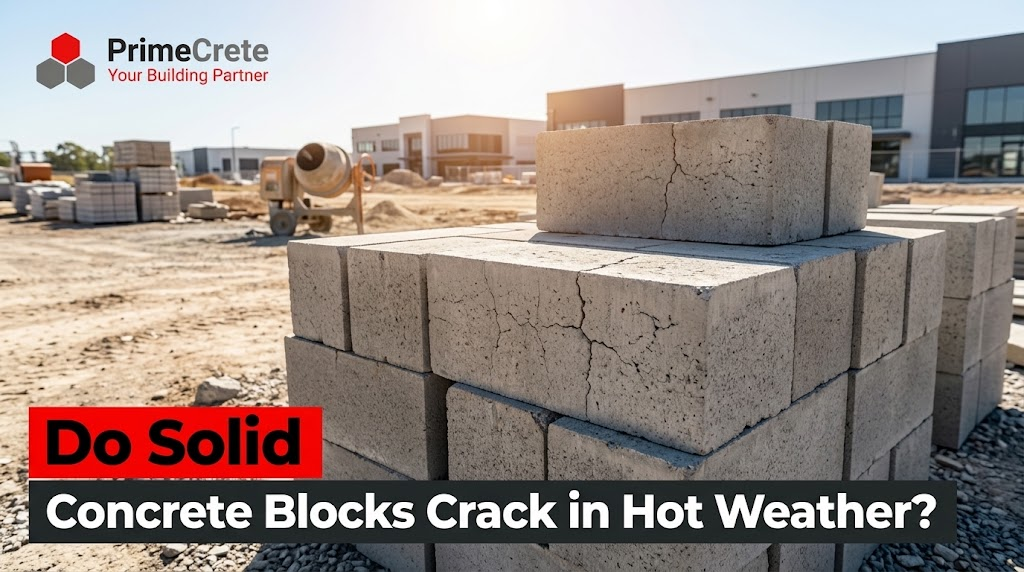
A newly constructed solid concrete block boundary wall in Lahore or Islamabad can look immaculate in March, only to reveal vertical hairline fractures by June. When property owners and site supervisors see these cracks developing during intense summer heatwaves, the instinctive reaction is to blame the concrete units or suspect structural failure. However, concrete blocks do not simply crack because the ambient air is hot.
The real challenge lies in the complex thermodynamic and moisture dynamics that unfold when masonry assemblies encounter peak Pakistani summer temperatures exceeding 42°C to 48°C. Understanding how heat drives drying shrinkage, thermal expansion, and mortar moisture loss is essential for designing resilient masonry. Specifying engineered solid concrete blocks from certified automated manufacturers like PrimeCrete ensures high compressive strength and low linear shrinkage, but wall longevity ultimately depends on how well structural detailing accommodates natural thermal movement.
The Short Answer
No, solid concrete blocks do not crack or lose strength simply from exposure to hot ambient weather. Cracking occurs when unrestrained thermal expansion, rapid drying shrinkage, and differential temperature gradients generate internal tensile stresses that exceed the masonry’s tensile capacity. Because concrete masonry shrinks as it loses moisture, hot dry weather accelerates shrinkage. If walls lack properly spaced control joints, horizontal joint reinforcement, and proper mortar hydration, relief cracks inevitably appear at points of restraint.
The Physics of Thermal Movement and Drying Shrinkage
To understand why masonry cracks in hot weather, builders must distinguish between two competing physical mechanisms: thermal expansion and drying shrinkage.
1. Thermal Expansion and Diurnal Temperature Swings
Like all dense construction materials, concrete expands when heated and contracts when cooled. Concrete masonry has a thermal expansion coefficient of approximately 0.0000081 to 0.000010 mm/mm per °C ($8.1 \times 10^{-6}\text{ /}^\circ\text{C}$).
In regions such as Multan, Faisalabad, or Peshawar, exterior wall surfaces exposed to direct south or west sunlight often reach surface temperatures of 60°C to 65°C during the day, cooling down to 28°C at night. Over a 30-meter continuous wall, a 35°C diurnal temperature swing can create several millimeters of theoretical cyclic movement.
2. Drying Shrinkage (The Primary Culprit)
While heat causes thermal expansion, high summer temperatures simultaneously drive rapid evaporation of residual moisture from the cement matrix. Concrete masonry units undergo irreversible drying shrinkage as capillary water leaves the hydrated calcium silicate hydrate (C-S-H) gel.
Under recognized manufacturing benchmarks such as the ASTM C90 Standard Specification for Loadbearing Concrete Masonry Units, the maximum allowable linear drying shrinkage of concrete masonry units is strictly capped at 0.065%. When low-grade, manual wet-cast blocks with uncontrolled moisture content are laid into a wall and baked under summer sun, unmitigated shrinkage strains easily exceed the tensile limit of the mortar and concrete.
Why Free Blocks Don’t Crack, but Restrained Walls Do
A solid concrete block resting freely on a wooden pallet in the middle of a 45°C afternoon will expand and contract without cracking. Cracking only occurs when restraint prevents the masonry from moving naturally.
In typical construction across Pakistan, walls are restrained by:
- Rigid RCC strip footings and grade beams that lock the base of the wall in place.
- Reinforced concrete columns in framed structures that restrict longitudinal expansion and contraction.
- Bond beams and floor slabs that impose differential thermal movement between shaded structural frames and exposed sunlit blockwork.
Tensile strength in unreinforced concrete masonry is roughly 10% of its compressive strength. When drying shrinkage causes the masonry panel to shorten while the foundation holds its base rigid, tensile stress accumulates across the length of the wall. Once this tensile stress surpasses the masonry’s tensile capacity, the wall relieves itself by tearing vertically or diagonally through the weakest planes-usually through vertical mortar head joints or across the middle of solid blocks.
Hot-Weather Masonry Construction Realities in Pakistan
Beyond post-construction movement, the installation process itself during extreme heat introduces critical failure risks if site practices are not adjusted.
Mortar “Flash Drying” and Bond Failure
Standard cement-sand masonry mortar requires sufficient water for complete cement hydration over 28 days. In a typical dry summer day in Punjab or Khyber Pakhtunkhwa:
- High ambient heat, low relative humidity, and hot winds accelerate water evaporation from freshly placed mortar beds.
- If hot, dry blocks are laid, their natural capillary suction rapidly draws mixing water out of the mortar paste.
- This “flash drying” deprives the cement of hydration water, leaving a weak, powdery mortar matrix with severely compromised tensile and shear bond strength.
- Cracks then develop along the block-mortar interface under negligible thermal stress.
For an in-depth breakdown of block types, densities, and strength grades suited to regional climates, see our detailed guide to solid concrete blocks in Pakistan.
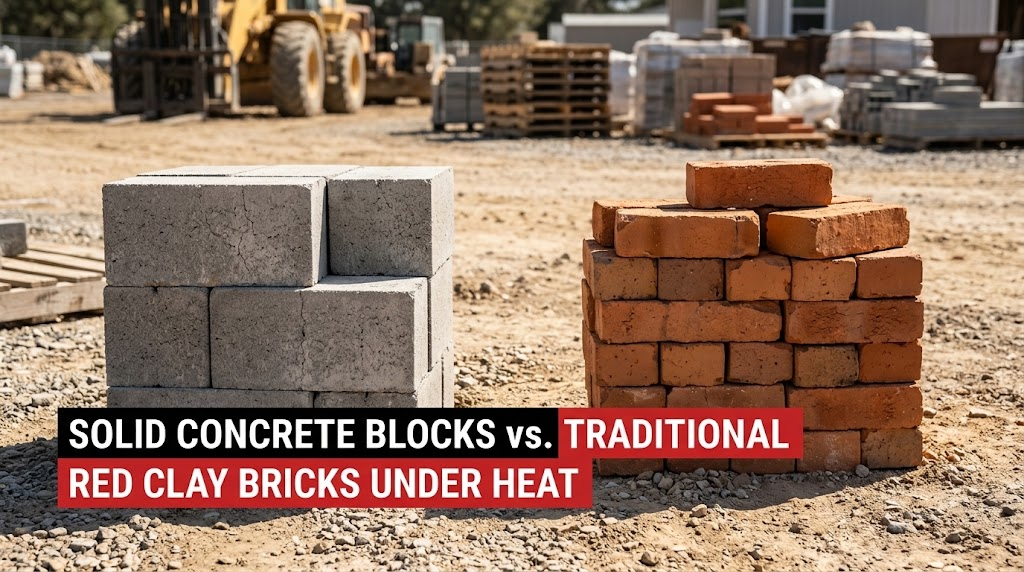
Solid Concrete Blocks vs. Traditional Red Clay Bricks Under Heat
Pakistani contractors frequently compare solid blocks to traditional kiln-fired red clay bricks (Awwal ent). While both materials are durable, their behavioral response to heat and moisture is fundamentally opposite.
| Performance Parameter | Solid Concrete Blocks | Traditional Red Clay Bricks |
| Moisture-Related Movement | Shrinks over time as moisture leaves (Drying Shrinkage). | Expands irreversibly over years through moisture absorption. |
| Thermal Expansion Coefficient | Approx. $8.1 \times 10^{-6}\text{ /}^\circ\text{C}$ to $10.0 \times 10^{-6}\text{ /}^\circ\text{C}$. | Approx. $5.0 \times 10^{-6}\text{ /}^\circ\text{C}$ to $7.0 \times 10^{-6}\text{ /}^\circ\text{C}$. |
| Primary Movement Joint Required | Control Joints (allows panels to shrink and contract). | Expansion Joints (allows panels to expand without buckling). |
| Dimensional Regularity | Exact tolerances via automated machinery; uniform joint thickness. | Variable sizes; irregular joints require thicker mortar beds. |
| Hot-Weather Pre-Wetting | Light surface dampening only; never soak saturated units. | Must be fully soaked in water tanks to prevent suction. |
Because clay brick expands while concrete masonry contracts, substituting one material for another without updating structural joint detailing is a frequent cause of unexpected wall cracking on Pakistani job sites.
Engineering Strategies to Prevent Hot-Weather Cracking
Cracking in solid block walls is neither inevitable nor acceptable. Professional structural engineers and masonry contractors manage thermal and shrinkage stresses through four established techniques:
1. Control Joint Spacing (Movement Joints)
According to industry recommendations detailed in NCMA TEK 10-2C: Control Joints for Concrete Masonry Walls, continuous concrete masonry walls must be divided into discrete panels using vertical control joints.
- Maximum Spacing: Control joints should not exceed a panel length-to-height (L/H) ratio of 1.5:1, with an absolute maximum spacing of 25 feet (7.62 meters). For instance, a 7-foot (2.13 m) tall boundary wall should have control joints spaced no farther than 10.5 feet (3.2 m) to 15 feet (4.5 m) apart.
- Locations: Always place joints at points of stress concentration:
- At abrupt changes in wall height or thickness.
- Near one or both sides of window and door openings.
- Within 3 to 4 feet of wall corners and T-intersections.
- Detailing: To explore proper joint fillers, debonded dowels, and elastomeric sealants, review our technical guide on control joints in concrete masonry.
2. Bed Joint Horizontal Reinforcement
Installing continuous prefabricated 9-gauge steel wire reinforcement (ladder or truss type) in bed joints provides the tensile strength necessary to span micro-strains. Placing joint reinforcement every 16 inches (400 mm) vertically (every second course of standard 8-inch high units) restrains shrinkage micro-cracks, preventing them from coalescing into visible structural fractures.
Crucial Rule: Horizontal joint reinforcement must terminate at control joints (with a 2-inch clearance). Running continuous steel straight through a control joint ties adjacent panels together, defeating the joint entirely.
3. Factory Pre-Curing and Moisture-Controlled Units
Using steam-cured, automated block production ensures that hydration is completed in factory chambers rather than in the wall. PrimeCrete utilizes German MASA automated block plant machinery at Hattar Industrial Estate to produce solid concrete blocks with tightly calibrated aggregate gradation, uniform density, and low residual drying shrinkage conforming to ASTM C90 and BS 6073 standards.
4. Hot-Weather Site Protection Practices
- Store units off bare ground under tarpaulins that shield top surfaces from direct solar baking while allowing lateral cross-ventilation.
- Never soak solid concrete blocks in water tanks. Unlike porous clay bricks, pre-soaking concrete blocks saturates the cement matrix; as the saturated wall dries in the hot sun, massive drying shrinkage occurs. Only moisten contact faces lightly if dust is present.
- Retempering limits: Discard mortar that has sat for more than 1.5 to 2 hours in 40°C heat. Never continuously add water to revive stiffened mortar.
Common Mistakes That Cause Block Cracks in Hot Weather
- Building Infinite Boundary Walls: Constructing 40- to 60-meter continuous boundary walls around housing plots without a single movement joint. Thermal contraction will guarantee vertical cracks every 5 to 7 meters.
- Plastering Straight Over Control Joints: Applying rigid cement-sand plaster continuously across control joints. The joint will open beneath the plaster, telegraphing a ragged crack directly onto the exterior paint. Control joints must be carried cleanly through the render and sealed with polyurethane sealant.
- Using “Green” Manual Blocks: Purchasing freshly demolded blocks from uncertified roadside yards that have had only 2 to 4 days of informal watering. These units experience their entire life-cycle shrinkage inside your finished wall.
- Poor Sun Protection During Mortar Setting: Failing to shade freshly laid walls or neglecting wet-curing of the mortar joints for at least 7 days during dry summer weather.
Multi-Stakeholder Checklist for Hot-Weather Masonry
For Structural Engineers & Consultants
- Specify control joint locations on architectural and structural elevations (maximum 1.5:1 aspect ratio or 25 ft).
- Require horizontal bed joint reinforcement (9-gauge at 16 inches on center).
- Insist on certified mill test certificates confirming compliance with ASTM C90 or BS 6073 drying shrinkage and compressive strength limits.
For Contractors & Site Supervisors
- Protect mortar boards and sand stockpiles from direct sunlight.
- Check that ladder reinforcement is cut cleanly at all control joints.
- Wet-cure mortar joints twice daily for a minimum of 7 consecutive days.
- Do not plaster walls until the masonry assembly has seasoned for at least 14 to 28 days.
For Homeowners & Private Developers
- Verify that your masonry contractor is not treating concrete blocks like clay bricks (no dunking in water tanks).
- Request factory-made, automated concrete blocks with verified compressive strength.
- Ensure control joints are incorporated into long perimeter walls before exterior finishes are applied.
Frequently Asked Questions
Can summer heat crack a solid concrete block boundary wall?
Yes, but heat is the catalyst, not the root cause. Long, unarticulated boundary walls expand in daytime heat and contract at night. Combined with moisture loss, unrestrained walls develop vertical relief cracks every 5 to 8 meters unless segmented by properly detailed control joints.
Should you soak solid concrete blocks in water before laying them in summer?
No. Unlike traditional red clay bricks, solid concrete blocks should never be soaked in water before installation. Soaking causes excessive expansion during laying; when the saturated wall subsequently dries under direct sun, severe drying shrinkage cracks will develop. Lightly misting dust off the surface is sufficient.
How far apart should control joints be in solid concrete block walls?
Under empirical masonry standards (NCMA TEK 10-2C), control joints in exposed above-grade concrete masonry walls should be spaced at a length-to-height ratio of no more than 1.5:1, and never exceed 25 feet (7.62 meters). Shorter spacings are recommended at window jambs and wall corners.
Are hairline cracks in hot weather structurally dangerous?
Most hairline cracks (less than 0.5 mm wide) occurring along mortar joints or mid-block are non-structural shrinkage relief cracks. While they do not compromise the gravitational capacity of the wall, they must be sealed against monsoon water ingress to protect embedded reinforcement and prevent plaster spalling.
Building Durable Masonry in Pakistan’s Extreme Climates
Solid concrete blocks deliver exceptional compressive strength, acoustic insulation, and durability for Pakistan’s residential and commercial infrastructure. However, engineering high-performance walls requires respecting the thermal and moisture behavior of concrete masonry. Designing clear control joints, providing horizontal bed reinforcement, and sourcing pre-cured, dimensionally uniform units eliminate hot-weather cracking before the first trowel of mortar is spread.
PrimeCrete manufactures precision-engineered solid and hollow concrete masonry units using automated German MASA technology in Hattar Industrial Estate, delivering tested compressive strength and controlled shrinkage performance for projects across Islamabad, Rawalpindi, Peshawar, and Punjab.
Contact our technical team today to review your project specifications, request material test certificates, or discuss bulk supply for your next construction milestone.

[…] For additional information about environmental cracking, read PrimeCrete’s article Do Solid Concrete Blocks Crack in Hot Weather?. […]