
The total wall construction cost in Pakistan depends on more than the price of individual masonry units. A contractor comparing solid concrete blocks vs red bricks must calculate the number of units required, cement mortar consumption, masonry labour, plastering, transportation, wastage, and the final wall thickness.
For a 100 sq ft wall, larger concrete blocks generally require fewer individual units and mortar joints than traditional red clay bricks. However, lower unit counts do not automatically guarantee a lower final construction cost. The actual savings depend on delivered material prices, workmanship, dimensions, and project specifications.
At PrimeCrete, operated by Pak Dream (Pvt) Ltd, we manufacture concrete masonry products for residential, commercial, and infrastructure projects across Pakistan. Our solid concrete blocks are manufactured using controlled production processes designed to deliver consistent dimensions and specified material performance.
For projects requiring reduced wall dead load or alternative masonry configurations, our hollow concrete blocks provide another option, subject to the structural design and project requirements.
Which Is Cheaper: Solid Concrete Blocks or Red Bricks in Pakistan?
Solid concrete block walls can cost less to construct when savings in labour and mortar outweigh any higher masonry-unit cost. Red brick walls may remain competitive where bricks are inexpensive, skilled bricklayers are readily available, or concrete block transportation is expensive.
The correct comparison is the total installed cost per square foot of wall, not the purchase price of one block compared with one brick.
| Cost factor | Solid concrete blocks | Traditional red bricks |
| Individual unit price | Generally higher | Generally lower |
| Units per wall area | Fewer | More |
| Mortar joints | Fewer for typical large-format blocks | More |
| Masonry installation | Potentially faster | More individual units to lay |
| Material handling | Larger and heavier individual units | Smaller units |
| Plaster requirements | Depends on surface and specification | Depends on surface and specification |
| Transportation | Affected by block weight and delivery distance | Affected by brick quantity and delivery distance |
| Final construction cost | Project-dependent | Project-dependent |
The key question is whether savings in installation, mortar and waste compensate for the difference in unit prices.
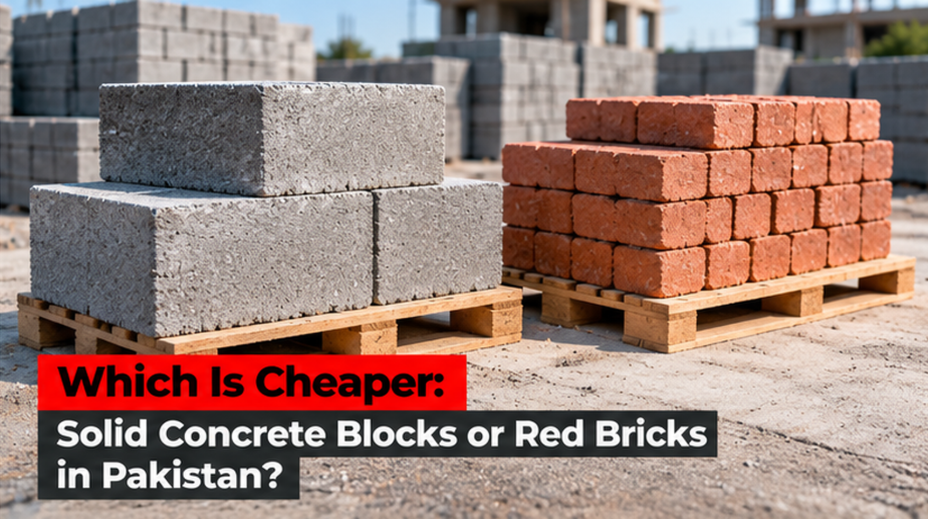
Solid Concrete Block and Red Brick Prices in Pakistan (2026)
Solid Concrete Block Prices by Size
The size, density, compressive strength, curing quality and order quantity influence the solid concrete blocks price in Pakistan.
PrimeCrete’s published September 2026 indicative price guide provides the following ranges:
| Solid block size | Indicative unit price |
| 16 × 8 × 4 inches | PKR 45–65 |
| 16 × 8 × 6 inches | PKR 70–95 |
| 16 × 8 × 8 inches | PKR 100–140 |
These are published planning ranges, not guaranteed current factory quotations. Large-volume procurement, strength requirements and delivery distance can change the payable amount.
Prime Crete
For a detailed explanation of sizes, grade selection and transportation charges, see our solid concrete blocks price guide.
Red Brick Prices in Major Pakistani Cities
Traditional Awwal or first-class red brick rates vary by location, kiln availability, transportation conditions and market demand.
The Pakistan Bureau of Statistics’ September 2026 construction-price data, as reported in a city-level analysis, gives the following averages:
| City | First-class bricks per 1,000 | Equivalent price per brick |
| Lahore | PKR 24,831 | PKR 24.83 |
| Karachi | PKR 22,000 | PKR 22.00 |
| Islamabad | PKR 27,016 | PKR 27.02 |
| Rawalpindi | PKR 26,694 | PKR 26.69 |
| Multan | PKR 16,533 | PKR 16.53 |
| Peshawar | PKR 21,439 | PKR 21.44 |
September 2026 city-average benchmark data, not supplier quotations for November 2026.
which.pk+1
Construction estimators should check the latest Pakistan Bureau of Statistics price statistics before finalizing a bill of quantities.
Why the Price Difference Matters
Consider an 8-inch solid concrete block priced at PKR 120 and a red brick priced at PKR 25.
One concrete block is more expensive than one brick. However, a typical large-format block covers considerably more wall face area.
Therefore, a meaningful financial comparison must account for coverage, wall thickness, joint dimensions, mortar, labour and finishing costs.
How Many Solid Concrete Blocks or Red Bricks Are Required for a 100 Sq Ft Wall?
A quantity takeoff is the starting point for calculating brick wall vs block wall cost.
For illustration, consider a wall measuring:
- Length: 20 feet
- Height: 5 feet
- Gross wall area: 100 sq ft
- No door or window openings
The two masonry alternatives must also satisfy the required engineering performance. An 8-inch block wall and a nominal 9-inch brick wall are not identical in thickness, mass or structural behaviour.
Solid Concrete Block Quantity Calculation
Assume a nominal block face measuring 16 inches long by 8 inches high, including the modular allowance for joints.
Nominal face area:
168144=0.889sqft
Blocks required:
1000.889=112.5
Round the theoretical quantity upward to 113 blocks.
With an illustrative 5% cutting and breakage allowance:
1131.05=118.65
Estimated procurement quantity: 119 solid concrete blocks.
This estimate assumes nominal modular dimensions. If 16 × 8 inches refers to actual manufactured unit dimensions instead, the joint allowance and required block count must be recalculated.
Red Brick Quantity Calculation
For a nominal 9-inch-thick brick wall, assume a typical exposed brick face and joint module equivalent to approximately 4.33 bricks per square foot. This is an illustrative planning factor that must be checked against the selected brick dimensions and bonding pattern.
The theoretical quantity is:
1004.33=433bricks
Allowing 5% for cutting and breakage:
4331.05=454.65
Estimated procurement quantity: 455 red bricks.
Material Quantity Comparison
| Measurement | Solid block wall | Red brick wall |
| Gross wall area | 100 sq ft | 100 sq ft |
| Nominal wall thickness | 8 inches | 9 inches |
| Theoretical units | 113 | 433 |
| Assumed wastage | 5% | 5% |
| Procurement quantity | 119 | 455 |
The block arrangement uses substantially fewer individual units. This can simplify handling and laying operations, although block weight and site conditions still affect actual productivity.
For more information about sizes, strength and suitable applications, refer to our complete guide to solid concrete blocks in Pakistan.
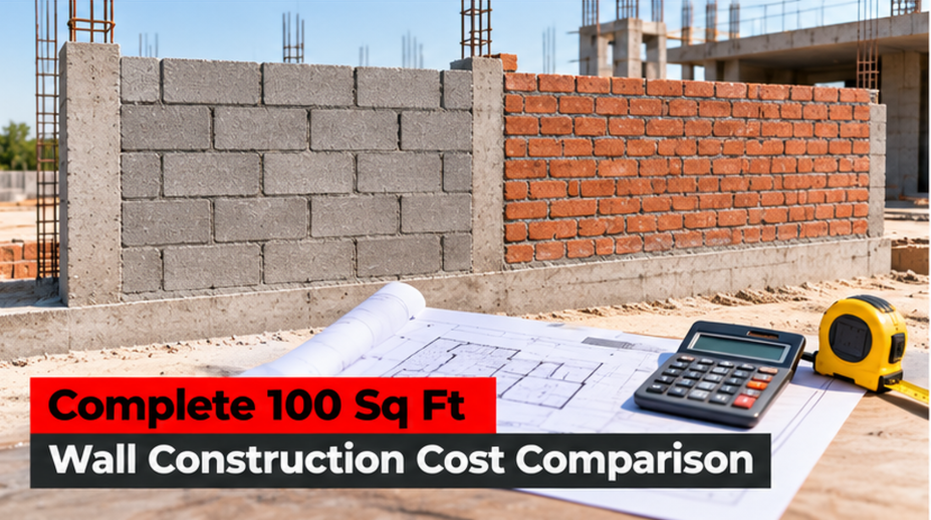
Complete 100 Sq Ft Wall Construction Cost Comparison
A proper wall construction cost comparison includes the cost of the delivered masonry units, cement mortar, labour, finishing and delivery.
Example Cost Assumptions
The following example uses assumed project rates to demonstrate the estimating method. These are not live market quotations, verified labour rates or an official PrimeCrete quotation.
Assumptions:
- 100 sq ft gross wall area
- 119 purchased solid blocks at PKR 120 each
- 455 purchased red bricks at PKR 25 each
- Both wall faces receive the same specified plaster finish
- Mortar, labour, plaster and transportation use hypothetical lump-sum values
Solid Concrete Block Wall Cost
| Cost component | Illustrative cost |
| 119 solid blocks × PKR 120 | PKR 14,280 |
| Cement mortar and sand | PKR 2,000 |
| Masonry labour | PKR 4,500 |
| Plastering both faces | PKR 9,000 |
| Transportation and handling | PKR 1,800 |
| Total estimated cost | PKR 31,580 |
Equivalent illustrative finished-wall cost:
PKR 315.80 per sq ft
Red Brick Wall Cost
| Cost component | Illustrative cost |
| 455 red bricks × PKR 25 | PKR 11,375 |
| Cement mortar and sand | PKR 3,500 |
| Masonry labour | PKR 6,500 |
| Plastering both faces | PKR 9,000 |
| Transportation and handling | PKR 2,000 |
| Total estimated cost | PKR 32,375 |
Equivalent illustrative finished-wall cost:
PKR 323.75 per sq ft
What the Example Shows
Illustrative 100 sq ft finished-wall cost
Solid concrete blocks
PKR 31,580
Red bricks
PKR 32,375
Illustrative difference
PKR 795 (2.46%)
Under these assumed rates, the solid-block wall is slightly cheaper. Different quotations or wall specifications can reverse the outcome.
The example demonstrates why the cheapest individual unit is not necessarily the cheapest finished wall.
It does not prove that concrete blocks always save 2.46%. That percentage applies only to the assumptions above. The comparison also excludes foundation changes, structural reinforcement, painting, taxes and project overheads.
How Mortar Consumption Affects the Total Wall Cost
Mortar consumption is an important difference between large-format concrete blocks and smaller red bricks.
Every masonry joint requires mortar, and the quantity depends on unit dimensions, joint thickness, wall bonding and construction quality.
Cement Mortar in Solid Concrete Block Walls
A typical large-format block creates fewer horizontal and vertical joints per square foot of wall. This can reduce the total volume of bedding and joint mortar.
However, contractors must account for actual block dimensions, mortar mix specifications, site waste and any joints that require additional filling.
Using precise, factory-manufactured blocks can improve dimensional consistency and reduce the need for unnecessarily thick joints.
Cement Mortar in Red Brick Walls
Traditional brick masonry involves more individual units. Consequently, it commonly has more joints for a comparable wall face area.
Mortar quantities vary with brick size, joint thickness and bonding pattern. A thick, multi-wythe brick wall can consume considerably more mortar than a single-wythe block wall.
Contractors should calculate mortar volume instead of assuming a fixed number of cement bags for every 100 sq ft.
How to Estimate Mortar Cost
A simplified estimating relationship is:
Vm=Vw-Vu
Where:
- Vm = approximate wet mortar volume
- Vw = gross masonry wall volume
- Vu = total volume occupied by masonry units
The estimator must account for actual unit geometry, joints, cavities, openings and cutting losses.
After calculating mortar volume, determine cement and sand quantities using the approved mix proportions and appropriate conversion factors.
A 1:4 or 1:6 cement-to-sand mix may appear in project specifications, but the correct ratio depends on engineering requirements. Contractors should never select a weaker mix solely to reduce costs.
The Pakistan Engineering Council’s masonry specifications provide useful technical context for concrete block masonry materials and workmanship.
pec.org.pk
Which Wall Requires Less Masonry Labour?
Labour productivity directly influences the total wall construction cost in Pakistan, particularly on large residential and commercial projects.
Labour Cost of Solid Concrete Block Masonry
Larger masonry units can allow masons to cover more wall area with fewer placement operations.
For example, under the earlier quantity assumptions, installing 100 sq ft of blockwork requires approximately 113 block placements, compared with approximately 433 brick placements.
Nevertheless, placement count is only one factor. Heavy blocks may require additional handling, while accurately positioned corners, lintels and service openings can slow progress.
Labour productivity also depends on:
- Mason experience with concrete masonry
- Site access and material stacking
- Wall height and working platforms
- Required joint finishing
- Cutting around electrical and plumbing services
- Quality-control and alignment requirements
Labour Cost of Red Brick Masonry
Brickwork may be economical where local masons are highly experienced, brick supply is close to the site and the wall design contains numerous small details.
Although more units must be installed, smaller bricks can be easier to handle individually.
Consequently, a contractor should obtain separate labour rates for blockwork and brickwork rather than assuming a universal percentage saving.
Comparing Labour Productivity Correctly
Measure completed, accepted wall area per mason-day or crew-day.
For example:
Labourcostpersqft=TotalcrewcostAcceptedcompletedwallarea
This approach provides a more reliable comparison than counting the number of units installed.
How Wall Thickness Changes Construction Cost
Wall thickness affects material quantity, wall dead load, usable floor space and sometimes structural requirements.
Comparing 4-, 6- and 8-Inch Concrete Block Walls
A block’s thickness does not necessarily change the number of blocks required per square foot of wall face when the length and height remain identical.
However, thicker blocks usually contain more concrete and can have a higher unit price and greater weight.
| Block thickness | Common application to evaluate | Cost consideration |
| 4 inches | Internal partitions | Lower material volume |
| 6 inches | Selected partitions and enclosure walls | Intermediate material volume |
| 8 inches | Exterior or engineered masonry walls | Higher unit cost and wall mass |
Applications must be verified against structural calculations, wall height, lateral loads, fire requirements and local approval conditions.
Why a 6-Inch Block Wall Is Not Directly Comparable to a 9-Inch Brick Wall
Two walls with different thicknesses may not provide equivalent:
- Structural capacity
- Acoustic isolation
- Thermal resistance
- Fire-resistance performance
- Resistance to lateral loading
Therefore, comparing only their price per square foot can be misleading.
Where the design permits alternative masonry systems, the structural engineer should define equivalent performance requirements before the quantity surveyor compares costs.
For applications where lower unit weight is important, PrimeCrete also supplies lightweight concrete masonry units. These should be evaluated separately from conventional solid blocks because density, structural behaviour and pricing can differ.
Solid Concrete Blocks vs Red Bricks: Strength, Weight and Durability
A lower wall construction price offers limited value if the masonry cannot satisfy its intended design requirements.
Compressive Strength and Structural Suitability
Both concrete masonry units and fired clay bricks can perform well when properly specified, tested and installed.
However, the term solid does not automatically mean that a concrete block is suitable for every load-bearing application.
Structural suitability depends on factors such as:
- Tested compressive strength
- Unit dimensions and density
- Masonry assembly strength
- Mortar specification
- Wall slenderness and restraint
- Reinforcement and connection details
- Seismic and lateral load requirements
Chapter 21 of the 2021 Building Code of Pakistan addresses masonry materials, construction, quality assurance and seismic design.
2021 BUILDING CODE OF PAKISTAN
Dead Load and Foundation Considerations
Solid concrete masonry units can be heavy because they contain a substantial volume of dense material.
A solid block wall may therefore impose more dead load than a properly designed lightweight or hollow masonry alternative.
However, the total wall weight must be calculated from actual dimensions and measured densities. It is incorrect to assume that every concrete block wall is either heavier or lighter than red brick construction.
For an RCC-framed building, structural engineers must consider the contribution of infill walls to gravity loads and seismic behaviour.
Durability in Pakistani Conditions
Both red bricks and solid concrete blocks face exposure to moisture, salts, rainfall and temperature variations.
Poor drainage, defective damp-proof courses, weak mortar and inadequate exterior finishes can damage either material.
A dense concrete block may offer useful performance characteristics, but its water absorption and durability should be confirmed through product testing.
For an examination of moisture-related risks, read our article on rising damp in solid concrete block walls.
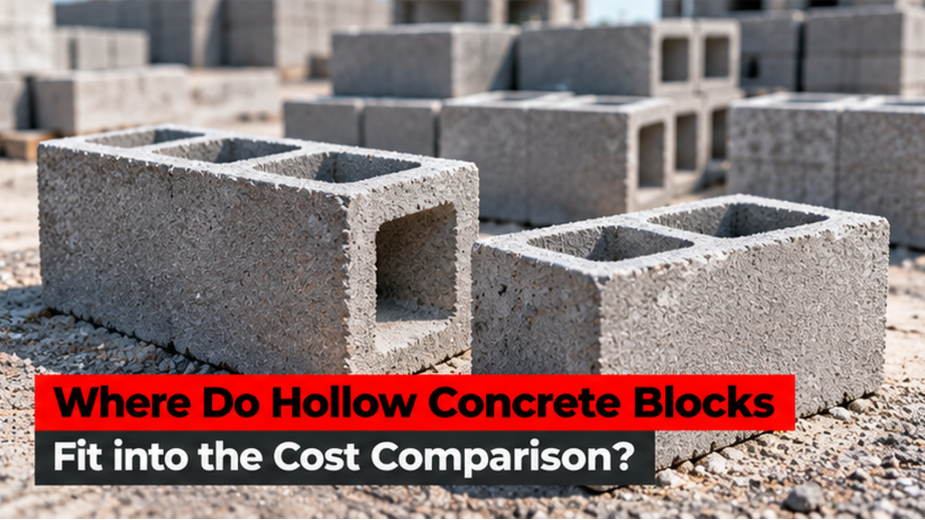
Where Do Hollow Concrete Blocks Fit into the Cost Comparison?
Although this article focuses on solid concrete blocks vs red bricks, contractors may also consider hollow concrete blocks when evaluating walling alternatives.
Hollow blocks contain engineered cavities, reducing material volume and unit mass compared with an otherwise equivalent solid block of the same density.
Their potential advantages include reduced wall dead load and, in some configurations, easier reinforcement and service integration.
However, hollow blocks are not automatically cheaper or thermally superior in every completed wall assembly.
Solid vs Hollow Concrete Blocks
| Factor | Solid concrete blocks | Hollow concrete blocks |
| Internal structure | Predominantly solid | Engineered cavities |
| Individual weight | Generally higher for equivalent dimensions and density | Generally lower |
| Material consumption | More concrete per equivalent unit | Less concrete per equivalent unit |
| Reinforcement arrangement | Depends on design | Cores may accommodate grout and reinforcement |
| Structural applications | Subject to verified strength and design | Subject to verified strength and design |
| Total wall cost | Depends on installed BOQ | Depends on installed BOQ |
The correct choice should reflect the engineer’s design, verified test results and the finished-wall budget.
For a dedicated comparison of hollow-block installation, heat and construction economics, see our existing article, Hollow Blocks vs Bricks in Pakistan: Cost, Speed and Heat.
This distinction is important because a general hollow-block comparison and a detailed solid-block construction-cost analysis answer different buyer questions.
How Transportation and Material Wastage Affect Final Wall Costs
Construction material estimates often become inaccurate when contractors exclude transportation and unloading charges.
Transporting Concrete Blocks
Concrete block delivery costs depend on factory distance, truck capacity, block dimensions, total order weight and site accessibility.
An 8-inch solid block can occupy more truck capacity by weight than a lighter masonry unit.
Therefore, the supplier’s factory price should not be treated as the final delivered rate.
Transporting Red Bricks
Red bricks also incur substantial transportation charges, particularly where projects are located far from brick kilns.
Breakage during loading, transportation and unloading can increase procurement quantities.
Delivered Cost Per Usable Unit
A useful procurement calculation is:
Usableunitcost=Materialpurchase+delivery+handlingUsableunitsdelivered
For example, a low factory price may become less competitive when transportation charges are high or material damage reduces the number of usable units.
For larger projects, buyers should also consider purchasing schedules and storage requirements. Our article on ordering solid concrete blocks in one batch explains how procurement planning can affect consistency, delivery and project expenses.
How Price Changes Can Reverse the Cheapest Wall Option
The previous 100 sq ft estimate showed only PKR 795 between the two alternatives.
That small difference matters because construction-material quotations can change.
Sensitivity to Block Prices
If the solid block price increased from PKR 120 to PKR 130, with all other assumptions unchanged:
11910=PKR1,190
The total solid-block wall cost would increase to PKR 32,770.
It would then exceed the illustrative brick-wall cost of PKR 32,375.
Sensitivity to Brick Prices
If the brick price increased from PKR 25 to PKR 27:
4552=PKR910
The total brick-wall cost would increase to PKR 33,285.
This demonstrates why small differences in unit prices can influence material selection when both alternatives have similar finished-wall costs.
Interactive cost sensitivity calculator
Compare costs for a 100 sq ft wall
Adjust assumed prices and labour to see how the estimated totals change. Mortar, plaster, delivery and quantities remain at the illustrative values above.
Block price / unit (PKR)
120
Brick price / unit (PKR)
25
Blockwork labour (PKR)
4,500
Brickwork labour (PKR)
6,500
Solid block wall
PKR 31,580
PKR 315.8 / sq ft
Red brick wall
PKR 32,375
PKR 323.75 / sq ft
Solid blocks cost PKR 795 less under these assumptions.
Reset assumptions
How to Prepare an Accurate Wall Construction BOQ in Pakistan
Before selecting solid blocks or red bricks, contractors should prepare a material-specific Bill of Quantities (BOQ).
Step 1: Calculate Net Wall Area
Measure all wall lengths and heights, then subtract door openings, windows and other specified exclusions.
Confirm whether masonry quantities are measured by square feet, cubic feet or cubic metres under the project contract.
Step 2: Confirm Wall Thickness and Performance Requirements
Specify wall thickness, masonry strength, mortar grade, fire requirements and any structural reinforcement.
Obtain engineering approval before substituting one masonry system for another.
Step 3: Calculate Material Quantities
Use actual manufacturer dimensions and approved mortar joints.
Add justified allowances for cutting, breakage and site-specific waste. Avoid applying the same percentage to every project without examining conditions.
Step 4: Obtain Itemized Supplier Quotations
Ask suppliers to state unit dimensions, strength grade, quoted quantity, delivery charges, taxes and unloading responsibilities.
The quote should distinguish manufacturing quality and test documentation from marketing descriptions.
Step 5: Compare Completed Wall Costs
Calculate masonry materials, labour, mortar, finishing and transportation separately.
Include scaffold costs, lintel interfaces, reinforcement, movement joints and other items where relevant to both alternatives.
The final BOQ should allow a consultant or client to understand why one wall system costs more than another.
Which Wall Material Is More Cost-Effective for Pakistani Projects?
Residential Houses
For residential construction in Islamabad, Rawalpindi, Lahore and other cities, both solid concrete blocks and first-class red bricks can be evaluated where their use is permitted by the approved design.
Concrete blocks may be attractive when dimensional consistency and masonry installation productivity are important.
Red bricks may remain competitive where local supply is economical and brickwork labour is readily available.
Commercial and Industrial Buildings
Larger projects often benefit from standardized masonry dimensions, scheduled delivery and consistent material properties.
However, wall weights, height restrictions, fire performance, acoustic requirements and service penetrations can be more important than the difference in unit prices.
For these projects, the least expensive compliant wall system should be selected through an approved technical and commercial comparison.
Boundary Walls
Boundary walls require particular attention to wind loading, foundation design, columns, movement joints and site drainage.
A solid concrete block wall may suit some approved boundary-wall designs, but material strength alone cannot guarantee structural stability.
Frequently Asked Questions
Are Solid Concrete Blocks Cheaper Than Red Bricks in Pakistan?
They can be cheaper in completed wall construction, but the result depends on the total installed cost. Larger units may reduce joint counts and installation labour, while brick prices, plaster requirements and transportation can change the outcome.
How Much Does a 100 Sq Ft Solid Concrete Block Wall Cost?
In the illustrative calculation above, a 100 sq ft wall costs PKR 31,580, including assumed materials, masonry labour, mortar, plaster and delivery. This is an example, not a verified local quotation.
Actual costs depend on wall thickness, material grade, city, site access and contract specifications.
How Many Solid Concrete Blocks Are Required for 100 Sq Ft?
Using a nominal 16 × 8-inch face module, the theoretical requirement is approximately 113 blocks. With an assumed 5% waste allowance, the procurement estimate is 119 blocks.
The final quantity must reflect actual block dimensions, joint widths and openings.
Are Hollow Concrete Blocks Cheaper Than Solid Concrete Blocks?
Hollow concrete blocks may cost less to manufacture in some configurations because their cavities reduce material consumption. However, unit prices depend on strength, density, manufacturing process and order volume.
Structural reinforcement, grouting and wall-finishing requirements may also affect the final installed cost.
Which Is Stronger: Solid Concrete Blocks or Red Bricks?
Neither material is automatically stronger in every application. The comparison requires tested compressive strength, masonry assembly properties, wall geometry and the approved structural design.
Do Solid Concrete Blocks Require Plaster?
They may require plaster, render or another approved finish depending on the intended wall appearance, exposure, surface tolerance and project specification.
Uniform block dimensions do not automatically eliminate the need for finishing.
Can Solid Concrete Blocks Replace Red Bricks in Load-Bearing Walls?
They can be considered where the structural engineer confirms that the proposed masonry system satisfies the applicable design and construction requirements.
Substitution without approval can affect loading, reinforcement, foundations and overall building performance.
Conclusion: Compare Finished Wall Costs, Not Individual Masonry Prices
The solid concrete blocks vs red bricks decision in Pakistan should begin with an accurate quantity takeoff and a complete installed-wall BOQ.
Solid concrete blocks can reduce the number of units and mortar joints required for a wall, potentially improving construction productivity. Red bricks can remain economical where local material and labour rates are favourable.
The illustrative 100 sq ft cost comparison demonstrates that the difference between the two systems may be small enough for material prices, transportation or labour productivity to reverse the result.
For engineers, contractors and developers, the best decision is the masonry system that meets approved technical requirements at the lowest credible complete-project cost.
PrimeCrete manufactures concrete masonry products using automated production equipment at Hattar Industrial Estate, Pakistan. Explore our solid concrete blocks, hollow concrete blocks and concrete bricks to compare solutions for your project.
For bulk orders, material specifications and project-specific quotations, contact PrimeCrete with your approved wall dimensions, BOQ, required strength grades and delivery location.
