
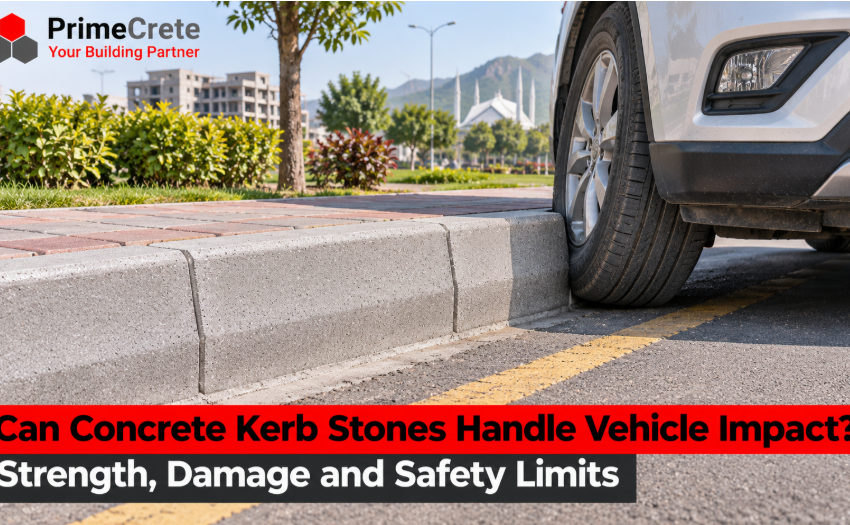
Concrete kerb stones can withstand certain low-speed vehicle contacts, but their resistance depends on the impact force, kerb profile, concrete strength, and supporting foundation. A properly installed kerb may tolerate occasional tyre contact without serious damage. However, repeated heavy-vehicle impacts or high-speed collisions can crack, displace, or overturn ordinary kerbs. For road and parking infrastructure in Pakistan, PrimeCrete manufactures concrete Kerb Stone Blocks for projects where durability, dimensional consistency, and appropriate installation are essential.
The critical distinction is between normal vehicle contact and a collision. Kerb Stones provide pavement edge restraint, road delineation, and drainage control. They should not automatically be treated as crash-rated vehicle safety barriers.
What Happens When a Vehicle Strikes Concrete Kerb Stones?
When a moving vehicle tyre contacts a kerb, it transfers force into the exposed concrete face. Part of that force acts horizontally, while another component may act vertically as the tyre deforms or begins climbing the kerb.
The resulting stresses depend on vehicle speed, wheel load, contact angle, kerb geometry, and the duration of contact.
Low-Speed Tyre Contact vs Heavy-Vehicle Impact
A passenger car gently brushing a kerb while parking creates a different loading condition from a delivery truck striking the same kerb during a sharp turn.
Low-speed contact may produce minor surface abrasion or edge chipping. A heavier or more forceful strike can produce bending stresses, cracking, or movement in the installed unit.
Repeated contact also matters. Even when individual strikes cause little visible damage, repeated impacts may progressively weaken concrete edges or disturb the supporting restraint.
Why Impact Angle Matters
A tyre travelling almost parallel to a kerb may brush along its surface. A more direct approach can concentrate force over a smaller contact area.
Kerb height also influences the interaction. A taller exposed face may create greater leverage against the foundation when struck near its upper edge.
Consequently, there is no universal vehicle speed or weight at which every concrete kerb stone will remain undamaged.
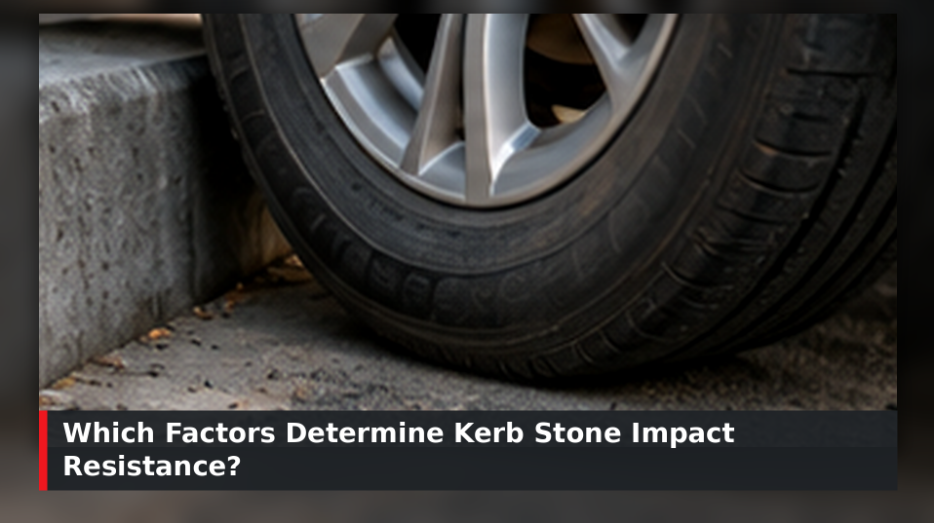
Which Factors Determine Kerb Stone Impact Resistance?
Vehicle-impact performance depends on the installed kerb system rather than the concrete unit alone.
1. Concrete Strength and Internal Quality
Dense, properly compacted concrete can provide resistance to cracking, abrasion, and localised surface damage.
However, compressive strength alone cannot establish vehicle-impact resistance.
A kerb may perform well under compression while remaining vulnerable to bending caused by an unevenly supported wheel strike.
The international standard BS EN 1340 — Concrete Kerb Units: Requirements and Test Methods covers product properties and testing for precast concrete kerbs, including mechanical performance.
Bending strength results help assess product quality, but they do not represent a complete dynamic vehicle-collision test.
Contractors seeking information about product-level cracking should also review PrimeCrete’s guide on how to choose kerb stones that won’t crack or chip.
2. Kerb Profile and Contact Geometry
The exposed profile changes how a vehicle tyre meets the concrete.
An upright kerb presents a relatively direct obstruction. A sloping or mountable profile can allow the tyre to climb more gradually under certain conditions.
Rounded edges may reduce localised corner chipping, but they do not automatically increase the overall structural capacity of the unit.
The appropriate profile must match the approved road geometry and anticipated vehicle movements.
3. Foundation Restraint and Lateral Stability
Even a strong concrete kerb can rotate or move when its supporting foundation provides insufficient restraint.
A concrete bed distributes loads, while rear haunching resists outward or inward displacement.
During a lateral tyre strike, the backing helps prevent the kerb from tipping. If the support cracks or separates, the unit may move without initially breaking.
PrimeCrete’s existing article on how much concrete support kerb stones need explains foundation and haunching requirements in greater detail.
What Types of Damage Can Vehicle Impact Cause?
Vehicle strikes can produce several distinct failure patterns.
Surface Chipping and Edge Spalling
A tyre or wheel rim may break small fragments from the upper edge of a kerb.
Minor chipping does not necessarily mean the entire unit has lost structural stability. Nevertheless, exposed cracks or continuing deterioration warrant closer inspection.
Cracking Through the Concrete Unit
A concentrated load may create bending or tensile stress beyond the kerb’s resistance.
Cracks can develop near the impact location, across the unit, or from existing defects. A full-depth crack is more serious than superficial surface abrasion.
Kerb Rotation and Joint Displacement
Sometimes the concrete remains intact while the installed kerb shifts.
Warning signs include uneven alignment, widened joints, movement when loaded, and disturbed pavement immediately behind the kerb.
This is particularly relevant at industrial entrances where turning trucks repeatedly contact the same sections.
How Should Contractors Inspect Kerb Stones After Vehicle Impact?
After a significant vehicle strike, contractors should inspect both the visible kerb and its supporting construction.
Step 1: Identify the Impact Location
Look for fresh tyre marks, chipped corners, exposed aggregate, and concentrated surface damage.
Record the damaged section with photographs and note the likely direction of vehicle contact.
Step 2: Examine Cracks and Concrete Separation
Check whether cracks remain superficial or extend across the unit.
Loose fragments, deep fractures, and substantial spalling may indicate a need for replacement.
Avoid concealing structural cracks with a cosmetic mortar repair before the cause has been assessed.
Step 3: Check Alignment and Stability
Compare the affected kerb with adjacent units.
Look for changes in height, visible rotation, separated joints, and evidence that the unit has moved from its original position.
Step 4: Inspect Adjacent Pavement and Support
A heavy strike can disturb surrounding construction even when visible kerb damage appears limited.
Check nearby paving for lifted edges, newly opened joints, settlement, or damaged backing.
Where significant movement or cracking is present, a qualified engineer should determine whether the kerb requires replacement or reconstruction.
For longer-term deterioration, PrimeCrete also explains how long concrete kerb stones last under different exposure conditions.
Can Concrete Kerb Stones Stop a Moving Vehicle?
Ordinary concrete Kerb Stones should not be relied upon to stop a moving vehicle during a collision.
Their primary functions are edging, delineation, drainage, and pavement restraint—not certified vehicle containment.
The US Federal Highway Administration explains in its Barrier Guide that conventional curbs provide limited vehicle redirection and can be mounted even at low speeds.
This distinction is important for Pakistani projects involving pedestrian areas, schools, industrial facilities, and roads near hazardous equipment.
Where preventing vehicle intrusion is a safety requirement, engineers should assess appropriate crash-tested barriers, bollards, or other engineered containment systems.
A normal kerb must not replace a safety barrier simply because the concrete has a high compressive strength.
Where Does Vehicle Impact Matter Most in Pakistan?
Vehicle-contact exposure varies considerably across infrastructure projects.
In Islamabad and Rawalpindi housing societies, kerbs near turning bays and parking entrances may experience repeated low-speed tyre contact.
Commercial developments in Lahore and Karachi may encounter delivery vehicles, reversing trucks, and frequent changes in vehicle direction.
Industrial premises in Hattar, Faisalabad, and other manufacturing centres can experience concentrated wheel contact from heavier vehicles.
For these locations, engineers should evaluate expected vehicle movements and determine whether ordinary precast kerbs provide suitable pavement restraint.
The surrounding paving system also matters.
For example, interlocking paver blocks used in parking areas require appropriate perimeter restraint to help maintain pavement stability.
Similarly, concrete grass pavers used in suitable landscaped parking applications may require correctly designed boundaries.
These products serve different functions: paving units support suitable surface traffic, while kerbs restrain and define their edges.
What Should Pakistani Engineers Verify Before Approval?
Before approving kerbs for vehicle-access areas, consultants and contractors should check:
- Vehicle exposure: Expected vehicle types, turning movements, wheel contact, and impact frequency.
- Product properties: Specified concrete performance, bending strength, dimensions, and relevant test documentation.
- Kerb geometry: Approved profile, exposed height, and location relative to the traffic path.
- Installed restraint: Foundation condition, rear support, and compatibility with approved construction drawings.
- Safety requirements: Whether the location needs ordinary edging or an independently assessed vehicle-containment system.
- Inspection criteria: Procedures for identifying damage, displacement, and unacceptable cracking.
The project specification and responsible engineer should establish acceptance requirements. A manufacturer’s general strength claim must not substitute for evidence applicable to the intended use.
Frequently Asked Questions About Kerb Stone Vehicle Impact
Can Concrete Kerb Stones Withstand Car Tyre Contact?
Yes. Appropriately specified and installed concrete kerbs may tolerate occasional low-speed tyre contact. Actual resistance depends on the kerb’s geometry, strength, restraint, and contact conditions.
Can a Heavy Truck Crack a Concrete Kerb Stone?
Yes. Heavy vehicles can cause cracking, edge damage, or displacement, especially during sharp turning movements or repeated wheel strikes. Vehicle weight alone does not determine the outcome.
Does Higher Concrete Strength Guarantee Better Impact Resistance?
No. Concrete quality matters, but bending behaviour, contact geometry, existing defects, and foundation restraint also influence performance. High compressive strength does not establish a certified collision rating.
Should a Kerb Be Replaced After a Vehicle Impact?
Not every surface chip requires replacement. However, full-depth cracks, significant movement, unstable support, or extensive spalling should be assessed. Replacement may be necessary where structural integrity or alignment is compromised.
Final Thoughts
Concrete Kerb Stones can provide durable pavement edging in areas exposed to ordinary vehicle movements, but their impact performance has practical limits.
For Pakistani road, commercial, and industrial projects, the essential considerations are vehicle behaviour, tested product properties, installed restraint, and post-impact inspection.
PrimeCrete manufactures precast concrete products using automated production technology at Hattar Industrial Estate. Engineers and contractors can explore PrimeCrete Kerb Stone Blocks and request project-specific product information before finalising their approved specifications.
The right approach is to evaluate the complete kerb installation rather than assume every strong concrete unit can safely resist a vehicle collision.
