
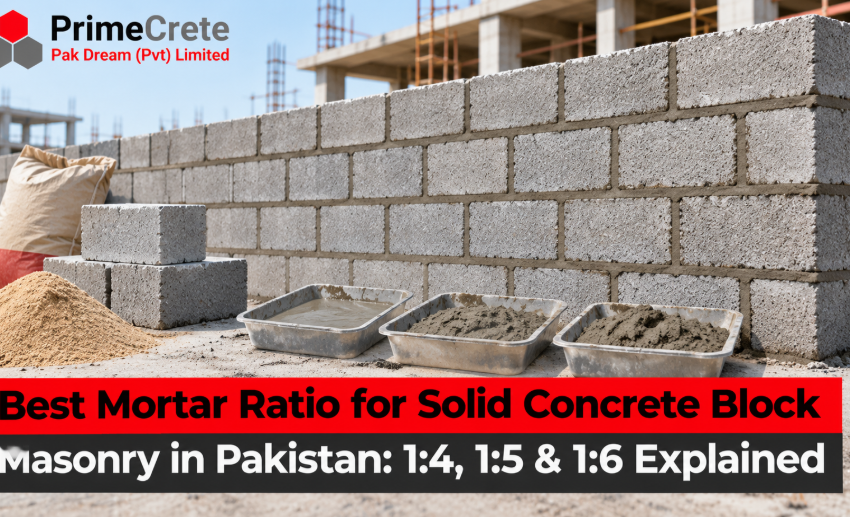
Selecting the correct cement-sand mortar ratio is essential for achieving reliable bonding, uniform joints, and durable Solid Concrete Block masonry. For projects using PrimeCrete products, contractors should match the mortar specification with the approved wall design, loading conditions, and installation requirements of Solid Concrete Blocks.
In Pakistan, 1:4, 1:5, and 1:6 cement-sand mortar ratios are commonly specified for concrete block masonry. However, no single ratio suits every wall. Structural requirements, material quality, exposure conditions, and workmanship determine the appropriate selection.
Which Mortar Ratio Is Best for Solid Concrete Block Masonry?
A 1:4 cement-sand mortar is a relatively rich mix, while 1:5 and 1:6 contain progressively less cement. The best ratio is the one approved for the specific masonry application, rather than automatically choosing the richest mixture.
The following comparison explains the practical differences.
| Mortar Ratio | Cement-to-Sand Proportion | Selection Consideration |
| 1:4 | 1 part cement, 4 parts sand | Richer mix where specified bonding and performance requirements justify it |
| 1:5 | 1 part cement, 5 parts sand | Intermediate option for approved masonry applications |
| 1:6 | 1 part cement, 6 parts sand | Leaner mix for applications where design requirements permit |
These ratios represent proportions by volume, not weight. They should never replace the engineer’s approved mortar specification.
How Do 1:4, 1:5 and 1:6 Mortar Ratios Compare?
1:4 Cement-Sand Mortar
A 1:4 mortar ratio contains more cement than the other two mixes when measured using equal batching volumes.
It may be specified where higher mortar strength or particular masonry performance is required.
However, adding more cement does not automatically improve the completed wall. Excessively strong mortar can create compatibility and shrinkage concerns when its properties do not suit the masonry units.
1:5 Cement-Sand Mortar
A 1:5 mortar ratio offers an intermediate cement content.
It can be considered for general block masonry where the approved project specification permits it.
Reliable performance depends on clean sand, consistent batching, sufficient workability, and correctly filled joints.
1:6 Cement-Sand Mortar
A 1:6 mortar ratio contains less cement and is sometimes specified for less demanding masonry applications.
Its suitability for load-bearing construction must be established through the structural specification rather than assumed from common site practices.
These proportions are also discussed in PrimeCrete’s separate hollow-block mortar ratio guide, which focuses on hollow block construction and material quantities.
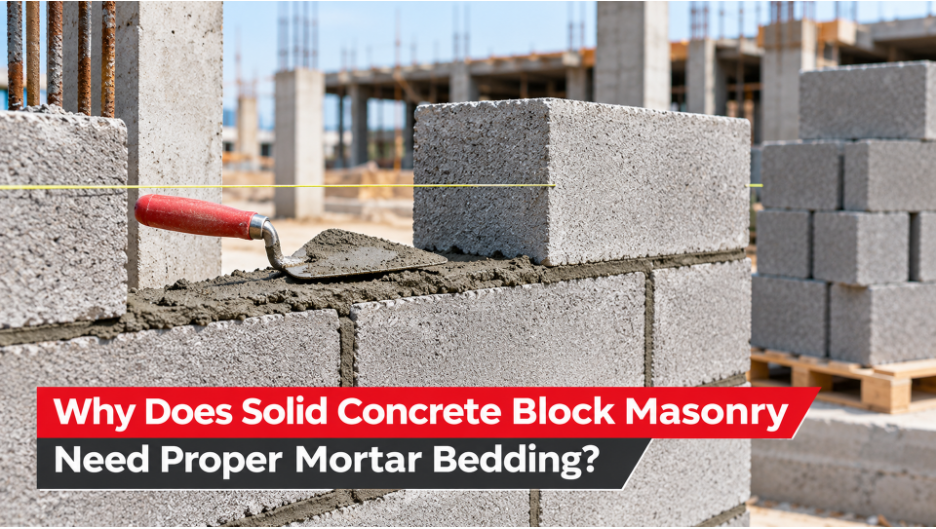
Why Does Solid Concrete Block Masonry Need Proper Mortar Bedding?
Unlike hollow masonry units, which contain internal cores, Solid Concrete Blocks provide a continuous solid bearing surface.
Mortar transfers forces between adjoining units while accommodating minor surface irregularities.
Two joints require particular attention:
- Horizontal bed joints: Distribute bearing loads between successive block courses.
- Vertical head joints: Maintain continuity and bonding between neighboring blocks.
Incomplete bedding can create localized stress concentrations, while poorly filled vertical joints may contribute to cracking and water penetration.
The selected mortar must therefore provide adequate adhesion and workability without excessive shrinkage.
For comparison, Hollow Concrete Blocks require bedding arrangements appropriate to their face shells and internal geometry. Lightweight Concrete Masonry Units may also require different moisture-control practices because their absorption characteristics can vary.
What Do Pakistani Specifications and ASTM C270 Require?
Pakistan’s construction specifications recognize different mortar proportions depending on the project.
For example, the Government of AJ&K Cement Concrete Block Masonry Schedule includes 1:4, 1:5, and 1:6 cement-sand mortar for several solid block masonry thicknesses.
These schedule entries establish specification and costing options; they do not independently certify each ratio for every structural application.
Internationally, ASTM C270 establishes proportion-based and property-based requirements for masonry mortar.
Importantly, a simple cement-sand ratio should not be treated as automatically equivalent to ASTM Type N, S, or M mortar.
Engineers must consider the applicable specification, cementitious materials, sand characteristics, and required mortar properties.
Does Stronger Mortar Always Produce Stronger Solid Block Masonry?
Not necessarily.
The performance of a Solid Concrete Block wall depends on more than the compressive strength of its mortar.
Concrete block strength, joint adhesion, workmanship, and the interaction between masonry units all influence completed masonry performance.
A 2021 experimental study involving UET Peshawar researchers investigated solid concrete block masonry using different mortar compositions, including 1:4 and 1:8 cement-sand mixes.
Researchers evaluated compressive, shear, and diagonal tensile behavior.
The findings demonstrated that changing mortar composition affects masonry performance, but results for individual mortar specimens cannot be directly substituted for the strength of an assembled wall.
This distinction matters particularly when evaluating load-bearing masonry in Pakistan.
How Should Cement and Sand Be Mixed for Solid Concrete Blocks?
Use Consistent Volume Batching
Measure cement and sand using a calibrated measuring box or another consistent-volume method.
For example, a 1:5 ratio requires one volume of cement for five equal volumes of sand.
Do not estimate proportions using inconsistent shovel loads.
Check Sand Quality and Water Content
Use clean, appropriately graded masonry sand with minimal harmful clay, organic matter, or contamination.
Add clean water gradually until the mixture becomes workable and cohesive.
Excess water can increase shrinkage and reduce hardened mortar performance.
Mix the dry ingredients uniformly before introducing water, and follow the approved mixing and usage procedures.
What Mortar Joint Thickness and Curing Practices Matter?
Approximately 10 mm is a commonly used nominal masonry joint thickness, but the approved drawings and specifications must determine the actual requirement.
Avoid unnecessarily thick joints to compensate for dimensional variations.
Select uniform masonry units and maintain consistent joint alignment.
PrimeCrete’s guide on storing solid concrete blocks correctly explains how site handling helps protect block condition before installation.
Prevent Rapid Moisture Loss
Hot weather, direct sunlight, and strong winds can remove moisture from fresh mortar before adequate hydration and bonding develop.
Protect newly constructed masonry and apply curing practices appropriate to the mortar, temperature, and project specification.
Avoid laying saturated blocks. PrimeCrete’s article on solid concrete blocks delivered too wet explains the importance of checking their condition before installation.
How Can Site Engineers Check Mortar Quality?
Before accepting Solid Concrete Block masonry, site engineers should verify:
- Approved ratio: Cement and sand proportions match the project specification.
- Material quality: Cement is properly stored and sand is clean.
- Batching consistency: Workers use the same measuring method throughout.
- Mortar workability: The mixture spreads evenly without excessive water.
- Joint quality: Bed and head joints have appropriate coverage and thickness.
- Block condition: Units are sound, dimensionally suitable, and not saturated.
- Curing: Fresh masonry receives adequate protection against premature drying.
Record nonconformities and correct them before subsequent work conceals defective joints.
Frequently Asked Questions
Is 1:4 Mortar Better Than 1:6 for Solid Concrete Blocks?
A 1:4 mortar contains more cement, but it is not universally the better option. The correct ratio depends on the wall’s structural requirements, exposure, and approved specification.
Can 1:6 Mortar Be Used for Load-Bearing Solid Block Walls?
Only when the structural design and project specification permit it. A site’s usual mortar practice is not sufficient evidence of structural suitability.
Should Solid Concrete Blocks Be Soaked Before Installation?
Generally, avoid soaking concrete masonry units. Their surface moisture condition should follow manufacturer guidance and the approved installation requirements.
What Causes Weak Mortar Joints?
Common causes include contaminated sand, incorrect batching, excessive mixing water, incomplete bedding, rapid drying, and poor workmanship.
Conclusion
The best mortar ratio for Solid Concrete Block masonry in Pakistan depends on the approved wall specification, not simply the amount of cement in the mix.
Although 1:4, 1:5, and 1:6 ratios are recognized in local construction practice, reliable masonry also requires correct bedding, controlled water content, uniform joints, and proper curing.
For projects requiring consistent masonry units, explore PrimeCrete Solid Concrete Blocks and confirm the appropriate block grade and mortar requirements with your project engineer before construction.
