
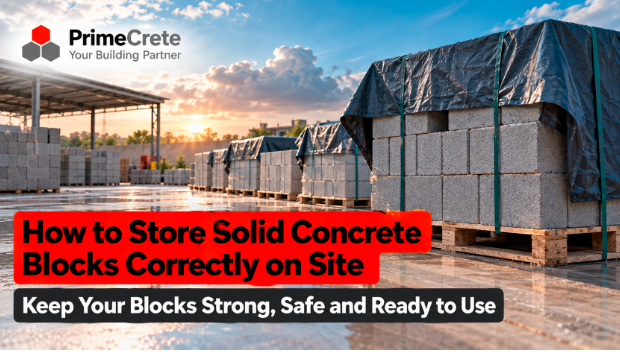
Nobody joins the construction trade because they love storage. Yet the way you keep solid concrete blocks on site quietly decides how they behave in your wall. Dump them in mud, leave them in the rain, and you end up paying for strength you never fully get.
At Prime Crete, we manufacture solid concrete blocks for foundations, boundary walls, basements and high-rise projects. Every block leaves our Hattar plant tested for strength and size. What happens after the truck drives away? That part belongs to your site team.
This guide shows you how to store concrete blocks on site the right way. We lean on published guidance from recognised safety and masonry bodies, not guesswork. Let’s keep your blocks as good on day 30 as they were on delivery day.
Why Correct Storage of Solid Concrete Blocks Matters
Concrete blocks look tough, and they are. But tough doesn’t mean careless-proof. Poor storage hurts you in three ways.
Moisture Leads to Shrinkage and Cracks
The Concrete Masonry & Hardscapes Association (formerly NCMA) explains this clearly in its TEK 3-1C guide on all-weather masonry construction. When rain soaks a block, its shrinkage potential rises and cracking becomes more likely. Wet units also slow masons down and weaken the bond between mortar and block.
In simple words, a soaked block keeps drying after it goes into the wall. As it dries, it shrinks. Those hairline cracks in your plaster? They often start right here.
Unstable Stacks Put People at Risk
A stack of blocks weighs a lot. If it topples, it can injure workers or damage vehicles. That’s why the US safety regulator OSHA requires all stored materials to be stacked or secured so they can’t slide, fall or collapse (OSHA 1926.250).
Damaged Blocks Waste Money
Chipped corners and cracked edges mean more cutting, more mortar and more rejects. You paid for every block. A good storage routine makes sure you actually use every block.
How to Choose the Right Storage Area on Site
Good concrete block storage starts before the truck arrives. Pick the spot first, then call for delivery.
Pick Firm, Level, Well-Drained Ground
A stack on soft or sloping soil starts leaning. Leaning stacks love to fall. Choose compacted, level ground, and stay away from low spots where rainwater collects.
Keep Blocks Off the Ground
Never place blocks straight on bare soil. CMHA’s guidance says to protect masonry units from rain and ground water by storing them on pallets or a similar raised base. Wooden pallets or a platform of sturdy planks both do the job.
Stay Close to the Work, but Out of the Way
Every extra move risks a chipped corner, so store blocks near where masons will lay them. Still, keep paths clear. OSHA requires aisles and passageways to stay open for workers and equipment.
Respect Slab and Edge Limits
Storing on an upper floor? OSHA sets clear limits here:
- Stored weight must not exceed the floor’s safe load limit.
- Keep materials at least 6 feet (about 1.8 m) from hoistways and floor openings.
- Keep them at least 10 feet (about 3 m) from an exterior wall that doesn’t rise above the stack.
Check slab capacity with your structural engineer before parking a full pallet on fresh concrete.
Stacking Concrete Blocks Safely
Stacking concrete blocks is not a game of Jenga. Nobody wins when the tower falls.
Follow a Sensible Height Limit
OSHA gives a clear benchmark for masonry blocks. Once a stack goes higher than 6 feet (about 1.8 m), you must taper it back by half a block for every tier above that level. Pakistan’s sites don’t fall under OSHA, but the rule makes a practical, proven safety standard to adopt.
Build Stacks That Lock Together
- Start every stack on a level pallet or plank base.
- Keep blocks aligned so each layer sits square on the one below.
- Interlock or cross-tie layers where the block shape allows, so the stack works as one unit.
- Leave delivery strapping or shrink-wrap in place until you need the blocks.
Keep Sizes and Batches Separate
Stack each size and strength class on its own. Mixing a 6-inch block into an 8-inch wall is the kind of surprise nobody enjoys. If you also bought hollow concrete blocks for partitions, give them their own labelled area too.
Protecting Blocks from Rain and Heat
Pakistan’s weather swings from scorching summers to heavy monsoon rains. Your blocks feel both.
Cover Blocks Before the Rain Comes
CMHA advises covering all construction materials whenever rain looks likely. Suitable covers include tarpaulins, polyethylene sheets, reinforced paper or other water-repellent sheeting. On larger projects, a simple shelter over the storage area works even better.
A quick tip: cover the top and sides, but don’t seal the stack airtight on wet ground. Moisture trapped underneath has nowhere to go. Raised pallets plus a loose, weighted cover usually strike the right balance.
Give Blocks Some Shade in Summer
For hot weather, CMHA recommends storing masonry materials in a shaded area. Sun-baked blocks pull water out of fresh mortar too quickly, and that weakens the bond. A shade net or a spot beside a standing structure helps a lot.

Handling, Inspection and Stock Rotation
Unload and Move Blocks Gently
Don’t throw blocks off the truck. Lift them, pass them or use a forklift with the pallet. Every dropped block is a gamble you’ll lose sooner or later.
Check Blocks on Arrival
Look for cracks, broken corners and uneven sizes before you sign the delivery note. Our guide on how to spot weak or under-cured solid concrete blocks walks you through the warning signs.
Test for Wetness Before Laying
CMHA offers a simple field test. If 50% or more of a block’s surface is wet, the block isn’t ready to lay. Less than 50% wet is acceptable, and damp surfaces don’t count as wet.
How do you tell damp from wet? Splash a little water on the surface. If it darkens, the block is only damp. If it doesn’t darken, it’s already wet.
Use Older Stock First
Rotate your stock on a first-in, first-out basis. Mark delivery dates on each stack. Also keep the area tidy, because OSHA requires storage areas to stay free of trip and fire hazards.
Common Storage Mistakes to Avoid
We see these on sites again and again:
- Stacking blocks on bare soil. The bottom rows soak up ground water like a sponge.
- Building towers instead of stacks. Height without taper invites collapse.
- Leaving blocks uncovered before rain. One monsoon evening can soak an entire delivery.
- Storing next to slab edges or openings. A falling block from height is a serious hazard.
- Mixing sizes in one pile. It wastes time and leads to wrong blocks in the wall.
- Ignoring housekeeping. Broken pieces and loose debris cause trips and slow the crew down.
Frequently Asked Questions
Can I store solid concrete blocks directly on the ground?
No. Place them on pallets or a plank platform. CMHA recommends raised storage to protect units from ground water.
How high can I stack concrete blocks on site?
OSHA’s benchmark says any masonry block stack above 6 feet (about 1.8 m) must taper back half a block per tier above that height. Lower, well-built stacks are always the safer choice.
Are rain-soaked blocks ruined?
Not usually. Let them dry first. Lay a block only when less than half of its surface is wet, as per CMHA’s field test.
Do hollow blocks and concrete bricks need the same care?
Yes, the same basics apply. Whether you store concrete bricks or hollow units, keep them raised, covered, stable and sorted by size.
Conclusion
Storing solid concrete blocks correctly isn’t rocket science. Choose firm ground, raise the blocks, stack them safely, cover them from rain and shade them from harsh sun. Then inspect, rotate and keep the area tidy.
Good storage protects the quality you paid for. Before you order, read our checklist on solid concrete block specifications: what to check before buying. Need help planning your next delivery? Talk to the Prime Crete team, and we’ll help you get the right blocks to site in the right condition.

[…] arrives and stack blocks on firm, level ground close to where masons will use them. Our guide on how to store solid concrete blocks correctly on site covers stacking, covering and handling in more detail. Secure storage also reduces losses to […]
[…] you want the full storage routine, including pallets, covers and stock rotation, read our guide on how to store solid concrete blocks correctly on site. This article focuses on the damage itself and what to do about […]