

A cracked kerb is a bit like a chipped front tooth. Everything else might be fine, but that’s all anyone notices. And unlike a tooth, a broken kerb can let water under your pavement and loosen the whole edge.
The good news? Most kerb failures are predictable, which means you can avoid them. At Prime Crete, we often notice one pattern: buyers compare prices first and ask about strength last. This guide flips that order.
Below, you’ll learn how to choose a kerb stone that survives traffic, weather and the occasional reversing truck. We’ll cover the tests that matter, the questions to ask your supplier, and the installation habits that keep edges in one piece.
Why Kerb Stones Crack or Chip in the First Place
Kerbs live a hard life. Interpave, the UK precast paving and kerb association, notes that kerbs in vehicle areas will almost certainly get driven over or hit by tyres at some point in their service life (Interpave kerb guide). So the real question isn’t if your kerb gets tested. It’s when.
Bending, not crushing
Most people ask about compressive strength. That’s only half the story. A 2023 study in the Journal of Building Engineering points out that premature kerb failure is common, and that designing for compressive strength alone may not be enough. Bending strength, water absorption and abrasion resistance matter too.
Think of a kerb like a biscuit. You can press straight down on it all day. Snap it across the middle, though, and it breaks fast. Wheels and uneven bedding do exactly that snapping.
Poor support underneath
A kerb sitting on loose soil or patchy mortar has gaps below it. When a tyre rolls over, the unsupported section bends and cracks. Interpave’s guidance says proper bedding gives even support and stops overrun from creating bending stress.
Weak edges and poor curing
Chips usually start at corners and arrises (the sharp edges). Poorly compacted or under-cured concrete has a weak, dusty surface that flakes under impact. If you want to know what bad curing looks like, our guide on how to spot weak or under-cured solid concrete blocks covers the warning signs, and most of them apply to kerbs too.
What to Check Before You Buy Kerb Stone
A good supplier won’t just say “strong hai, tension na lein.” They’ll show you numbers. Here’s what to ask for.
1. Bending strength class
The European standard BS EN 1340 tests concrete kerb units by loading them until they break. It then sorts them into three bending strength classes:
| Class | Marking | Characteristic bending strength (MPa) | Minimum single result (MPa) |
| 1 | S | 3.5 | 2.8 |
| 2 | T | 5.0 | 4.0 |
| 3 | U | 6.0 | 4.8 |
Source: Interpave, Concrete Kerbs guide. UK highway specifications ask for at least Class 2 on roads, which is a sensible benchmark for busy streets and parking areas. For garden edging, Class 1 is usually fine.
2. Water absorption
Low absorption means a denser, less porous kerb. Dense concrete resists weathering and surface flaking better. UK manufacturers declaring Class 2 absorption under BS EN 1340 quote a limit of 6% or less by mass. Ask your supplier for their lab figure.
3. Abrasion resistance
Traffic slowly grinds kerb surfaces down. According to a 2022 review of road kerb design in Sustainability, EN 1340 sets the abrasion limit at 23 mm or less in the wide wheel test. A smaller number is better.
4. Size accuracy and finish
Uneven kerbs rock on their bed, and rocking kerbs crack. BS EN 1340 allows only small length deviations: ±1%, with a minimum of 4 mm and a maximum of 10 mm. Run your hand along the edges too. Crumbly corners, honeycombing or hairline cracks at delivery are red flags.
5. Test reports, not promises
Ask for recent lab test certificates from the batch you’re buying. Any serious manufacturer keeps them. If a seller dodges the question, that tells you plenty.
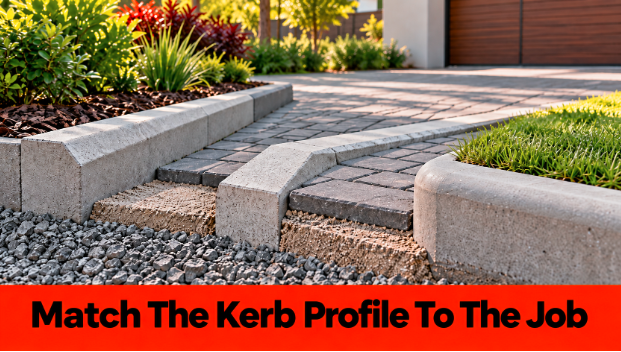
Match the Kerb Profile to the Job
A strong kerb in the wrong shape still gets beaten up. Profile decides how wheels meet the stone.
Half battered kerbs
The sloped face pushes tyres back onto the road. Interpave recommends this profile where you want to redirect traffic away from the footpath.
Splayed kerbs
The 45° face lets vehicles climb over gently. It suits driveway entrances and verges where cars cross daily. A sharp upright kerb here would take a beating every single morning.
Bullnosed kerbs and edgings
Rounded tops have no sharp corners to chip. They work well for walkways, gardens and pedestrian zones.
Radius kerbs for curves
Don’t force straight units around a tight bend. Under BS EN 1340, curves of 15 m radius or less should use purpose-made radius kerbs. Cut or badly angled joints create weak points.
Kerbs also act as edge restraints for paving. If you’re laying interlocking paver blocks or grass pavers, a solid kerb line stops the paving from creeping outward. Planning a budget as well? Our kerb stone price in Pakistan guide covers rates and sizes.
Kerb Stone Installation: Where Good Kerbs Go to Die
You can buy the best kerb in the market and still ruin it in one afternoon. Good kerb stone installation follows a few simple rules from Interpave’s guide, which is based on the UK code of practice BS 7533-6.
Build a proper concrete foundation
Kerbs need a concrete base, called a kerb race. When laid on fresh concrete, the race should be at least 150 mm thick under standard kerbs, 100 mm under small kerbs and 75 mm under edgings.
Bed and haunch every unit
On a hardened race, bed each kerb on a 1:3 cement-sand mortar, 12 to 40 mm thick. Then back it with concrete haunching so it can’t lean or shift sideways. For heavy traffic, the guide suggests making the race and haunch in one pour or adding steel dowels.
Leave a small joint
Never butt kerbs tightly against each other. Interpave recommends joints of at least 2 mm. Tight joints let edges grind together and chip, a bit like two passengers fighting over one armrest.
Cut carefully, and not too short
Don’t cut long kerbs shorter than 300 mm. Tiny offcuts are fragile and tend to crack first.
Handle with care
A standard 915 mm half battered kerb (HB1) weighs about 97 kg. Dropping it off a tractor trolley is a quick way to chip it before it ever sees a road. Use proper lifting tools and lay kerbs straight from the pallet.
Quick Checklist Before You Order
- Bending strength class declared (Class 2 or higher for roads)
- Water absorption figure from a lab test
- Abrasion result within the EN 1340 limit
- Straight, even units with clean, solid corners
- A profile that suits the traffic: half battered, splayed or bullnosed
- Radius kerbs for tight curves
- An installer who plans a concrete race, haunching and proper joints
The Bottom Line
A kerb that won’t crack or chip isn’t luck. It’s the result of dense concrete, the right strength class, a sensible profile and honest installation. Skip any one of these, and the kerb will let you know. Loudly, and usually right after the rains.
Prime Crete’s kerb stone blocks are made with precision moulds and compaction technology, and every batch goes through quality control testing. Tell us about your road, parking area or garden, and we’ll help you pick the right unit.
Frequently Asked Questions
Which kerb stone is best for roads?
Pick a dense, hydraulically pressed concrete kerb with a declared bending strength of Class 2 (5.0 MPa) or higher. A half battered profile works well where you want traffic kept off the footpath.
Why do new kerbs chip at the corners?
The usual causes are weak surface concrete, rough handling during delivery, and butt joints with no gap. Each of these puts stress on the sharp edges.
Can I fix a cracked kerb, or should I replace it?
Replacement is usually the lasting fix. Interpave advises breaking out the damaged unit and its haunching, then relaying on a fresh bed with new haunch concrete.

[…] a deeper checklist on cracks and chips? Read our guide on how to choose kerb stone that won’t crack or chip. And if budget is your next question, our kerb stone price in Pakistan guide covers rates and […]