
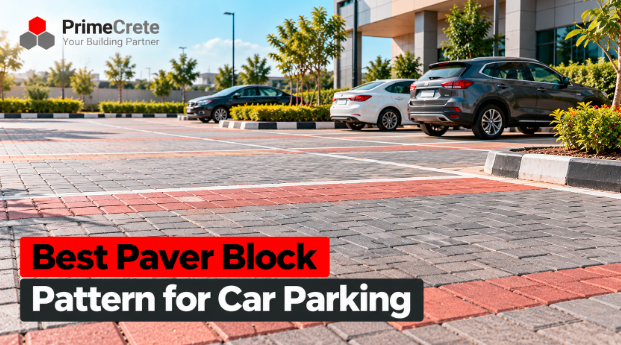
Walk through any older parking area in Lahore or Rawalpindi and you can often spot the problem from a distance. Long lines of pavers have crept sideways, joints have opened near the entrance, and the spot where everyone brakes looks like a slow-motion wave. Very often, the pattern played a bigger role than the paver.
At PrimeCrete, we manufacture interlocking paver blocks for driveways, commercial parking, petrol stations and housing-society roads. This guide explains which laying pattern performs best under cars, why it works, which patterns to avoid, and what else a parking area needs to stay level.
The Short Answer
For car parking, a herringbone pattern — laid at 45° or 90° to the direction of traffic — is generally the best choice for rectangular pavers. Its zigzag joints lock pavers together in every direction, so they resist the twisting and pushing forces from turning, braking and accelerating vehicles. Avoid patterns with long, continuous joints running in the direction of traffic.
Why the Laying Pattern Matters Under Vehicles
A laying pattern is the arrangement in which pavers are placed relative to each other and to the direction of traffic. Under foot traffic, the pattern is mostly about looks. Under cars, it becomes a structural decision.
Interlocking concrete pavement works because pavers, joint sand and edge restraints act together. Vehicles do not just press down. They also push pavers forward when braking, backward when accelerating, and sideways when turning into a bay. A good pattern spreads those horizontal forces across many pavers instead of letting one line of blocks slide.
The Interlocking Concrete Pavement Institute’s construction tolerance guide recommends a herringbone laying pattern for all vehicular applications. That is a strong, practical benchmark for any Pakistani parking project.
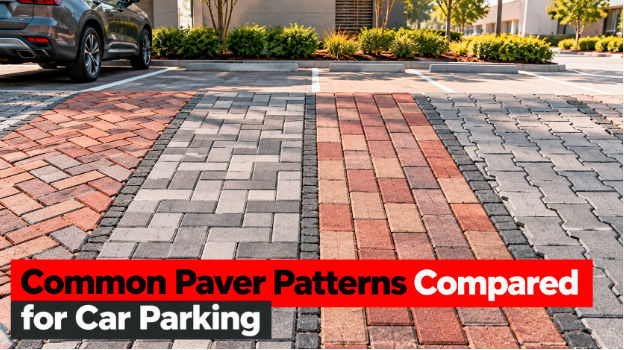
Common Paver Patterns Compared for Car Parking
| Pattern | How it looks | Interlock under vehicles | Suitability for car parking |
| 45° herringbone | Zigzag, angled to traffic | Strongest in all directions | Best choice; more edge cutting |
| 90° herringbone | Zigzag, square to edges | Very strong | Excellent; less cutting than 45° |
| Stretcher (running) bond | Staggered rows like brickwork | Good only across the rows | Light residential use if rows run across traffic |
| Basket weave / parquet | Pairs in alternating squares | Weak; continuous straight joints | Not recommended for vehicles |
| Stack bond | Straight grid | Very weak | Avoid for any traffic |
Why Herringbone Works Best
In a herringbone pattern, no joint runs straight for more than about one paver length. Every paver is braced by neighbours on several sides. When a car brakes, the force has nowhere obvious to go, so the surface stays tight.
The ICPI’s structural design guide (Tech Spec 4) illustrates both 45° and 90° herringbone as laying patterns for vehicular traffic. Use 45° where turning and braking are heavy, such as entrances and drive aisles. Use 90° where you want a cleaner look and fewer cuts along straight edges.
When Stretcher Bond Is Acceptable
Stretcher bond can work on a lightly used home driveway if the long joints run across the direction of travel, not along it. Laid the wrong way round, long continuous joints act like rails that let rows creep. For commercial parking with frequent turning, choose herringbone.
What About Shaped Interlocking Pavers?
Shaped units, such as zigzag or I-shaped pavers, have dentated edges that interlock in a fixed arrangement. Their laying pattern is largely set by the shape itself. Follow the manufacturer’s recommended layout and keep joints tight and fully sanded.
Pattern Alone Will Not Save a Parking Area
A perfect herringbone laid on a weak base will still rut and sink. A durable car parking surface depends on the complete pavement system:
- Compacted sub-base of suitable thickness for the soil and traffic
- Even bedding sand layer, screeded to a consistent depth, never used to fill hollows
- Edge restraints, such as concrete kerbs, to stop the pattern spreading
- Joint sand swept in and compacted until joints are full
- Correct paver thickness and strength for the traffic expected
- Surface drainage, with falls toward drains so monsoon water does not soften the base
If you are worried about cracked pavers, read our guide on whether interlocking paver blocks crack under cars. For service yards and loading areas, see whether interlocking pavers can handle truck loads.
Practical Layout Tips for Parking Bays
- Set out the pattern from a straight, square string line
- Orient 45° herringbone relative to the main drive aisle
- Install kerbs or edge restraints before laying pavers
- Cut edge pavers cleanly; avoid tiny slivers at the perimeter
- Compact pavers and joint sand with a plate compactor
- Use contrasting pavers, not paint, to mark bay lines if possible
Frequently Asked Questions
Is herringbone stronger than stretcher bond for parking?
Yes, for vehicular traffic. Herringbone provides interlock in multiple directions, while stretcher bond resists movement well only across its rows.
Should I choose 45° or 90° herringbone?
Both suit vehicles. 45° offers the best resistance at entrances and turning areas, while 90° needs fewer edge cuts and suits rectangular bays.
Can basket weave pavers be used for a driveway?
Basket weave has long straight joints that can shift under turning wheels. It is better suited to walkways and patios.
Does the pattern affect how much paver material I need?
The area remains the same, but herringbone at 45° usually produces more cut waste at the edges. Allow a little extra when ordering.
Conclusion
For car parking, herringbone is the safest pattern choice, with 45° suited to busy turning areas and 90° to neat rectangular bays. But pattern is only one part of the job. Base preparation, edge restraint, joint sand and drainage decide whether that pattern stays tight for years.
PrimeCrete can help contractors and developers select suitable interlocking pavers and plan supply for parking projects across Pakistan.
