

A homeowner in Islamabad finishes a new paver driveway, parks an SUV on it for a month, and then finds three cracked blocks right where the front wheels stop. The first instinct is to blame the pavers. The second instinct, usually more accurate, should be to look underneath them.
At PrimeCrete, we manufacture concrete paving products at our plant in Hattar Industrial Estate, and “will these crack under my car?” is one of the first questions driveway buyers ask. This article explains whether interlocking paver blocks can crack under cars, the real causes when they do, how thickness, strength and the base work together, and what to specify so a driveway or parking area stays intact.
The Short Answer
Properly made interlocking paver blocks, laid on a well-compacted base, should not crack under normal cars. When pavers crack under cars, the cause is usually a weak or poorly compacted base, missing edge restraint, too thin a paver for the traffic, or low-strength units. The paver works as part of a pavement system, and the system fails at its weakest layer.
How Interlocking Pavers Carry a Car’s Weight
An interlocking paver is a precast concrete paving unit shaped to lock with its neighbours through its geometry and the sand-filled joints between units. When a wheel rolls over one paver, the load spreads to surrounding pavers through joint friction and interlock, then down through the bedding sand into the compacted base.
The Concrete Masonry & Hardscapes Association describes paver pavements as semi-flexible systems in which units share load with their neighbours, unlike a rigid poured slab. That load-sharing only works when every layer underneath does its job. A durable interlocking-paver surface depends on the complete pavement system: subgrade, sub-base, compaction, bedding sand, joint sand, edge restraint, drainage and traffic loading.
Why Pavers Crack Under Cars
1. Weak or Poorly Compacted Base
This is the most common cause by far. If the sub-base settles under a wheel, the paver above loses uniform support and bends. Concrete is strong in compression but much weaker in bending, so a paver bridging a soft spot can crack under a load it would easily carry on a firm base. Pavers can be strong enough to survive years of traffic and still crack in a month if someone treats compaction as an optional hobby.
2. Missing or Weak Edge Restraint
Without a firm edge, such as a kerb or concrete haunch, pavers at the boundary creep outward under turning wheels. Joints open, interlock drops, and individual units start carrying loads alone. Edge pavers then rock, chip and crack.
3. Too Thin for the Traffic
Thicker pavers resist rotation and bending better under wheel loads. Many manufacturers offer thinner units for footpaths and light domestic areas and thicker units for heavier vehicular areas. The correct thickness depends on traffic type, wheel loads, base design and ground conditions, and the project specification should state it.
4. Low-Strength or Under-Cured Units
Paver strength depends on mix design, compaction during manufacture and curing. International standards set minimum performance for paving units: ASTM C936, the specification for solid concrete interlocking paving units, and BS EN 1338 both define strength and durability requirements and test methods. Ask the supplier which standard their test reports follow.
5. Point Loads and Turning
Power steering on a stationary car twists the tyre against the surface. Car jacks, motorcycle stands and loaded tyres on unsupported edges create concentrated point loads. A good base and tight joints spread these loads; a weak one concentrates them on a single paver.
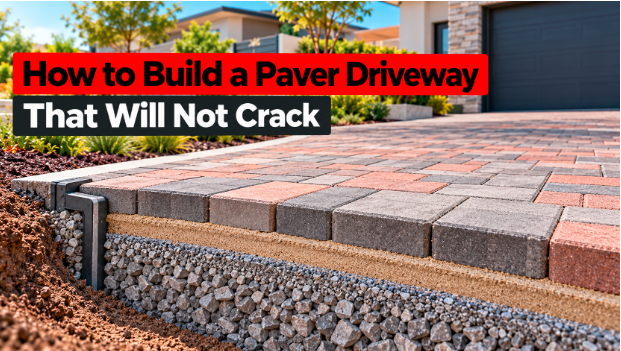
How to Build a Paver Driveway That Will Not Crack
Getting a crack-free driveway is mostly about doing the boring layers properly. The pavers are the visible part; the base is where the performance lives.
| Layer or factor | What it does | What to check |
| Subgrade (natural soil) | Final support for everything above | Remove soft clay, organic soil and fill; compact |
| Sub-base (crushed stone) | Spreads wheel loads | Thickness per traffic and soil; compact in layers |
| Bedding sand | Provides an even seat for pavers | Uniform, screeded thickness; not used to fill dips |
| Pavers | Carry and share wheel loads | Thickness and strength suited to vehicles |
| Joint sand | Creates interlock between units | Joints fully filled and topped up after compaction |
| Edge restraint | Stops lateral creep | Kerb or concrete haunch on all open edges |
| Drainage and slope | Keeps the base from softening | Fall away from buildings; no ponding |
For Pakistani conditions, drainage deserves extra attention. Monsoon rain that soaks into a poorly drained sub-base softens it, and a softened base is exactly where pavers start to sink and crack. Build in a fall, provide an outlet for runoff, and avoid letting roof downpipes discharge directly onto the paving.
If you expect delivery trucks, water tankers or construction vehicles on the same surface, the design changes considerably. Our guide on whether interlocking paver blocks can handle truck loads covers heavy-duty paving in more detail.
Checklist Before Ordering Pavers for a Driveway
- Define the traffic: cars only, SUVs, occasional trucks or regular heavy vehicles
- Confirm paver thickness suits that traffic
- Ask for strength test reports and the standard they follow
- Check soil conditions and plan sub-base thickness accordingly
- Plan edge restraints on every open edge
- Design slope and drainage before excavation starts
- Inspect pavers on delivery for cracks, chipped edges and size consistency
For a practical inspection routine, see our guide on how to test interlocking paver block quality on-site.
Common Mistakes to Avoid
- Laying pavers on loose soil or a thick sand bed. Sand is a bedding layer, not a structural base.
- Skipping plate compaction after laying. Compaction seats the pavers and drives joint sand down for interlock.
- Leaving edges unrestrained. Edges are where most failures start.
- Choosing pavers by price per square foot alone. A cheap, weak paver on a good base still cracks; so does a strong paver on a bad base.
Frequently Asked Questions
Can interlocking pavers carry an SUV?
Yes, when the paver thickness, strength and base suit vehicular traffic. Most driveway failures under SUVs trace back to the base or edge restraint, not the paver.
Why did only a few pavers crack?
Localised cracking usually points to a local base problem, such as a soft spot, a service trench backfilled without compaction, or a section near an unrestrained edge.
Can cracked pavers be replaced?
Yes. One advantage of interlocking paving is that individual units can be lifted, the base corrected and new pavers relaid. Fix the base problem first, or the new paver will crack too.
Are pavers better than poured concrete for driveways?
Both can work. Pavers are easier to repair locally and handle minor ground movement well; poured concrete forms a continuous slab. The right choice depends on budget, traffic, appearance and maintenance expectations.
Conclusion
Interlocking paver blocks can crack under cars, but they rarely do when the whole pavement system is designed and built properly. Match paver thickness and strength to the traffic, compact the base in layers, restrain every edge and plan drainage for monsoon conditions.
Planning a driveway, housing-society street or commercial parking area? Explore PrimeCrete’s interlocking paver blocks for driveways and parking areas and talk to our team about thickness, quantities and delivery for your project.
