
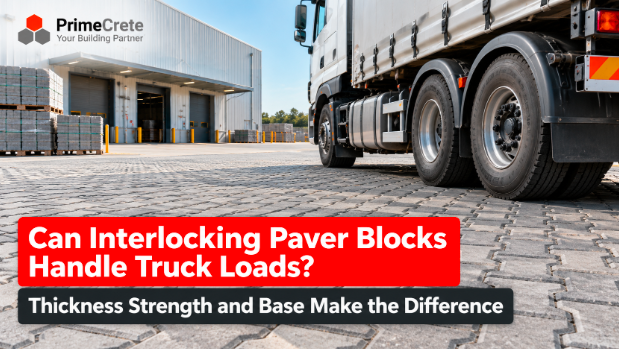
Picture a loaded 10-wheeler reversing into a factory yard. The driver brakes, cranks the steering, and tonnes of weight twist on the ground underneath. So, does the pavement hold, or does it start waving goodbye one block at a time?
At Prime Crete, we hear this question almost every week. The honest answer: yes, interlocking paver blocks can handle truck loads. They already do it in bus terminals, industrial yards and container ports. But they only perform when you get three things right: thickness, strength and the base underneath.
Let’s break down what the standards actually say, minus the sales talk.
Why Interlocking Pavers Handle Heavy Loads So Well
A single concrete block can’t carry a truck on its own. The secret lies in teamwork.
The Interlock Spreads the Load
When a wheel presses down on one paver, the sand-filled joints transfer that force to neighbouring blocks. The load spreads across a wider area before it reaches the base. Think of a crowd holding hands on a slippery floor. Nobody falls easily.
The Pavement Gets Stronger With Use
Here’s the fun part. The Interlocking Concrete Pavement Institute (ICPI) notes that these pavements stiffen and gain structural capacity as traffic runs over them. Its guidance even states that pavers plus bedding sand can contribute more strength than an equal thickness of asphalt. Few materials improve with abuse. Pavers do.
Paver Block Thickness for Truck Traffic
Thickness is where most buyers go wrong. A 60 mm paver looks tough in a showroom. Under a dump truck, it quickly loses the argument.
India’s IS 15658 standard, widely used as a reference across South Asia, links paver block thickness and grade to traffic type:
| Traffic Category | Min. Thickness | Grade | Typical Use |
| Non-traffic | 50 mm | M-30 | Gardens, patios |
| Light traffic | 60 mm | M-35 | Footpaths, car parks |
| Medium traffic | 80 mm | M-40 | City streets, market roads |
| Heavy traffic | 100 mm | M-50 | Bus terminals, factory floors, industrial yards |
| Very heavy traffic | 120 mm | M-55 | Container terminals, ports |
You can read the full specification in the IS 15658 standard document.
American guidance points the same way. ICPI recommends a minimum 80 mm thickness for any vehicular pavement other than residential driveways. It also suggests a maximum length-to-thickness ratio of 3:1, so heavy-duty blocks stay stocky and resist tipping.
Bottom line: for regular truck movement, plan for 100 mm heavy-duty paver blocks at minimum. For container handling or port-style loads, move up to 120 mm.
Strength Matters: What the Standards Demand
Thickness gets the headlines. Concrete quality does the actual work.
Compressive Strength
The ASTM C936 standard requires interlocking concrete pavers to average at least 55 MPa (8,000 psi) in compressive strength, with no single unit below 50 MPa. That’s far stronger than the concrete in many building slabs.
Water Absorption
The same standard caps average water absorption at 5%, with no unit above 7%. Low absorption means denser concrete, and denser concrete lasts longer under grinding tyres and monsoon rain.
A tip from experience: always ask your supplier for lab test reports. A reputable manufacturer will share them happily. If a seller changes the subject, change your supplier.
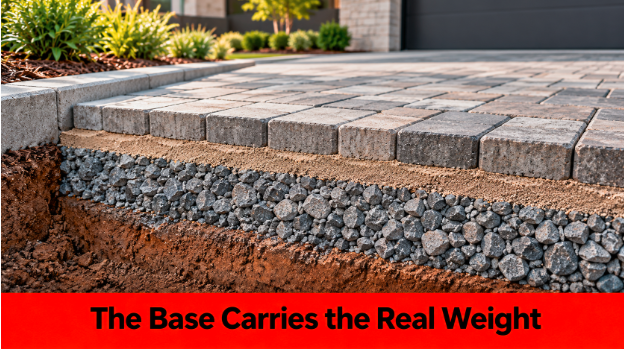
The Base Carries the Real Weight
Here’s an uncomfortable truth. Perfect pavers on a weak base will still fail. The paver surface only spreads the load; the layers beneath carry it.
Subgrade Compaction
For areas with heavy vehicle traffic, ICPI guide specifications recommend compacting the soil subgrade to at least 98% modified Proctor density. Skip this step, and ruts will show up faster than your next electricity bill.
Aggregate Base Thickness
ICPI’s application guide lists typical aggregate base thicknesses:
- Walkways: 100–150 mm
- Driveways: 150–200 mm
- Streets: 200–300 mm
Engineers adjust these numbers based on soil conditions and expected traffic. Industrial yards on soft clay often need more, so get a site-specific design.
Bedding Sand
Screed the bedding sand to about 25 mm and never exceed 40 mm. Thick sand beds feel soft to the pavers, and soft beds lead to settlement under heavy wheels.
Laying Pattern: Why Herringbone Wins
Pattern choice isn’t just about looks. ICPI recommends 45° or 90° herringbone patterns wherever vehicles drive continuously.
Why? Herringbone locks every block in multiple directions. When a truck brakes or turns, the blocks resist sliding and rotating. Stack or running-bond patterns can creep sideways under the same forces.
ICPI also advises that cut pieces exposed to vehicle traffic should stay no smaller than one-third of a full unit. Tiny slivers at the edges tend to crack or pop out.
Edge Restraints: The Unsung Heroes
Without firm edges, pavers slowly spread outward like guests leaving a boring wedding. Truck traffic speeds that up.
Strong kerb stone blocks lock the pavement in place and keep joints tight. If you’re budgeting for them, our guide on kerb stone price in Pakistan covers current sizes and rates.
Where Heavy-Duty Pavers Make Sense
Interlocking paver blocks for heavy traffic suit:
- Factory yards and warehouse loading bays
- Bus terminals and truck stands
- Petrol and service stations
- Mandi and market roads
- Container yards (with 120 mm blocks)
For lighter areas like overflow parking, where you want some greenery, grass pavers offer a softer look while still supporting cars.
Common Mistakes That Wreck Truck Pavements
Most failures we see trace back to shortcuts, not the pavers. Watch out for these:
- Using 60 mm blocks where trucks operate
- Skipping subgrade compaction to save a day
- Laying thick sand beds to fix uneven bases
- Choosing stack bond for vehicle routes
- Ignoring edge restraints entirely
- Buying untested blocks because they’re cheaper
Every one of these saves money today and costs far more next year.
Real-World Proof
Pavers aren’t a new experiment for heavy loads. The US Federal Highway Administration’s technical brief on interlocking concrete pavement confirms that engineers use 80 mm or thicker units in vehicular areas. IS 15658 names container terminals directly in its very heavy traffic category. Ports don’t gamble with their floors, so that tells you something.
Quick FAQs
What thickness of paver block is best for trucks?
Use at least 100 mm (M-50 grade) for regular truck traffic, and 120 mm (M-55) for container or port loads, as per IS 15658.
Can 80 mm pavers take truck loads?
They suit medium traffic like city streets. For frequent heavy trucks, step up to 100 mm.
Do pavers crack under heavy vehicles?
Properly made and installed pavers rarely crack. Failures usually come from a weak base, poor compaction or undersized blocks.
Final Word
So, can interlocking paver blocks handle truck loads? Absolutely, when you respect the engineering. Pick 100–120 mm blocks, insist on tested strength, build a compacted base, lay herringbone and lock the edges.
Planning a project? Check our interlocking paver blocks price guide for current rates, then talk to our team about the right specification for your site. Your trucks will thank you. Quietly, of course.

[…] a yard for heavy vehicles? Our article on whether interlocking paver blocks can handle truck loads covers that question in […]
[…] tankers or construction vehicles on the same surface, the design changes considerably. Our guide on whether interlocking paver blocks can handle truck loads covers heavy-duty paving in more […]