
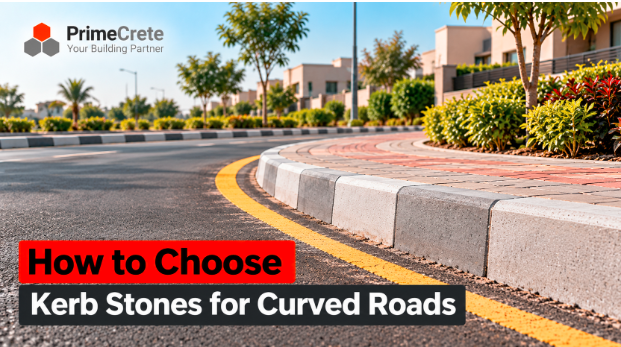
A straight road forgives a lot. A curve shows every mistake. Lay long, straight Kerb Stones units around a tight roundabout and the result looks like a polygon drawn by a nervous student, with wide wedge-shaped joints that crack and let water into the base.
At PrimeCrete, we manufacture precast concrete kerb stones in Hattar Industrial Estate for roads, parking areas and landscaping. This guide explains how to choose kerbs stones for curved alignments, including roundabouts, housing-society bends, gate entrances and parking islands. It covers when you need radius kerbs, when shorter straight units will do, how to estimate the visual and joint effect, and what bedding and backing curves need.
The Short Answer
For curved roads, choose kerbs based on the curve radius. Tight curves need purpose-made radius kerbs, or short straight units if radius units are unavailable and the specification allows it. Gentle curves can usually take standard straight units. In every case, the kerbs need a continuous concrete bed and backing (haunching), consistent joints, and drainage designed for where water collects on the curve.
Start With the Curve Radius
A kerb stone is a precast concrete unit that defines the edge of a carriageway, footpath or paved area, guides traffic and often directs surface water. On a curve, the single most important number is the radius of the kerb line, measured on the drawings.
The radius controls everything that follows. The tighter the curve, the more a straight unit deviates from the true arc and the wider its joints open on the outer face. That is why highway specifications set a radius below which purpose-made curved units are expected.
The UK’s Specification for Highway Works, Series 1100 (February 2021 amendment) required radius kerbs to BS EN 1340 on curves of 15 m radius or less. Pakistani projects may follow a different specification, but the principle is widely used: tight curves need curved units, not straight ones forced into shape.
Your Three Options for Curved Kerbing
1. Radius Kerbs
Radius kerbs are cast with a curved face to match a specific radius, either internal or external. They give a smooth line and tight, consistent joints. They are the best choice for roundabouts, small islands and tight corners, provided units are available for the radius on the drawings. Ask the supplier which radii they can produce before finalising the design.
2. Short Straight Units
Where radius kerbs are not available, short straight units can approximate a curve. An earlier edition of the same UK specification (November 2004 amendment) allowed straight kerbs no longer than 450 mm for radii of 3 to 12 m, and no longer than 300 mm below 3 m, with ends splayed where needed. Shorter units mean smaller facets and narrower joints.
3. Cut Standard Units
Cutting standard kerbs into shorter pieces works for small quantities, but it is slow, creates waste, and every cut needs to be clean and square. Very short cut pieces are fragile and harder to bed firmly. Treat cutting as a site solution for odd lengths, not a strategy for a whole roundabout.
Why Long Straight Kerbs Look Bad on Tight Curves
Two effects matter, and both are simple geometry.
The first is faceting. A straight unit of length L on a curve of radius R sits off the true arc at its midpoint by roughly L² ÷ (8R). The second is joint opening. Each unit turns through a small angle, so if the front faces touch, the joint on the opposite face opens by roughly W × L ÷ R, where W is the kerb width.
The next section shows what those numbers mean on site.
Worked Example: Straight Units on a 6 m Radius
Assumptions: kerb line radius R = 6 m (a typical small roundabout or society junction); kerb width W = 150 mm; front faces butted together. These values are for illustration only. Use your actual radius and the actual dimensions of the units you buy.
| Unit length (L) | Offset from true arc, L² ÷ 8R | Joint opening on far face, W × L ÷ R | Visual result |
| 1,000 mm | ≈ 21 mm | ≈ 25 mm | Clearly faceted, wide wedge joints |
| 600 mm | ≈ 7.5 mm | ≈ 15 mm | Noticeable facets |
| 450 mm | ≈ 4 mm | ≈ 11 mm | Acceptable for many service roads |
| 300 mm | ≈ 2 mm | ≈ 7.5 mm | Reads as a smooth curve |
A 90° turn on a 6 m radius is about 9.4 m long, so it takes roughly 10 one-metre units or about 32 units of 300 mm. Shorter units mean more joints and more labour, but a far better line. Purpose-made radius kerbs avoid the trade-off altogether.

Bedding, Backing and Drainage on Curves
Curves load kerbs differently. Vehicles cut corners, tyres scrub the kerb face, and turning trucks push sideways. A kerb that sits on loose soil will rotate or shift long before the concrete itself fails.
- Bedding: set each unit on a continuous concrete bed or mortar on a hardened concrete race, as specified, never directly on soil or loose fill.
- Backing (haunching): place concrete behind the kerb to resist sideways movement and tilting, as the drawings detail.
- Line and level: set out curves with pegs at close intervals so the string line follows the arc, then check level along the whole curve.
- Joints: keep them consistent. On curves, the outer-face joints need filling where the specification calls for pointed joints.
- Drainage: water collects on the low side of a curve. Place gullies or openings where the levels send water, especially in areas with heavy monsoon runoff.
Choosing the Kerb Profile for the Curve
The curve also affects which profile makes sense. A half-battered or splayed face lets vehicles mount occasionally without damaging tyres, which suits parking islands and tight turns used by delivery trucks. A vertical or upright face gives stronger separation at pedestrian areas and medians. Our guide to the best kerb stone for parking areas in Pakistan covers profile choice in more detail.
Checklist Before Ordering Kerbs for a Curve
- Kerb-line radius for every curve, from the drawings
- Internal or external curve, and the required profile
- Whether radius units are available for each radius, or the maximum straight-unit length allowed
- Quantity per curve, including cut pieces and spares
- Bedding and backing concrete specification
- Drainage positions along the curve
- Strength and durability requirements for the traffic expected
Common Mistakes to Avoid
- Forcing long straight units around tight radii. Wide joints crack and admit water into the base.
- Skipping the backing concrete on curves. Turning traffic pushes kerbs outward over time.
- Setting out with too few pegs. The string line becomes a series of long chords and the curve looks angular.
- Ignoring drainage at the low point. Ponding at a curve softens the base and undermines the kerb.
- Choosing on price per unit only. A curve’s cost includes cutting, labour and repairs. Our article on choosing kerb stone that won’t crack or chip explains the quality checks that matter.
A kerb can survive years of traffic. It is less talented at surviving a contractor who believes concrete haunching is decorative.
Frequently Asked Questions
When do I need radius kerbs instead of straight ones?
When the curve is tight enough that straight units look faceted or open wide joints. Some highway specifications set a threshold, such as 15 m radius in the UK specification referenced above. Your project specification or engineer should confirm the limit for your job.
Can I use standard straight kerbs on a gentle curve?
Usually yes. On large radii, the offset and joint opening from a standard unit are small. Run the L² ÷ 8R and W × L ÷ R checks with your actual dimensions to see whether the result is acceptable.
How do I calculate kerbs for a curve?
Work out the arc length first: radius × angle in radians, or for a quarter circle, about 1.57 × radius. Divide by the unit length and round up, then add spares for cuts and breakage.
Why do kerbs on curves tilt or move?
Usually because of missing or thin backing concrete, poor bedding, or water softening the base. Turning vehicles apply sideways force, so curves need a properly bedded and backed kerb more than straight runs do.
Conclusion
Choosing kerb stones for curved roads starts with the radius. Tight curves need radius kerbs or short straight units; gentle curves can take standard lengths. Whatever you choose, bed and back the kerbs properly and plan drainage for the low side of the curve.
If you are planning roundabouts, society bends or parking islands and want to check unit sizes and options, explore PrimeCrete’s kerb stone blocks or contact our team with your drawings and radii.
