
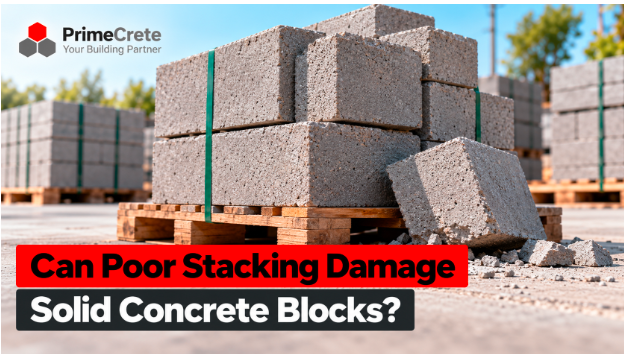
A truck unloads 3,000 blocks at a boundary-wall site in Rawalpindi. The labour throws them off the tailgate, piles them on soft soil beside a puddle, and stacks them as high as the tallest man can reach. A week later, the mason complains about broken corners and the contractor blames the factory. In most cases like this, the block was fine when it left the plant. The stacking was not.
At PrimeCrete, the concrete-products brand of Pak Dream (Pvt) Ltd in Hattar Industrial Estate, we see this argument play out on Pakistani sites regularly. This article answers a narrow but expensive question: can poor stacking actually damage solid concrete blocks, what kind of damage it causes, which damage affects the wall, and how site teams and buyers can check delivered blocks before they go into masonry.
The Short Answer
Yes. Poor stacking can chip edges, crack units, soak the bottom rows with ground moisture, contaminate faces with mud, and cause stacks to topple. Most stacking damage is mechanical and visible, so a careful inspection catches it. A block with a cracked body or a missing corner should not go into a load-bearing wall. Minor surface chips are usually cosmetic, but the project specification and the engineer decide what is acceptable.
How Poor Stacking Damages Solid Concrete Blocks
A solid concrete block is a precast concrete masonry unit with no significant internal voids. That solid body makes it heavy and stiff, which is exactly why careless stacking hurts it. Concrete resists compression well but handles impact, bending and concentrated point loads far less well. Most stacking damage comes from one of those three forces.
Edge and Corner Chipping
Corners and arrises are the weakest geometric points of any block. When labourers throw blocks onto a pile, or drop them block-on-block, the corners take the impact. Chipped corners leave gaps the mason must fill with extra mortar, and they spoil fair-faced work where the wall stays unplastered.
Cracking from Uneven Bases and Point Loads
A stack on uneven soil, broken bricks or a warped pallet does not sit evenly. The bottom rows then bear the weight of the stack on a few high spots instead of their full bed face. That concentrated bearing can bend a unit and crack it, even though the same block would comfortably carry that load in a properly bedded wall. The higher the stack, the larger the load on those bottom rows.
Moisture and Mud from Ground Contact
Blocks stacked directly on soil absorb ground moisture, especially in the monsoon. Concrete masonry units shrink as they dry, and ASTM C90, the specification for loadbearing concrete masonry units, limits drying shrinkage for that reason. A soaked block laid straight into a wall keeps drying in place, which raises the risk of shrinkage cracks later. Mud-stained faces also reduce mortar bond and need cleaning before laying.
Stack Collapse
Tall, untapered stacks fall over. A collapse breaks dozens of units at once and, far more importantly, can injure workers. As a safety benchmark, the US regulator OSHA states that masonry block stacks above 6 feet must taper back half a block per tier above that level. Pakistani sites do not fall under OSHA, but the rule is a sensible, well-tested practice to adopt.
If you want the full storage routine, including pallets, covers and stock rotation, read our guide on how to store solid concrete blocks correctly on site. This article focuses on the damage itself and what to do about it.
Does Stacking Damage Reduce Wall Strength?
It depends on the type of damage and the wall’s job. A small chip on a corner rarely changes how a block carries load once it sits in a full mortar bed. A crack running through the body of a unit is different, because it splits the block into pieces that no longer act as one solid element.
Masonry standards recognise this distinction. ASTM C90 accepts minor cracks from manufacture and minor chipping from customary handling, while it limits larger chips and cracks on faces that will remain exposed. In other words, the standard expects some handling wear, not broken blocks.
The strength of a concrete masonry wall does not depend on the block alone. Unit strength, mortar, bedding, workmanship, wall geometry, loading and structural detailing all affect how the wall performs. A damaged unit weakens that chain at one point, which matters most in load-bearing walls, piers and retaining structures.
| Damage type | Usually affects | Typical site decision |
| Small chip on edge or corner | Appearance, mortar use | Use in plastered walls; avoid on fair faces |
| Large missing corner | Bedding, bond, appearance | Use as cut piece or reject for load-bearing work |
| Hairline surface crack | Usually appearance | Engineer or site inspector decides |
| Crack through the block body | Structural integrity | Reject for structural walls |
| Saturated or mud-coated unit | Shrinkage risk, mortar bond | Clean and allow to dry before laying |
This table is general site guidance, not an engineering acceptance criterion. Your project specification and structural engineer set the final rules for load-bearing solid concrete block walls.
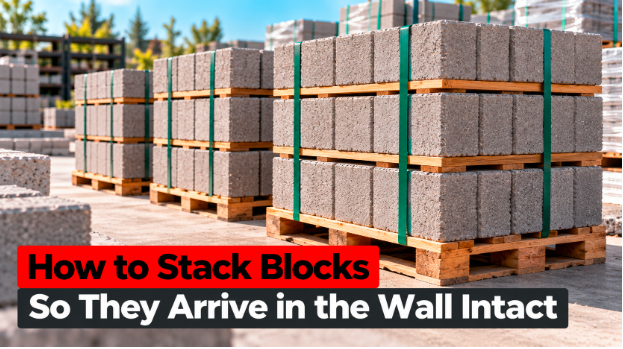
How to Stack Blocks So They Arrive in the Wall Intact
Good stacking prevents most of the damage above. Concrete blocks are good at carrying loads; they are less talented at surviving a tailgate drop.
- Unload by hand or forklift. Pass or lift blocks; never throw them.
- Start on a level, raised base. Use sound pallets or planks on firm, compacted, well-drained ground.
- Keep stacks square and bonded. Each layer should sit fully on the one below.
- Limit height. Keep stacks low enough to stay stable, and taper taller stacks.
- Separate sizes and strength classes. Mixed piles lead to wrong units in load-bearing walls.
- Cover before rain, shade in summer. Protect the top and sides without trapping moisture underneath.
- Stack close to the work. Every extra move is another chance to chip a corner.
Checklist: Inspecting Blocks Before Laying
Site engineers, contractors and procurement teams can use this quick check at delivery and again before laying:
- Count chipped, cracked and broken units in a sample from several stacks
- Look for cracks that run through the block body, not only the surface
- Check bottom rows for saturation, mud and efflorescence
- Confirm sizes and strength class match the delivery note and specification
- Note damage on the delivery note before signing
- Ask the supplier for compressive-strength test documentation where the wall is load-bearing
If blocks look damaged and you are unsure whether the cause is handling or manufacture, our guide on how to spot weak or under-cured solid concrete blocks explains the warning signs that point to the product itself.
Common Mistakes to Avoid
- Treating breakage as normal waste. A high breakage rate usually signals a handling problem worth fixing.
- Signing delivery notes without checking. Once signed, disputes about damage become hard to settle.
- Using cracked units in load-bearing walls to save money. The saving is small; the risk is not.
- Laying soaked blocks straight from a waterlogged stack. This invites shrinkage cracking in the finished wall.
Frequently Asked Questions
Can I use chipped solid concrete blocks?
Often, yes, in plastered walls or as cut pieces, provided the chip does not reduce the bearing surface significantly. Avoid chipped units on exposed fair faces and follow the engineer’s instructions for structural walls.
Can a block crack from stacking weight alone?
Yes, when the stack sits on an uneven base. The bottom units then carry the load on a few points instead of their full bed face, which can bend and crack them.
Do rain-soaked blocks lose strength permanently?
Wetting alone does not usually destroy a properly cured block. The bigger concern is laying it wet, which increases shrinkage as the wall dries. Let blocks dry before laying.
Who is responsible for stacking damage?
Responsibility usually transfers at delivery. Inspect and record damage before signing, so any manufacturing defect is separated from site handling damage.
Conclusion
Poor stacking can damage even well-made solid concrete blocks, but the damage is almost always preventable and visible. Handle blocks gently, stack them on level raised bases, keep them dry, and inspect them before they reach the mason. Reject units with body cracks for structural walls and let the engineer decide on borderline cases.
If you are planning a boundary wall, foundation, basement or commercial project, explore PrimeCrete’s solid concrete blocks for load-bearing construction and speak with our team about sizes, strength requirements and delivery planning for your site.
