
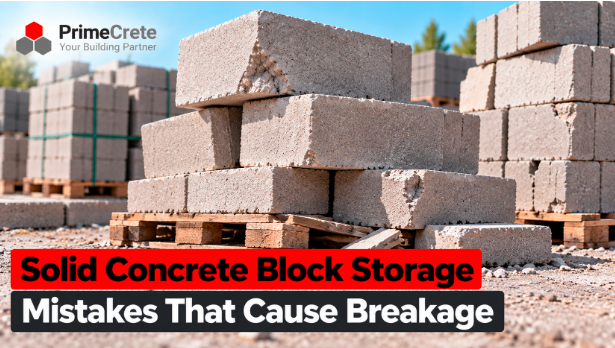
A truck unloads at a 10 marla site in Islamabad on Monday. By Friday, the mason is complaining about chipped corners, one stack has leaned into the boundary wall, and there is a growing pile of halves that nobody ordered. The blocks left the factory whole. Somewhere between the tailgate and the wall, the site broke them.
At PrimeCrete, we manufacture solid concrete blocks for load-bearing walls, boundary walls, foundations and commercial buildings across Pakistan. We see the same storage errors cost contractors money on project after project. This guide explains which storage mistakes cause the most breakage, why they happen, and the simple site rules that prevent them.
The Short Answer
Most solid concrete block breakage on site comes from a handful of avoidable causes: rough unloading, stacking on soft or uneven ground, tall untapered stacks, storage inside vehicle routes, wet and muddy storage areas, and repeated re-handling. Store blocks on firm, level, drained ground, in stable stacks of controlled height, away from traffic and close to the work. Breakage usually drops sharply.
Why Block Breakage Costs More Than It Looks
A broken block costs more than its purchase price. You also pay for the transport that delivered it, the labour that moved it, the mason’s time spent working around chipped units, and sometimes a second delivery to cover the shortfall.
A simple example shows the scale. Assume a boundary wall order of 3,000 blocks and 5% site breakage:
- 3,000 blocks × 0.05 = 150 broken blocks
- Those 150 blocks need reordering, a new delivery and fresh handling
- Work may stop while the wall waits three courses short of completion
The 5% figure is an illustrative assumption, not an industry average. Real breakage depends almost entirely on site handling. Under-ordering and breakage together explain many mid-project shortages, which we cover in why contractors run out of solid concrete blocks.
Damaged blocks also create a quality problem. A cracked unit can still look usable, so labour may lay it anyway. In a load-bearing wall or an exposed boundary wall, that unit becomes a weak point that nobody recorded.
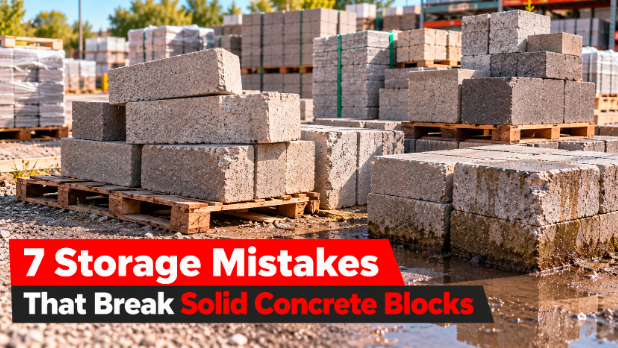
7 Storage Mistakes That Break Solid Concrete Blocks
1. Dumping Blocks Off the Tailgate
Throwing or tipping blocks is the fastest way to break them. Concrete performs well in compression, but a sharp impact on a corner or edge concentrates force on a small area, so arises spall and thin cracks start. A block that falls one metre onto another block often survives with hidden damage that shows up later during cutting or laying.
Unload by hand, passing blocks person to person, or by mechanical means where pallets are supplied. Place them directly onto the prepared storage area rather than onto the ground for re-stacking later.
2. Stacking on Soft, Loose or Uneven Ground
Fresh plot fill, loose soil and sand heaps are poor foundations for a stack weighing several tonnes. The ground settles unevenly, bottom blocks take point loads, and the stack begins to lean. During the monsoon, the same patch can turn to mud overnight.
Build a firm, level base first. Compacted ground with timber pallets, planks or a brick-on-edge platform keeps the bottom course flat and out of standing water.
3. Building Stacks Too High or Without Tapering
Tall, straight-sided stacks topple, and toppled stacks break dozens of blocks at once. US construction safety rules offer a useful benchmark: OSHA’s materials storage requirements (29 CFR 1926.250) require masonry block stacks taller than 6 feet (about 1.8 m) to step back by half a block per tier above that height. Pakistan does not enforce OSHA, but the principle is sound for any site.
Alternate the direction of each tier so blocks interlock, keep stacks within comfortable manual-handling height, and never pull blocks from the bottom of a stack.
4. Storing Blocks Inside Vehicle and Labour Routes
Tractor trolleys, dumpers, mixer trucks and wheelbarrows clip stacks placed near gates and turning areas. The Hong Kong Environmental Protection Department’s site waste guide, based on CIRIA guidance, advises keeping concrete units in their original packaging until use and protecting them from vehicle movements.
Mark a dedicated storage zone with a clear buffer from the gate, the mixer position and the trolley route.
5. Leaving Blocks in Water, Mud or Splash Zones
Rain does not dissolve a well-made block, but poor wet-weather storage still causes damage. Mud stains block faces and weaken mortar bonds. Saturated blocks are heavier and slippery, so labour drops more of them. Concrete masonry also shrinks as it dries, so laying very wet units can add to shrinkage movement in the finished wall.
Raise stacks off the ground, keep drainage away from the storage area, and cover the tops with a tarpaulin during heavy rain while leaving the sides open for airflow.
6. Storing Blocks Far From the Work
Every extra trip is another chance to drop a block. Blocks dumped at the plot entrance and then moved twice by wheelbarrow see far more handling damage than blocks placed near the wall lines once. Plan the drop point before the truck arrives, avoiding zones reserved for excavation, scaffolding or the slab shuttering.
7. Mixing Damaged Blocks Back Into Good Stacks
When chipped and cracked blocks go back into the main stack, masons lay them without noticing. Sort blocks at delivery. Set rejects aside, use minor-chip units for cut pieces where the engineer allows, and record transit damage before signing the delivery note. Our guide on how to store solid concrete blocks correctly on site covers stack layout in more detail.
Site Storage Checklist Before Delivery
- Firm, level, compacted storage area prepared
- Pallets, planks or a raised base ready
- Storage zone marked away from gates and vehicle routes
- Drop point close to the wall lines
- Tarpaulins available for monsoon or dust storms
- Labour briefed: no throwing, no tipping
- Delivery quantity and condition checked before signing
- Separate area for damaged or rejected units
Frequently Asked Questions
How high should solid concrete blocks be stacked on site?
No single height suits every site, because block size, base stability and handling method all matter. Keep stacks stable, cross-tiered and within safe manual reach. As a reference, OSHA requires tapering above 6 feet for masonry blocks.
Should solid concrete blocks be covered during rain?
Covering the top of the stack during heavy rain keeps blocks cleaner and easier to handle. Leave the sides open so trapped moisture can dry out.
Can chipped solid concrete blocks still be used?
Minor surface chips may be acceptable for cut pieces or plastered faces. Cracked blocks should not go into load-bearing walls. The site engineer should decide what counts as acceptable.
Who pays for blocks broken on site?
That depends on the delivery terms. Generally, damage found and recorded at offloading falls under the supply agreement, while damage after acceptance becomes the site’s responsibility. Inspect before you sign.
Conclusion
Most broken blocks are a site-management problem, not a product problem. Prepare a firm, drained base, unload carefully, keep stacks stable and tapered, and keep traffic away. Those few habits protect your budget, your schedule and the quality of the finished wall.
If you are planning a block delivery, PrimeCrete can help you confirm product type, quantities and delivery arrangements for projects across Pakistan.
