
Every builder has heard it from a client: “It’s just a wall. How expensive can it be?” Then the final bill arrives, and suddenly that wall has strong opinions.
The good news is that a solid concrete block wall follows simple maths. At PrimeCrete, we supply blocks to homeowners, contractors and large projects across Pakistan, and we keep seeing one pattern. Projects that stay on budget measure first and buy second.
This guide walks you through the full method. You’ll learn how to count blocks, price mortar, plan labour, and catch the hidden costs that quietly eat budgets.
What Goes Into Solid Concrete Block Wall Construction Costs?
Before you open a calculator, list every cost bucket. Most estimates fail because someone forgot a line item, not because they got the maths wrong.
A complete estimate covers these parts:
- Blocks: number of units × delivered price
- Mortar: cement, sand and water
- Labour: masons and helpers
- Structural extras: footings, columns or bands, if your engineer specifies them
- Transport, handling and wastage
- Finishing: plaster, paint and curing
Miss one, and your “final” figure becomes a first draft.
Step 1: Measure the Net Wall Area
Start with length × height. A boundary wall 100 ft long and 7 ft high gives you 700 sq ft of gross area.
Next, subtract the openings. Gates, doors and windows need no blocks, and paying for blocks you’ll never lay is an expensive hobby.
Say the wall has a 10 × 7 ft gate. That opening takes out 70 sq ft.
Net wall area = 700 − 70 = 630 sq ft
This net figure drives every calculation that follows, so measure twice.
Step 2: Count Your Solid Concrete Blocks
Most solid concrete blocks in Pakistan come in a 16 × 8 inch face size. That face covers 128 square inches, or about 0.89 sq ft.
So you need roughly 1.125 blocks per sq ft of wall. PrimeCrete’s own quantity guide uses the same figure. It runs slightly conservative because it ignores mortar joints, which works in your favour when ordering.
For our example:
630 × 1.125 = 709 blocks
Add a Wastage Allowance
Blocks chip in transit. Masons cut them at corners and jambs. Sometimes one simply slips off the scaffold and meets gravity.
An 8–10% allowance suits normal work. At 10%, our order becomes about 780 blocks. Walls with many corners, short sections or odd angles need a bigger buffer.
Does Block Thickness Change the Count?
No. A 4-inch, 6-inch and 8-inch block share the same 16 × 8 face, so they cover the same area. Thickness changes weight, strength and price, not quantity.
Your engineer should choose the thickness. If you’re still deciding on block type, our comparison of solid concrete blocks vs hollow blocks explains where each one fits.
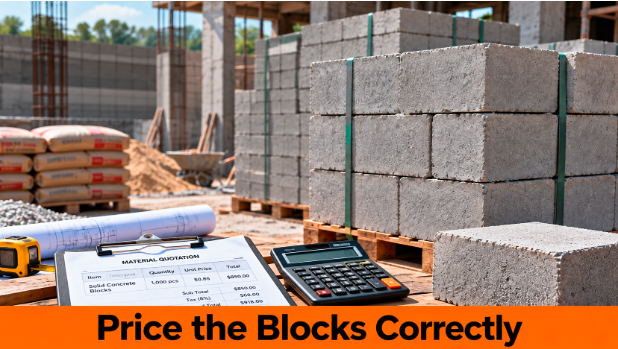
Step 3: Price the Blocks Correctly
Block prices shift with size, strength, order volume and distance from the factory. That’s why a rate you saw online last month tells you very little about your site today.
Ask every supplier three questions:
- Is the rate ex-factory or delivered to site?
- Does it include loading and offloading?
- What compressive strength does the block meet, and can you share test results?
The third question matters more than people think. A cheap block that fails a strength test costs you twice. The international ASTM C90 standard covers loadbearing concrete masonry units, including solid units, and gives you a useful benchmark to discuss with suppliers.
For a practical checklist, read our guide on solid concrete block specifications to check before buying.
Then run the simple formula:
Block cost = total blocks × delivered rate per block
Always get the rate in writing.
Step 4: Estimate Mortar and Cement
Cement is the price you should watch most closely. According to the Pakistan Bureau of Statistics, the average 50 kg cement bag cost about Rs 1,550 in the week ending 24 September 2026. That’s roughly 10% higher than a year earlier.
Masonry work in Pakistan commonly uses a cement-to-sand ratio between 1:4 and 1:6. Your engineer should set the final mix, especially for load-bearing or exposed walls.
PrimeCrete’s mortar guide puts consumption at about one 50 kg bag per 100 standard 8-inch hollow blocks with a 1:4 mix. Solid blocks have no cores, so masons lay a full mortar bed. Treat that figure as your minimum and add some margin.
For 780 blocks, that means at least 8 bags. At Rs 1,550 each, cement alone starts at around Rs 12,400. Add sand at your local rate.
Step 5: Budget for Labour
Labour rates vary widely by city, season and the mason’s skill. Some teams quote per sq ft, some per block, and others per day.
Get at least two quotes and compare them on the same basis. A per-day quote looks cheaper until the wall takes twice as many days.
Block quality affects labour too. Uniform, machine-made blocks sit level with less corrective mortar, so masons work faster and waste less.
Step 6: Don’t Forget the Hidden Costs
These items rarely appear in the first quote, yet they show up in every final bill.
Foundation and Structural Elements
Tall boundary walls and load-bearing walls often need footings, columns or tie bands. Your structural drawings decide this, not guesswork.
Transport and Handling
Concrete blocks are heavy. Delivery costs rise with distance, and sites with narrow access may need extra handling.
Curing and Finishing
Fresh masonry needs regular curing. After that, plaster and paint add their own material and labour costs.
A Simple Estimate Sheet You Can Copy
| Item | Quantity (example) | How to price it |
| Solid concrete blocks | 780 | × supplier’s delivered rate |
| Cement | 8+ bags | × current bag price |
| Sand | As per mortar ratio | × local quote |
| Labour | 630 sq ft | × mason’s quoted rate |
| Transport | Per trip | × supplier quote |
| Contingency | Small buffer | For price moves and surprises |
Fill in real quotes, and you’ll have a number you can actually defend.
When Hollow Blocks Make More Sense
Solid concrete blocks suit load-bearing walls, foundations, basements, and boundary or security walls. Their density gives them the edge where strength matters most.
Interior partitions are a different story. Hollow concrete blocks weigh less and can lower costs for non-structural walls. If you need help matching units to wall function, see our range of load-bearing and non-load-bearing blocks.
Final Thoughts
Estimating solid concrete block wall construction costs isn’t magic. Measure the net area, count blocks at 1.125 per sq ft, add wastage, then price materials and labour from real quotes.
Do that, and “it’s just a wall” stays just a wall.
Need accurate rates for your project? Contact PrimeCrete for a delivered quote on blocks built to consistent size and tested strength.
