
A homeowner planning a 10-marla driveway may receive quotations for paver blocks, interlocking tiles, and decorative concrete flooring from different suppliers. Although these products can look similar, their installation methods and suitability for vehicle loads may differ. Understanding the distinction is important before selecting materials. For driveways, parking facilities, and other paved areas, PrimeCrete interlocking paver blocks offer a concrete paving option that buyers can evaluate against project requirements.
PrimeCrete manufactures concrete paving and masonry products through Pak Dream (Pvt) Ltd at Hattar Industrial Estate. Its paving solutions serve residential, commercial, and infrastructure applications across Pakistan. This article explains the differences between paver blocks and interlocking tiles, relevant paving standards, thickness selection, construction layers, material quantities, and the practical considerations that affect long-term pavement performance.
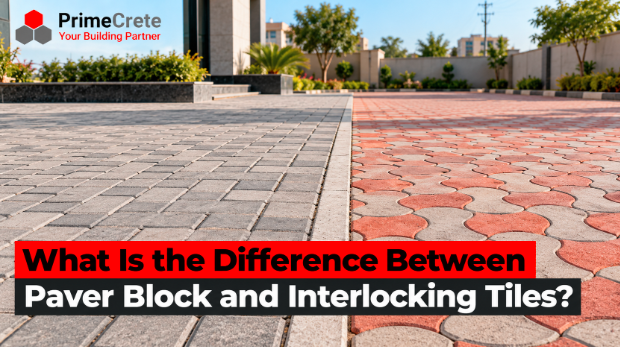
What Is the Difference Between Paver Blocks and Interlocking Tiles?
Paver blocks are precast concrete paving units designed to create outdoor paved surfaces. Interlocking tiles is a broader market term in Pakistan that may refer to interlocking concrete pavers, decorative concrete tiles, or other paving products.
When a supplier uses both terms for the same concrete unit, there may be no technical difference.
The important distinctions are the product’s geometry, thickness, compressive strength, installation system, and intended traffic loading.
What Are Concrete Paver Blocks?
Concrete paver blocks are individual precast units that form a pavement surface.
Manufacturers produce them using cementitious materials, aggregates, water, and optional pigments or admixtures.
A typical flexible interlocking concrete pavement transfers traffic loads through pavers, sand-filled joints, bedding material, and compacted supporting layers.
Common Paver Shapes
Paver blocks are available in several profiles, including rectangular, zigzag, I-shaped, and other interlocking configurations.
The shape can influence laying pattern and the pavement’s resistance to horizontal movement.
For vehicular surfaces, the interaction between unit geometry, joint friction, laying pattern, and edge restraint is particularly important.
What Are Interlocking Tiles?
In Pakistan, contractors commonly use the term interlocking tiles for precast concrete paving units used on driveways, pathways, courtyards, and parking areas.
However, some products marketed as interlocking tiles are decorative units intended primarily for pedestrian areas.
A product name alone cannot establish whether it is suitable for vehicular traffic.
Can Interlocking Tiles Carry Cars?
Yes, when the units are designed for that application and the complete pavement system provides suitable support.
For vehicle areas, buyers should verify product thickness, strength, bedding, compacted base, drainage, and edge restraints.
Thin decorative tiles intended for bonded installation may not perform like thicker concrete block paving.
Paver Blocks vs Interlocking Tiles: Comparison
| Feature | Concrete paver blocks | Products sold as interlocking tiles |
| Definition | Precast paving units | Broad commercial term |
| Materials | Commonly concrete | Concrete or other paving materials |
| Shapes | Rectangular and shaped profiles | Varies |
| Thickness | Selected for application | Varies considerably |
| Installation | Often sand-set | Sand-set or bonded, depending on product |
| Vehicle suitability | Possible with proper design | Must verify specific product |
| Maintenance | Individual units may be replaceable | Depends on installation |
| Applicable standards | ASTM C936 where specified | Depends on product category |
The distinction is therefore technical rather than purely linguistic.
Which Is Better for a Driveway in Pakistan?
For typical residential driveways, properly specified interlocking concrete paver blocks can provide a practical, repairable paving surface.
Their performance depends on the subgrade, base thickness, paver quality, laying pattern, edge restraint, and drainage.
What Thickness Should Driveway Pavers Have?
Common preliminary selection ranges include:
| Application | Common thickness consideration |
| Pedestrian pathways | Approximately 60 mm |
| Residential car driveways | Often 60–80 mm |
| Regular commercial vehicle traffic | Often 80 mm or greater |
| Heavy industrial traffic | Engineered thickness and pavement structure |
These are common industry selection ranges, not universal engineering requirements.
Some designs or standards may specify different minimums. Heavy traffic requires assessment of axle loads, traffic frequency, ground conditions, and structural support.
Why Laying Pattern Matters
The herringbone pattern is frequently preferred for vehicular concrete block pavements because it provides resistance to horizontal forces from braking, acceleration, and turning.
Other patterns can be suitable when the designer considers the particular loading conditions.
PrimeCrete’s article on the best paver block patterns for car parking explores this decision in greater detail.
What Standards Apply to Interlocking Concrete Pavers?
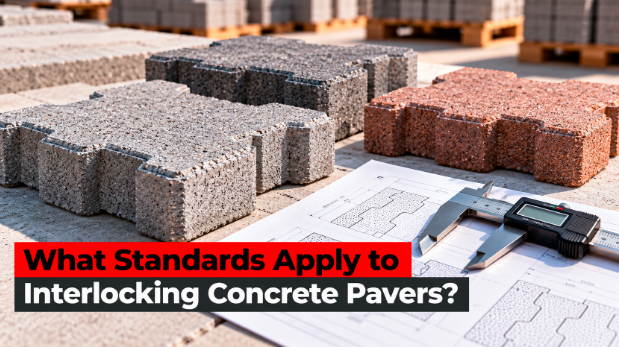
ASTM C936/C936M covers solid concrete interlocking paving units manufactured for paved surfaces.
The ASTM C936/C936M paving-unit specification addresses product characteristics and requirements associated with interlocking concrete paving units.
A commonly cited benchmark in established ASTM C936 specifications is:
- Average compressive strength: At least 55 MPa (8,000 PSI)
- Average water absorption: No greater than 5%
- Individual compressive strength: At least 50 MPa in editions specifying that threshold
Because standard requirements can change between editions, buyers should confirm the precise criteria in the edition adopted by their project rather than assume every specification uses identical limits.
The ASTM C140/C140M testing methods cover sampling and measurements used to evaluate concrete paving units, including strength and absorption.
Does ASTM Compliance Guarantee a Good Pavement?
No. Product compliance addresses properties of the manufactured units.
It does not establish that the site has suitable subgrade preparation, structural base thickness, drainage, or installation quality.
The complete pavement must perform as a system.
How Should Interlocking Paver Blocks Be Installed?
A typical flexible concrete block pavement consists of several engineered layers.
Illustrative pavement cross-section — not to scale
Concrete Paver Blocks
Surface / Wearing Layer
Bedding Sand
Uniform Screeded Layer
Compacted Aggregate Base
Thickness Determined By Design
Prepared Subgrade
Compacted Supporting Soil
Step 1: Prepare the Subgrade
Remove unsuitable material and establish the required formation level.
The contractor should identify soft locations, provide proper drainage, and achieve the specified compaction.
A weak subgrade can cause pavement deformation even when the pavers themselves are strong.
Step 2: Construct the Compacted Base
Use suitable graded aggregate in layers that can be effectively compacted.
The designer should determine the base thickness and compaction requirements based on expected traffic and soil conditions.
Step 3: Install Bedding Sand
Place suitable bedding sand at the specified thickness.
Avoid using an excessively thick sand layer to correct major irregularities in the compacted base.
Step 4: Lay the Pavers
Install the approved pattern with consistent joints.
Maintain alignment and avoid damaging the units during installation.
Step 5: Install Edge Restraints
Edge restraints prevent sideways movement and help maintain interlock.
Kerbs, concrete edge beams, or other suitable restraint systems may serve this purpose.
Step 6: Compact and Fill Joints
Use appropriate compaction equipment and jointing sand for the installed paver system.
Follow the manufacturer’s installation guidance to avoid chipping or surface damage.
How Many Paver Blocks Are Required Per Square Metre?
The required quantity depends on the dimensions of the paving unit.
Suppose a rectangular paver has a plan size of 200 × 100 mm.
Area per unit:
0.20.1=0.02m2
Theoretical units per square metre:
10.02=50
For a driveway measuring 60 m²:
6050=3,000pavers
Allowing an illustrative 5% for cutting and waste:
3,0001.05=3,150
The actual quantity will depend on manufacturing dimensions, joint widths, edge cuts, and the selected laying pattern.
What Affects Interlocking Paver Prices in Pakistan?
The total project cost includes more than the unit price.
Important factors include block thickness, concrete quality, colour, shape, order volume, site location, transport distance, base preparation, drainage, and installation labour.
Compare Complete Installation Costs
When reviewing supplier quotations, ask whether the price includes excavation, subgrade compaction, aggregate base, bedding sand, paver installation, edge restraints, joint sand, and final compaction.
A low per-square-foot quotation may exclude essential ground preparation.
Consider Long-Term Maintenance
A major advantage of individual concrete pavers is the possibility of lifting and replacing damaged units.
In appropriate installations, contractors can also access underground utilities and reinstate the paved surface.
This makes concrete block paving attractive for sites where future maintenance access matters.
For long-term performance considerations, review PrimeCrete’s guide to how long interlocking paver blocks last.
Common Interlocking Paving Mistakes
Installing Pavers on Uncompacted Soil
Poor compaction often leads to uneven settlement and rutting.
Selecting Units by Colour Alone
Colour and surface appearance do not establish compressive strength or durability.
Omitting Edge Restraints
The pavement may spread sideways under repeated vehicle movements.
Ignoring Surface Drainage
Standing water can contribute to deterioration of the bedding and supporting layers.
Using Thin Decorative Tiles for Vehicle Areas
Products intended for pedestrian use should not automatically be substituted for traffic-bearing pavers.
Frequently Asked Questions
Are Paver Blocks and Interlocking Tiles the Same?
They can refer to the same product in the Pakistani market, but the terminology is not standardized. Always check the actual unit specifications.
Are 60 mm Pavers Suitable for Cars?
They can be suitable for some light-duty applications when permitted by the design. Higher loads, turning movements, or weak soil may require thicker units or a more substantial pavement structure.
Which Paver Pattern Is Best for Parking?
Herringbone is commonly preferred for vehicular traffic because of its resistance to horizontal movement.
Can Paver Blocks Be Installed Without Concrete?
Yes. Many interlocking concrete pavements use compacted aggregate and bedding sand rather than a full concrete slab. Other installations may require engineered rigid bases.
Conclusion
The main difference between paver blocks and interlocking tiles is often the terminology used by sellers rather than a completely different material.
For dependable construction, buyers should compare verified specifications, product thickness, installation systems, traffic requirements, and total project costs.
PrimeCrete’s concrete paver range provides options for Pakistani driveways, pathways, parking facilities, and commercial paving projects, subject to appropriate design and installation.
