
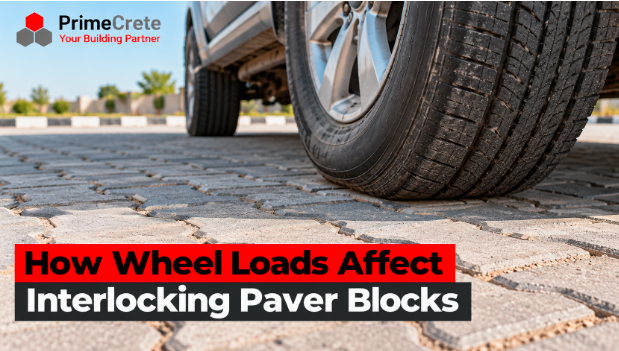
A driveway may look perfectly level when contractors finish installation, yet develop cracks, depressions, or uneven joints after months of vehicle movement. These problems often appear near gates, parking bays, turning areas, and locations where delivery trucks regularly stop. For Pakistani residential and commercial developments, selecting suitable PrimeCrete interlocking paver blocks is only one part of designing a durable traffic-bearing surface.
PrimeCrete, a concrete-products brand of Pak Dream (Pvt) Ltd, manufactures paving and masonry units at Hattar Industrial Estate. Its concrete paving products serve applications ranging from residential driveways to commercial paving. This guide explains how wheel loads affect interlocking paver blocks, why axle loads and tyre pressure matter, and how paver thickness, compaction, interlock, and drainage determine pavement performance.
How Do Wheel Loads Affect Interlocking Paver Blocks?
Wheel loads create localized contact pressure and repeated stresses within an interlocking concrete pavement. Properly designed pavers transfer these loads through adjacent units, bedding sand, compacted base layers, and the supporting subgrade.
A pavement can fail even when individual pavers have high compressive strength if the supporting layers cannot withstand repeated traffic.
Understanding Wheel Load and Axle Load
Wheel load is the force transferred from a vehicle to the pavement through an individual wheel or wheel assembly.
Axle load is the total force carried by the wheels connected to a particular axle.
For example, suppose a vehicle axle supports a mass equivalent to 2,000 kg and distributes its load equally between two wheel positions.
The approximate static load at each wheel position is:
20002=1000kg
The approximate vertical force is:
10009.81=9,810N
Therefore, each wheel position applies about 9.81 kN under the simplified static assumptions.
Real vehicle loading varies with axle configuration, suspension, braking, acceleration, turning, uneven surfaces, and dynamic effects.
What Happens When a Vehicle Drives Over Concrete Pavers?
An interlocking concrete pavement behaves as a system of individual units connected through their arrangement, joint friction, and lateral restraint.
When a wheel moves across the surface, contact stresses pass through the pavers and bedding into the supporting layers.
Load Distribution Through Adjacent Blocks
Sand-filled joints allow neighbouring blocks to interact and transfer a portion of the imposed load.
The degree of load sharing depends on paver geometry, thickness, joint filling, laying pattern, and restraint.
If joints widen or lose sand, the pavement can lose some of this load-sharing effectiveness.
Vertical Movement Under Wheels
A properly supported pavement experiences limited movement under normal design loading.
However, weak subgrade or poorly compacted base material may deform under repeated loading.
That deformation can appear at the surface as rutting or local depressions.
Horizontal Forces During Turning
Tyres create horizontal forces when vehicles brake, accelerate, or turn.
These forces can cause individual units to rotate, shift, or open joints if interlock and edge restraint are inadequate.
This is why entrances, corners, and manoeuvring areas often require particular attention.
How Does Tyre Pressure Affect Paver Performance?
Tyre pressure influences the contact area between the tyre and pavement.
A vehicle carrying the same wheel load can create different contact conditions depending on tyre inflation pressure and tyre construction.
A simplified contact relationship is:
Averagecontactpressure=WheelforceContactarea
Suppose a wheel applies 10 kN over an assumed contact area of 0.02 m².
10,0000.02=500,000Pa
This equals:
500kPa=0.5MPa
The calculation represents an approximate average pressure.
Actual tyre contact stresses are nonuniform, and contact pressure should not be equated directly with paver compressive strength.
Why High Tyre Pressure Matters
High contact pressures can contribute to concentrated stresses within the pavement structure.
Forklifts, heavily loaded trailers, and specialized industrial vehicles may create more demanding contact conditions than passenger cars.
For these applications, engineers must consider tyre type, wheel loads, contact areas, traffic repetitions, and local operating conditions.
Does Paver Block Thickness Affect Wheel-Load Resistance?
Yes. Paver thickness influences load distribution, rotational stability, and resistance to movement under traffic. However, thickness alone cannot compensate for a weak subgrade or poorly constructed base.
Common Paver Thickness Selections
| Application | Preliminary thickness range |
| Residential pedestrian areas | Around 60 mm |
| Light-duty domestic driveways | Often 60–80 mm |
| Commercial vehicle areas | Often 80 mm or more |
| Heavy industrial yards | Engineered selection based on loading |
These figures are general selection guidance and must not replace pavement design.
For example, a heavily loaded delivery truck using a narrow entrance repeatedly may create greater pavement demands than a passenger car parked on the same surface.
Why Thicker Pavers Can Be Beneficial
Thicker units may provide greater resistance to tilting and improved load-transfer characteristics in suitable interlocking pavement systems.
They also provide greater structural depth within the paving layer.
However, increasing thickness does not remove the requirement for appropriate foundation support.
How Important Is Paver Compressive Strength?
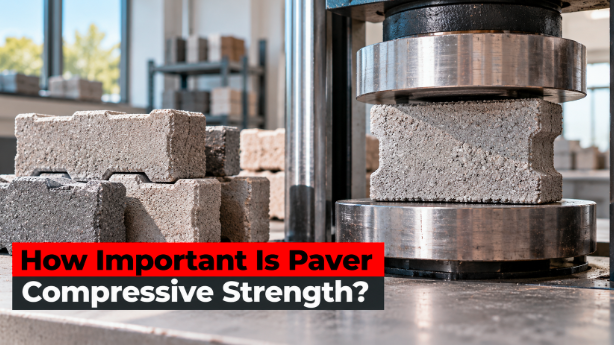
Compressive strength indicates a concrete paver’s ability to withstand compressive stress during standardized testing.
It is an important indicator of unit quality, but it is not a complete measure of pavement bearing capacity.
Relevant ASTM Standards
ASTM C936/C936M covers solid concrete interlocking paving units used in paved surfaces.
Established editions of ASTM C936 commonly specify an average minimum compressive strength of 55 MPa (8,000 PSI) and average water absorption no greater than 5%, subject to the adopted edition’s full requirements.
The ASTM C140/C140M testing methods provide procedures for evaluating paving-unit characteristics.
Why High-Strength Pavers Can Still Fail
A paver might satisfy the specified compressive-strength requirement while the pavement develops significant deformation.
Possible causes include poor drainage, inadequate base compaction, weak supporting soil, loss of joint sand, or lack of edge restraint.
Strength testing must therefore be combined with proper pavement design and construction inspection.
Why Sub-Base Preparation Matters Under Heavy Wheel Loads
The sub-base is an engineered supporting layer located below the base where the pavement design requires one. It improves support and helps distribute traffic loads to the subgrade.
Not every pavement contains a separate sub-base; the layer arrangement depends on the design.
Subgrade Strength
Subgrade refers to the prepared soil supporting the pavement structure.
Its load-bearing ability depends on soil composition, density, and moisture.
Weak subgrade conditions may require stabilization, replacement, reinforcement, or greater aggregate thickness.
Aggregate Base Compaction
A compacted aggregate base distributes loads and supports the bedding and paving units.
Compaction requirements should be specified using suitable field density or other project-approved testing methods.
For example, a specification might require a percentage of maximum dry density determined by a designated laboratory compaction test.
The correct acceptance target depends on the material, test method, and engineer’s pavement design.
Why Monsoon Rainfall Matters in Pakistan
Poor drainage can allow water to accumulate beneath the pavement.
Moisture may soften certain soils, wash away fine materials, and reduce supporting-layer performance.
Proper surface gradients, drainage outlets, suitable aggregate grading, and water management help protect the pavement during Pakistan’s monsoon season.
How Does Vehicle Turning Affect Interlocking Pavers?
Turning vehicles impose both vertical and horizontal forces.
In many traffic-bearing pavements, these horizontal forces can contribute to unit displacement, joint opening, and surface deformation.
Herringbone Laying Patterns
A 45-degree or 90-degree herringbone pattern is commonly recommended for rectangular paving units in vehicular applications.
Its arrangement helps resist movement under braking and turning forces.
Other patterns may be acceptable where engineers assess the expected loading.
For more detail, review PrimeCrete’s guide to the best paver block patterns for car parking.
Edge Restraints
Edge restraints help maintain lateral confinement.
Common options include concrete kerbs, edge beams, and properly anchored restraint systems.
Without effective edge restraint, repeated wheel movement may push blocks outward.
The problem often becomes visible near unrestrained driveways, drainage channels, and pavement edges.
Why Do Paver Blocks Crack Under Cars?
Cracking can result from several interacting causes.
A weak or uneven base can leave individual pavers insufficiently supported.
Concentrated loads may then produce bending or local stress concentrations within the units.
Manufacturing defects, unsuitable thickness, impact loading, and damaged blocks may also contribute.
How to Diagnose a Cracked Paver
A contractor should examine whether cracking occurs in isolated units or throughout a larger area.
If numerous blocks crack along a traffic path, investigate the pavement structure and loading conditions.
If pavers remain intact but the pavement develops wheel-track depressions, subgrade or base deformation may be the more significant concern.
For related fault diagnosis, read PrimeCrete’s article on whether interlocking paver blocks can crack under cars.
How Should Engineers Design Pavers for Heavy Vehicles?
The engineer should start with the expected traffic rather than the desired paving pattern.
Step 1: Identify Vehicle Categories
Separate passenger cars, delivery vans, buses, trucks, and specialized equipment.
Vehicle weight alone is insufficient; axle configuration and wheel loading also matter.
Step 2: Determine Traffic Frequency
Repeated loading can gradually accumulate pavement damage.
A surface used by one occasional service vehicle may require a different design from a busy loading yard receiving dozens of trucks every day.
Step 3: Assess Subgrade Conditions
Obtain the relevant soil information.
The project may require California Bearing Ratio (CBR) testing, plate-load testing, or other geotechnical investigations, depending on the adopted design method.
Step 4: Select Pavement Layers
Determine paver thickness, bedding, aggregate base, any sub-base, and drainage provisions.
Step 5: Confirm Installation Quality
Inspect compaction, finished levels, edge restraints, joint filling, and material acceptance before opening the pavement to traffic.
How Can Contractors Prevent Wheel-Load Damage?
Effective prevention starts before paver installation.
A practical construction plan should include the following measures:
- Verify paver strength, dimensions, and intended application.
- Compact the subgrade and supporting aggregate layers according to the design.
- Maintain proper bedding-sand thickness and evenness.
- Use a suitable laying pattern for vehicular traffic.
- Install continuous and effective edge restraints.
- Fill joints with approved jointing material.
- Provide surface and subsurface drainage where required.
- Protect completed paving from construction traffic beyond its design capacity.
Routine inspections should identify joint-sand loss, settlement, edge movement, and localized damage before they become extensive.
Frequently Asked Questions
Can 60 mm Interlocking Pavers Carry Cars?
Yes, in some appropriately designed light-duty driveways. However, vehicle loading, traffic frequency, subgrade strength, and project specifications determine whether 60 mm is suitable.
Are 80 mm Pavers Better for Heavy Vehicles?
An 80 mm unit may be preferable for certain heavier traffic applications, but heavy industrial pavements often require project-specific design beyond a simple thickness selection.
Can High-Compressive-Strength Pavers Prevent Rutting?
Not by themselves. Rutting commonly reflects deformation within the bedding, base, sub-base, or subgrade layers.
Which Paver Pattern Works Best Under Turning Wheels?
Herringbone is commonly preferred for rectangular pavers subjected to vehicle turning and braking forces.
Why Do Driveway Pavers Sink After Rain?
Possible causes include poorly compacted fill, water-induced soil softening, erosion of bedding material, inadequate drainage, or localized foundation failure.
Conclusion: Design the Pavement for the Wheels It Must Carry
Wheel loads affect interlocking paver blocks through repeated vertical pressure, localized stresses, and horizontal forces during braking, accelerating, and turning.
Long-term pavement performance depends on the interaction between paver strength, unit thickness, laying pattern, jointing, compacted supporting layers, and drainage.
For residential driveways, commercial parking facilities, housing-society roads, and industrial applications in Pakistan, PrimeCrete offers interlocking concrete paving products that can form part of a properly specified pavement system.
Selecting units according to verified specifications and actual traffic requirements helps contractors avoid preventable settlement, movement, and premature pavement repairs.
