
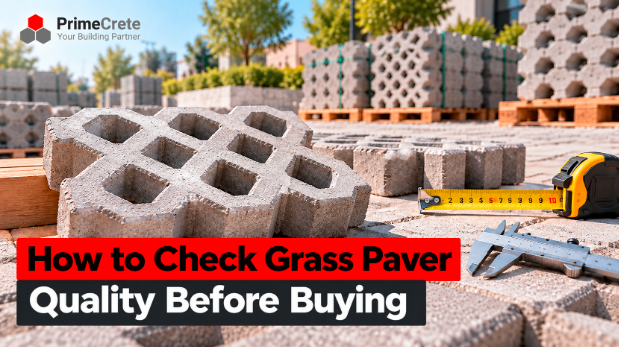
Grass pavers have an unusual problem: half of every unit is empty space. The thin concrete ribs between the openings carry every car, every rickshaw and every monsoon downpour. When a buyer chooses a weak or badly made grass paver, those ribs are the first thing to crack, and the green parking area turns into broken concrete and mud.
At PrimeCrete, we manufacture concrete grass pavers at Hattar Industrial Estate for driveways, parking areas and landscaping across Pakistan. This guide explains how to check grass paver quality before you buy: what quality actually means for these units, which documents to request, simple checks you can do on a sample, and the buying mistakes that cost the most later.
The Short Answer
To check grass paver quality, confirm the intended traffic, ask for compressive-strength and water-absorption test reports, and inspect sample units for consistent dimensions, full-thickness ribs, sharp intact edges, a dense surface and no cracks. Check that the open area suits grass growth and that the supplier can deliver consistent batches. Good units still need a well-compacted base to perform.
What Quality Means for a Concrete Grass Paver
A grass paver (also called a concrete grid paver) is a precast concrete unit with regular openings that are filled with soil and grass or with aggregate. The Concrete Masonry & Hardscapes Association describes concrete grids as slab-like units with up to 75% open area, placed on a compacted aggregate base and suitable for limited vehicular traffic. That open area is the whole point, and also the main quality challenge.
Compressive Strength
Strength matters more in grass pavers than in solid pavers, because the load travels through thin ribs rather than a full block. Strength depends on mix design, compaction during manufacture and curing. ASTM C1319, the specification for concrete grid paving units, covers units for vehicular areas, parking and soil stabilisation, and sets physical requirements that suppliers can test against. Ask which standard the supplier’s test reports follow.
Water Absorption and Durability
Water absorption gives an indirect picture of how dense and well-compacted the concrete is. Grass pavers stay in contact with damp soil, irrigation water and monsoon rain, so a porous unit will weather faster, grow algae more readily and lose surface material sooner.
Rib Thickness and Dimensional Consistency
Check that ribs are full, even and the same thickness throughout the unit. Thin, honeycombed or uneven ribs are weak points. Consistent length, width and thickness across units also matter: uneven units create a rocking, uneven surface that concentrates wheel loads on individual ribs.
Edges, Corners and Surface Finish
Sharp, intact edges and a dense, closed surface usually point to good compaction. Crumbly edges, visible voids, powdery surfaces and loose aggregate on the face often point to a weak mix, poor compaction or inadequate curing.
Open Area and Cell Shape
The openings must hold enough soil for grass roots to establish and survive Pakistani summer heat. Very small cells dry out quickly; very large cells reduce the concrete available to carry wheels. The right balance depends on whether you want a mostly green surface or a mostly hard one.
Documents to Request Before You Buy
A supplier’s brochure tells you what the product is meant to do. Test documents tell you what it actually did in a lab. Before placing a sizeable order, ask for:
- Compressive-strength test results for the specific product and thickness you are buying
- Water-absorption test results
- The standard the tests follow, and whether testing was done in-house or by an independent laboratory
- Product dimensions and tolerances, including thickness and rib width
- Recommended applications, such as pedestrian, car parking or occasional heavier vehicles
- Batch or production date information, so you know the units have had time to cure
Test reports should be recent and should match the product on your quotation. A report for a different thickness or a different product line proves very little about yours.
Simple Checks You Can Do on Sample Units
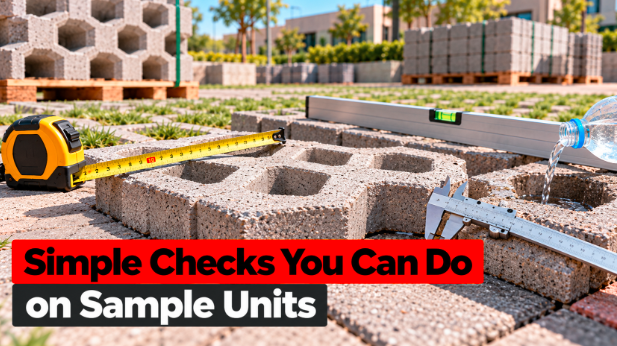
Test reports come first, but a few hands-on checks on samples can catch obvious problems before delivery:
| Check | How to do it | What a problem looks like |
| Dimensions | Measure length, width and thickness of several units | Noticeable variation between units |
| Ribs | Look along each rib from the side | Thin, uneven or honeycombed ribs |
| Edges and corners | Run a hand along edges | Crumbling, flaking or missing corners |
| Surface | Scratch lightly with a key or coin | Powder or loose grains come away easily |
| Cracks | Inspect top, bottom and inside cells | Hairline cracks through ribs |
| Sound | Tap two units together gently | A dull sound compared with other samples |
| Consistency | Compare units from different pallets | Different colours, textures or sizes |
These field checks screen for poor quality; they do not replace laboratory strength testing. Treat them as a filter, not a certificate.
Buying Checklist for Grass Pavers
- Define the traffic: pedestrians, cars, or occasional heavier vehicles
- Confirm unit thickness suits that traffic
- Obtain compressive-strength and water-absorption test reports
- Confirm the standard used for testing
- Inspect sample units for ribs, edges, surface and cracks
- Compare samples from more than one pallet
- Confirm quantity, including cut units at edges and allowance for breakage
- Plan the sub-base, edge restraint and fill material before delivery
For a wider view of options, sizes and applications, read our grass pavers in Pakistan buying guide.
Common Mistakes to Avoid
- Buying on price per square foot alone. Cheap units with thin ribs often crack within a season of car traffic.
- Accepting a brochure as proof of strength. Ask for test reports that match the actual product.
- Checking only the top unit on a pallet. Inspect units from the middle and bottom too.
- Ignoring the base. Even strong grass pavers crack and sink on loose soil. Our guide on whether grass pavers get muddy explains how the base and fill keep the surface stable.
- Choosing very small cells for a green look. Grass struggles in small, shallow cells during hot Pakistani summers.
Frequently Asked Questions
Are grass pavers strong enough for cars?
Well-made concrete grass pavers on a properly compacted base can carry cars. Suitability depends on unit thickness, rib design, strength and the base. For frequent heavy vehicles, ask for engineering advice.
How can I tell if a grass paver is under-cured?
Under-cured units often have powdery surfaces, crumbly edges and a dull sound when tapped. A recent production date and strength test results give a far more reliable answer.
Should grass paver cells be filled with soil or gravel?
Both work. Soil and grass give a green surface but need watering and maintenance; gravel drains well and needs less care. The choice also affects how much load the surface can carry and how it handles monsoon runoff.
Do grass pavers need edge restraint?
Yes. Without kerbs or a concrete edge, units at the boundary shift outward under wheels, which opens joints and weakens the whole surface.
Conclusion
Checking grass paver quality comes down to evidence and inspection: matching test reports, sound ribs, intact edges, consistent dimensions and a dense surface. Choose units for the traffic they will actually carry, and remember that the base matters as much as the paver.
Planning a green driveway, parking area or landscaped space? Explore PrimeCrete’s concrete grass pavers for driveways and parking and ask our team for product details, samples and supply planning for your project.
