
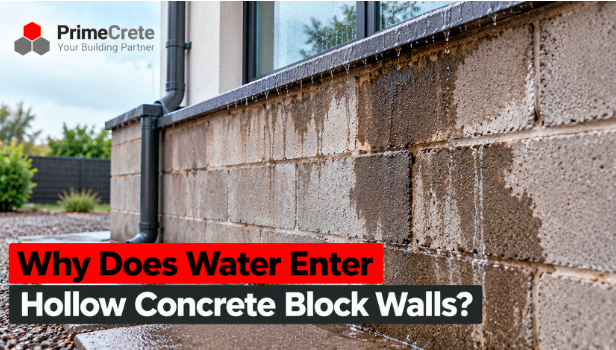
The first heavy monsoon spell arrives, and a few days later a damp patch appears on the inside of a new wall. The paint bubbles, the plaster darkens near the floor, and someone on site declares that hollow blocks “soak up water.” The real story is usually more specific than that, and far easier to fix once you know where the water got in.
At PrimeCrete, we manufacture hollow concrete blocks for residential, commercial and boundary-wall construction in Pakistan. This article explains the main routes water takes into hollow block walls, why the hollow cores change how leaks behave, and what builders and homeowners can do to keep walls dry.
The Short Answer
Water rarely enters a hollow concrete block wall through sound block alone. It usually gets in through poorly filled mortar joints, cracks, uncapped wall tops, missing damp-proofing at the base, and badly detailed openings. Once inside, the hollow cores let water collect and travel, so the damp patch often appears far from the real entry point. Good detailing, workmanship and plaster stop most leaks.
What Makes Hollow Block Walls Behave Differently?
A hollow concrete block is a precast concrete masonry unit with one or more internal voids, or cores, separated by thin face shells and webs. The cores reduce weight and material use, but they also create open channels inside the wall.
In a solid wall, water that gets past the outer face spreads slowly through the material. In a hollow block wall, water can pass through a joint or crack, drop into a core, run down, and pool near the base. That is why moisture often shows up at skirting level or below a window, even when the actual entry point sits higher up.
Concrete is also slightly porous by nature. The Concrete Masonry & Hardscapes Association’s TEK 19-02B explains that a dry single-wythe masonry wall depends on design and construction that manage how water moves into, through and out of the wall. In other words, the block is one part of the defence, not the whole of it.
6 Common Ways Water Enters Hollow Concrete Block Walls
1. Poorly Filled or Untooled Mortar Joints
Mortar joints are the most common entry route. Head joints (the vertical joints) are often left half-empty when masons “butter” only the edges or rush the work. Gaps at the joint let wind-driven rain pass straight into the cores.
Mortar also tends to absorb water more readily than a well-compacted block. Fully filled joints, tooled to a compact concave finish, shed water far better than raked or flush-cut joints.
2. Cracks in Blocks, Joints or Plaster
Cracks give water a direct path inside. In hollow block walls, cracks commonly come from:
- Shrinkage as blocks and mortar dry
- Thermal movement between hot Pakistani summers and cooler nights
- Settlement of poorly compacted foundations
- Missing movement joints in long boundary walls
- Electrical chasing cut carelessly into face shells
Even hairline plaster cracks can draw water in during long monsoon spells.
3. Uncapped Wall Tops and Parapets
An open-topped hollow block wall works like a funnel. Rain falls directly into the cores and saturates the wall from inside. This is a frequent problem on boundary walls and roof parapets in Pakistani housing societies, where a proper coping is often treated as optional.
Cap every exposed wall top with a sloped coping, ideally projecting beyond the face with a drip groove so water drops clear of the wall.
4. Rising Damp at the Base
Without a damp-proof course (DPC) above ground level, groundwater and splashback can wick into the lowest courses. Hollow cores can then hold that moisture. Walls on low-lying plots, beside lawns or next to blocked drains suffer most.
Walls close to or below ground need extra care, which we discuss in whether hollow concrete blocks are safe near foundations and in our guide on using hollow concrete blocks below ground.
5. Badly Detailed Windows, Doors and Sills
Water runs down glass and frames and collects at the sill. If the sill lacks a slope, a drip groove or a sealed joint with the frame, water runs straight into the block below. Gaps between frames and masonry are another frequent leak point.
6. Unplastered or Poorly Plastered External Faces
Plaster acts as a weather barrier on most Pakistani walls. Research summarised by the Portland Cement Association on stucco over concrete masonry found that an uncoated test wall failed early under simulated wind-driven rain, while walls with Portland cement plaster resisted penetration at much higher wind speeds. Plaster only works when it is continuous, well cured and free of cracks.
How to Find Where the Water Is Getting In
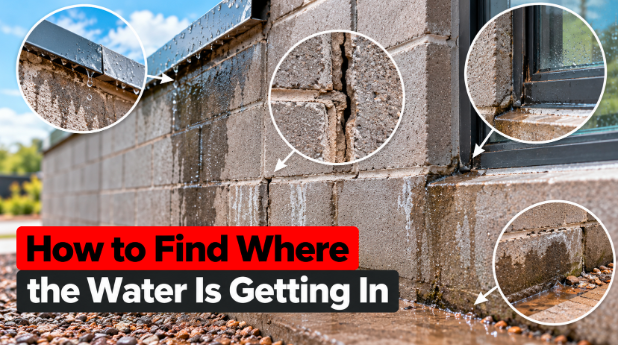
Start outside, above the damp patch, and work upward and sideways. Check:
- Wall top: is there a sloped coping with a drip?
- Plaster: any cracks, hollow-sounding areas or missing patches?
- Joints on unplastered faces: gaps or raked-out mortar?
- Openings: sill slope, drip groove and frame sealing
- Base: DPC present, ground level below it, drainage away from the wall
- Services: leaking pipes, AC drain lines or roof downpipes discharging against the wall
If the damp patch grows during rain and shrinks in dry weather, rain penetration is likely. If it stays near the floor year-round, suspect rising damp or a plumbing leak.
How to Keep Hollow Block Walls Dry
Prevention costs far less than repair. Specify and build:
- Fully filled, properly tooled mortar joints
- A continuous DPC above finished ground level
- Sloped copings on every exposed wall top
- Sill slopes, drip grooves and sealed frame joints
- Well-cured external plaster, or a suitable water-repellent coating on exposed faces
- Movement joints in long walls, as the engineer specifies
- Ground and paving sloped away from the wall
For existing leaks, fix the entry point before repainting. Repainting a wet wall only hides the problem for a season.
Frequently Asked Questions
Do hollow concrete blocks absorb more water than solid blocks?
Not necessarily. Absorption depends on the concrete mix, density and compaction of the unit, not just on whether it has cores. The cores mainly affect where water travels once inside.
Can water collect inside hollow block cores?
Yes. Water entering through joints, cracks or open wall tops can drop into the cores and collect near the base, especially where no weep or drainage path exists.
Is plaster enough to waterproof a hollow block wall?
Good, crack-free plaster provides strong resistance to rain penetration, but it cannot fix an uncapped wall top, a missing DPC or a leaking sill.
Should hollow block cores be filled to stop leaks?
Not as a waterproofing measure. Grouting cores is a structural decision for the engineer. Fix the entry routes instead.
Conclusion
Water enters hollow concrete block walls through weak details far more often than through the blocks themselves. Joints, cracks, wall tops, bases and openings are where the battle is won or lost. Build those details properly, and hollow block walls perform reliably through Pakistan’s monsoon.
PrimeCrete can help builders, contractors and homeowners choose suitable hollow blocks and plan supply for projects across Pakistan.
