
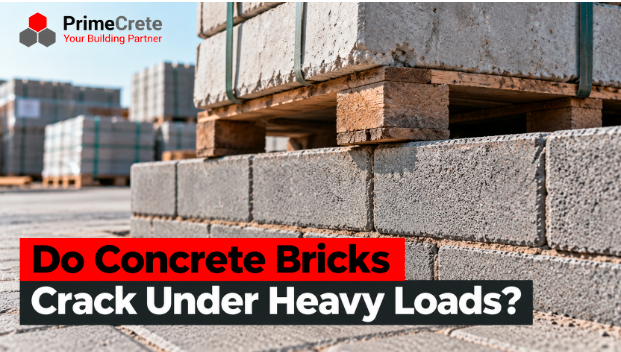
Cracks appearing in a newly completed masonry wall can raise serious concerns for homeowners, contractors, and structural engineers. When a building carries additional floors, heavy roof loads, or concentrated structural forces, the question becomes more important: can concrete bricks under heavy loads crack or fail? The answer depends on brick strength, wall design, construction quality, and load distribution. Selecting suitable PrimeCrete concrete bricks should form part of a properly engineered material specification.
PrimeCrete, a brand of Pak Dream (Pvt) Ltd, manufactures concrete masonry products at Hattar Industrial Estate in Haripur. For residential, commercial, and industrial projects throughout Pakistan, understanding concrete brick performance helps construction teams distinguish normal material behaviour from potential structural problems.
Can Concrete Bricks Crack Under Heavy Loads?
Yes. Concrete bricks can crack when applied stresses exceed their capacity or when the masonry wall experiences settlement, bending, shear, restraint, or inadequate support. However, properly specified and constructed concrete masonry can safely resist its intended design loads.
A visible crack does not always indicate that a brick has insufficient compressive strength.
Cracks may develop because of:
- Excessive vertical loading
- Differential foundation settlement
- Poor mortar quality
- Inadequate load distribution
- Thermal movement
- Drying shrinkage
- Structural deflection
- Lateral forces from earthquakes or wind
Identifying the cause matters more than simply filling the crack.
How Much Weight Can a Concrete Brick Support?
A concrete brick’s load capacity depends on its tested compressive strength, loaded area, geometry, and the conditions of the completed masonry assembly. A single laboratory strength figure cannot establish the safe load capacity of an entire wall.
Compressive strength expresses the force carried per unit area during a standardized compression test.
For example:
1MPa=1N/mm2
And approximately:
1MPa=145psi
Concrete masonry bricks may be manufactured to different strength grades depending on intended applications.
The project specification must identify the appropriate product standard and minimum performance.
Illustrative Compression Calculation
Suppose a brick has:
- Loaded area: 200 mm × 100 mm
- Hypothetical tested compressive strength: 15 MPa
Its nominal gross loaded area is:
200100=20,000mm2
A simple ultimate-load calculation gives:
1520,000=300,000N
This equals 300 kN.
However, this calculation assumes uniform stress and that the stated strength applies to the same loaded area definition.
It does not mean the brick or wall has an allowable structural load of 300 kN.
Actual masonry design must account for factors such as mortar behaviour, slenderness, eccentric loading, unit geometry, safety factors, and the relevant structural design standard.
What Standards Apply to Concrete Brick Compressive Strength?
Concrete bricks should be evaluated against the applicable specification for their intended use.
Relevant ASTM standards include:
- ASTM C55: Concrete Building Brick
- ASTM C1634: Concrete Facing Brick
- ASTM C140/C140M: Sampling and Testing Concrete Masonry Units and Related Units
ASTM C55 and ASTM C1634 serve different product applications. Neither should automatically substitute for a project’s structural design requirements.
The ASTM C140/C140M testing standard includes procedures for concrete masonry unit dimensions, compression testing, absorption, and density.
When larger concrete masonry units fall under ASTM C90, the applicable loadbearing-unit requirements also become relevant.
The ASTM C90 concrete masonry specification describes the standard’s scope for solid and hollow loadbearing units. The linked version is historical, so the latest applicable project edition must be checked.
Why Test Reports Matter
A supplier’s compressive strength declaration should identify:
- Product type and nominal dimensions
- Test method
- Number of specimens
- Individual results
- Average result
- Relevant strength-area definition
- Laboratory and test date
Buyers should not accept claims such as “heavy-duty grade” without supporting technical information.
PrimeCrete’s published product page identifies applications for concrete bricks, but project-specific strength compliance should be confirmed through the relevant product data and test reports.
Why Do Concrete Bricks Crack Even When Their Strength Is Adequate?
Concrete brick cracking often results from stresses that do not arise from direct compression alone.
1. Differential Foundation Settlement
When one section of a foundation settles more than another, the masonry wall experiences distortion.
Diagonal cracks may develop around doors, windows, or wall intersections.
Common contributing factors include uncontrolled fill, leaking drainage systems, variable soil conditions, and poorly detailed foundations.
A surface repair will not solve the problem if settlement continues.
2. Concentrated Structural Loads
A steel beam, concrete beam, or heavy structural component can apply a concentrated load to a small masonry area.
Without an appropriate bearing detail, local stresses may exceed the masonry’s capacity.
Engineers may specify bearing plates, reinforced concrete elements, or other load-distribution measures.
3. Excessive Wall Slenderness
Tall, thin masonry walls can experience bending and instability under lateral loading.
Wall thickness alone does not establish stability.
Support spacing, reinforcement, connection details, and loading conditions all matter.
4. Poor Mortar and Workmanship
Mortar joints influence the behaviour of the entire wall.
Poor joint filling, incorrect materials, excessive thickness, and inadequate curing can reduce masonry performance.
A strong brick placed in a poorly executed wall cannot compensate for defective structural workmanship.
5. Drying Shrinkage and Temperature Changes
Concrete masonry undergoes volume changes as moisture content and temperature change.
Restraint from columns, slabs, and adjoining structural elements can produce cracks where movement is not accommodated.
Movement joint design is particularly important for long walls exposed to large temperature variations.
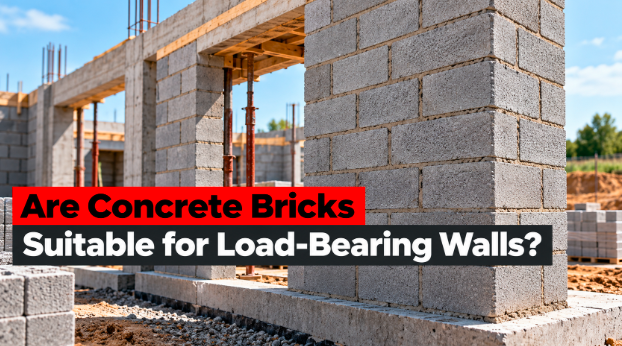
Are Concrete Bricks Suitable for Load-Bearing Walls?
Concrete bricks can be suitable for load-bearing construction when the specified units and complete masonry assembly satisfy the structural design requirements. They should not automatically be considered loadbearing merely because they are dense or machine-made.
The engineer must evaluate:
- Vertical loads from the building
- Lateral loads from wind and seismic action
- Wall thickness and slenderness
- Mortar specification
- Masonry strength
- Openings and bearing conditions
- Structural connections
- Foundation capacity
In Pakistan, the applicable Building Code of Pakistan and project-specific seismic design criteria also require consideration.
For many reinforced concrete frame buildings, masonry walls serve as partitions or infill rather than primary vertical loadbearing members.
However, such walls may still interact with the frame during seismic movement. Appropriate design and detailing remain essential.
Do Concrete Bricks Perform Better Than Red Clay Bricks?
The answer depends on verified product properties and the intended wall assembly.
Both concrete and fired clay bricks are used in Pakistani construction.
| Performance factor | Concrete bricks | Red clay bricks |
| Manufacturing | Cementitious mixture, often machine-moulded | Fired clay manufacturing |
| Strength | Depends on grade and testing | Depends on grade and testing |
| Dimensions | Factory control can improve uniformity | Varies with manufacturing method |
| Moisture absorption | Depends on porosity and mix | Depends on firing and composition |
| Shrinkage behaviour | Concrete-specific movement characteristics | Clay masonry-specific movement characteristics |
| Structural suitability | Requires engineered verification | Requires engineered verification |
Neither product should receive a universal strength ranking without comparable test results.
For projects evaluating larger masonry units, PrimeCrete’s guide to solid concrete blocks versus hollow blocks provides additional context on unit selection.
How Can Contractors Prevent Cracks in Concrete Brick Walls?
Preventing cracking requires attention to material quality and the complete construction process.
Select Suitable Materials
Use concrete bricks with the dimensions, strength, and durability properties required by the design.
Inspect deliveries for chipped corners, visible fractures, and dimensional inconsistency.
Build on Stable Foundations
Check subgrade preparation, foundation design, and drainage.
Do not build structurally significant masonry on unapproved or unstable support.
Maintain Consistent Mortar Joints
Use the specified mortar formulation and joint thickness.
Ensure proper joint filling and curing.
Provide Appropriate Movement Joints
Plan control or movement joints where the design requires them.
Do not cut structural masonry to create joints without engineering approval.
Avoid Unapproved Structural Alterations
Cutting openings, removing masonry, chasing deep service channels, or increasing wall loads can change structural performance.
Obtain engineering approval before undertaking alterations to loadbearing walls.
How Can You Tell Whether a Concrete Brick Crack Is Serious?
Not every crack carries the same risk.
| Crack observation | Possible interpretation | Appropriate response |
| Small stable surface crack | Local shrinkage or finish movement | Record and monitor |
| Diagonal crack near opening | Settlement or stress concentration | Structural assessment |
| Stepped crack through mortar joints | Differential movement or lateral action | Engineering inspection |
| Widening crack | Ongoing movement | Urgent professional assessment |
| Cracking with wall bulging | Possible instability | Restrict access and seek immediate assessment |
Crack width alone cannot determine structural safety.
A narrow crack in a critical location may matter more than a wider crack in a nonstructural finish.
Where damage is new, increasing, or associated with displacement, a qualified structural engineer should inspect the wall.
What Should Buyers Check Before Ordering Concrete Bricks?
A contractor should request material information before approving a large purchase.
The procurement review should include compressive strength, dimensions, intended application, water absorption where relevant, manufacturing consistency, delivery handling, and compatibility with the masonry specification.
For cost planning, buyers should also assess construction speed, waste, mortar requirements, and any finishing work.
PrimeCrete’s article on solid concrete block specifications explains related quality-control considerations that can support a masonry procurement checklist.
Frequently Asked Questions
Can concrete bricks support a two-storey house?
Potentially, but only where the complete building and masonry system have been designed for those loads. The number of floors alone does not establish suitability.
Are small cracks in concrete bricks normal?
Minor cracks may relate to shrinkage or local movement, but their cause should be assessed rather than assumed harmless.
What causes diagonal cracks in brick walls?
Possible causes include foundation movement, differential settlement, lateral loading, and stress concentrations around openings.
Does stronger mortar prevent concrete brick cracking?
Not automatically. Mortar must be compatible with the masonry units and structural design. Excessively strong or inappropriate mortar can create other problems.
Can cracked concrete bricks be repaired?
Some nonstructural cracks can be repaired after their cause has been addressed. Structural damage requires professional assessment and an approved repair method.
Conclusion
Concrete bricks under heavy loads can perform safely when contractors use appropriately specified materials and follow a suitable structural design.
Cracking does not always indicate weak bricks. Foundation movement, poor mortar, inadequate load distribution, and restrained movement can all contribute to damage.
For contractors, engineers, developers, and homeowners across Pakistan, the correct approach is to verify material quality, follow approved drawings, and investigate cracks before deciding on repairs.
Contact PrimeCrete for concrete brick product information and project-specific supply requirements.
