
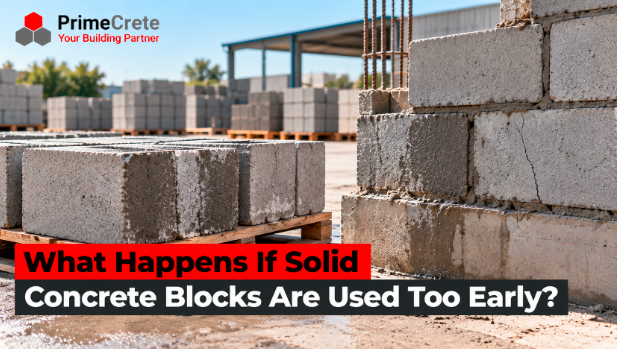
Starting masonry work with newly manufactured blocks may appear to save time, especially when a contractor faces a tight construction schedule. However, installing solid concrete blocks before they have developed sufficient strength and dimensional stability can lead to cracking, damaged units, poor mortar performance, and costly repairs. Before installation, contractors should verify the condition, maturity, and test results of the solid concrete blocks selected for their project.
At PrimeCrete, the concrete-products brand of Pak Dream (Pvt) Ltd, manufacturing takes place at Hattar Industrial Estate using automated MASA Germany equipment. For construction projects across Pakistan, understanding concrete block curing time, strength development, and correct handling practices is essential to achieving reliable masonry performance.
What Happens If Solid Concrete Blocks Are Installed Before Proper Curing?
Using solid concrete blocks too early increases the risk of breakage, cracking, dimensional movement, and unsatisfactory masonry performance. The severity depends on the block’s actual strength, moisture condition, production method, and the loads applied during construction.
Concrete masonry units contain cement, aggregates, and water. As cement hydrates, the concrete develops strength. Proper curing controls moisture and temperature to support this process.
When contractors use immature units, several problems may occur:
- Reduced compressive strength: Blocks may not yet support their intended construction loads.
- Cracking: Subsequent drying shrinkage can contribute to cracks in the masonry.
- Edge damage: Weak corners may chip during handling and installation.
- Mortar joint movement: Dimensional changes can stress the bond between blocks and mortar.
- Construction delays: Failed inspections may require additional testing, repairs, or replacement.
Not every early-used block will fail. However, installation should depend on demonstrated product performance rather than appearance or delivery date alone.
How Long Should Solid Concrete Blocks Cure Before Use?
Concrete block curing time depends on cement composition, manufacturing technology, curing temperature, moisture control, and the required strength at delivery. There is no universal rule requiring every factory-manufactured concrete block to wait exactly 28 days before installation.
Why Is the 28-Day Period Important?
Engineers commonly use 28-day compressive strength as a reference for conventional concrete strength development.
However, manufactured concrete masonry units often use dry-cast, vibration-compacted production methods and controlled curing procedures. These methods can produce blocks that achieve specified acceptance properties sooner than conventional site-cast concrete.
The important distinction is between:
- Curing duration: How long the product undergoes moisture and temperature control.
- Actual compressive strength: The measured resistance of the unit to compressive loading.
- Acceptance for installation: Confirmation that the delivered blocks meet the applicable specification and project requirements.
A block should not receive automatic acceptance simply because it is 28 days old. Similarly, a younger block should not face automatic rejection when the producer can demonstrate compliance with the governing requirements.
What Standards Apply to Strength Verification?
ASTM C90 — Standard Specification for Dry-Cast Loadbearing Concrete Masonry Units covers solid and hollow units intended for loadbearing applications.
Recent ASTM C90 requirements commonly use a minimum average net-area compressive strength of 2,000 psi (13.8 MPa), alongside other acceptance requirements. Project specifications may require higher performance.
The actual unit properties should be tested using ASTM C140/C140M — Sampling and Testing Concrete Masonry Units.
This method addresses measurements including compressive strength, absorption, density, and dimensions.
These values are specification references, not claimed PrimeCrete batch-test results.
What Are the Main Structural Risks of Using Blocks Too Early?
1. Reduced Load-Bearing Reliability
A load-bearing concrete block must transfer structural loads safely through the masonry assembly.
If a block has insufficient strength, concentrated stresses can produce crushing, cracking, or damaged bearing surfaces.
For a load-bearing wall, the structural engineer must consider more than the block strength alone. Mortar, wall geometry, slenderness, eccentric loads, reinforcement, and masonry workmanship also determine performance.
A wider block is not automatically structurally adequate merely because it contains more concrete.
2. Greater Risk of Drying-Shrinkage Cracks
Concrete masonry units undergo moisture-related dimensional changes.
When workers construct a wall with units that still have substantial drying shrinkage remaining, the blocks may continue contracting after the mortar has hardened.
The resulting restraint can contribute to vertical or stepped cracking, particularly around openings and long uninterrupted wall sections.
Movement joints, correct reinforcement, and appropriate masonry detailing help control these stresses.
3. Weaker Edges and Increased Breakage
Immature concrete can be vulnerable to handling damage, particularly around corners and edges.
On busy construction sites, forklift movement, pallet unloading, cutting, and manual stacking can damage units before installation.
Even small losses matter on large developments because damaged blocks increase waste and interrupt masonry productivity.
4. Problems With Mortar Bonding
Mortar must develop an appropriate bond with the masonry units.
The surface condition and moisture absorption of a block influence how water transfers between the unit and fresh mortar.
Very dry, highly absorptive units may draw water from mortar too quickly. Excessively wet units may create different bond and workmanship problems.
Contractors should follow the specified masonry installation procedure rather than indiscriminately soaking every concrete block.
How Can Contractors Identify Under-Cured Solid Concrete Blocks?
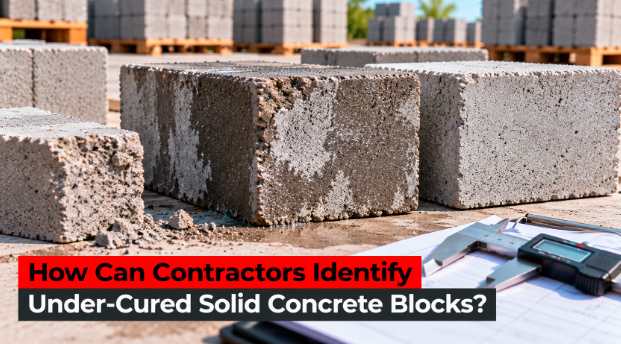
Under-cured concrete blocks cannot be reliably identified through visual inspection alone. However, certain conditions justify additional investigation.
| Observation | Possible concern | Recommended action |
| Powdery or friable edges | Weak surface material | Request strength testing |
| Frequent breakage during normal handling | Insufficient strength or damage | Quarantine affected units |
| Irregular dimensions | Production or quality-control issue | Measure a representative sample |
| Significant cracks | Manufacturing or handling defects | Separate and inspect units |
| No production or test records | Unknown acceptance status | Request documentation |
A block’s colour, weight, or tapping sound cannot replace laboratory results.
For further procurement guidance, PrimeCrete’s solid concrete block specifications and buying checklist explains why dimensional accuracy, strength reports, and material consistency matter.
How Should Concrete Blocks Be Stored Before Installation?
Correct storage preserves the condition of solid concrete blocks after manufacturing and delivery.
Use Firm, Level Storage Areas
Place pallets on a stable, level surface with adequate drainage.
Avoid direct contact with mud, standing water, loose soil, or unstable construction debris.
This precaution matters particularly during Pakistan’s monsoon season, when saturated ground can destabilize stacks and contaminate masonry units.
Protect Blocks From Weather Exposure
Follow the manufacturer’s storage instructions and protect units from conditions that could cause contamination or damage.
During hot weather, prevent unnecessary deterioration of newly manufactured units. During heavy rainfall, protect stockpiles from flooding and prolonged immersion.
Do not introduce uncontrolled site watering as a substitute for the manufacturer’s specified curing process.
Handle Units Carefully
Use appropriate lifting equipment, avoid dropping pallets, and separate visibly damaged blocks.
The same principles apply to hollow masonry products, as discussed in PrimeCrete’s guide to storage, handling, and curing of concrete blocks.
What Is the Financial Impact of Installing Blocks Before They Are Ready?
Premature installation can increase the total concrete block construction cost, even when blocks initially appear inexpensive.
Consider an illustrative procurement scenario for a residential project.
A contractor orders 5,000 blocks and pays PKR 100 per block.
| Cost element | Illustrative value |
| Total blocks purchased | 5,000 |
| Unit price | PKR 100 |
| Initial block expenditure | PKR 500,000 |
| Blocks rejected or damaged | 5% (250 units) |
| Replacement block cost | PKR 25,000 |
This example excludes unloading, delivery, labour, mortar wastage, testing, and rework.
If contractors must dismantle completed masonry because the blocks fail the specified acceptance tests, the financial consequences become substantially larger.
The figures above are illustrative assumptions, not PrimeCrete prices or measured failure rates.
What Should Engineers Check Before Approving Block Installation?
A practical concrete masonry quality-control checklist should cover the following:
- Confirm whether the wall is loadbearing or nonloadbearing.
- Verify the block dimensions and specified strength class.
- Request the applicable production-lot test documentation.
- Confirm which ASTM or Pakistani standard governs acceptance.
- Check production dates and the manufacturer’s release criteria.
- Inspect units for cracks, contamination, and handling damage.
- Verify the mortar specification and masonry reinforcement details.
- Confirm that the construction sequence will not overload immature masonry.
For loadbearing applications, the engineer should review the test evidence before authorizing installation.
Where the available evidence is insufficient, holding the affected batch is generally more prudent than building first and investigating later.
Frequently Asked Questions
Can solid concrete blocks be used after seven days?
Possibly, if the specific manufacturing process has produced units that meet all required acceptance criteria. Seven days alone does not establish compliance.
Do solid concrete blocks need water curing?
They require an appropriate curing process, but that process may involve controlled moisture, temperature, or other established production methods. The manufacturer’s validated procedure governs.
Can under-cured blocks crack after installation?
Yes. Insufficient strength development and subsequent drying shrinkage can contribute to damage, although masonry cracking has multiple possible causes.
Is 28-day-old concrete always safe for loadbearing construction?
No. Age cannot substitute for verified material properties, proper structural design, and sound workmanship.
Conclusion
Installing solid concrete blocks before they are ready introduces unnecessary construction and quality-control risks.
The safest approach is to verify compressive strength, inspect delivered units, follow appropriate storage procedures, and obtain engineering approval before starting structural masonry.
PrimeCrete manufactures concrete masonry products in Hattar, Khyber Pakhtunkhwa, for construction applications across Pakistan. Contractors and procurement teams should request the relevant product specifications, current test evidence, and a project-specific quotation before placing bulk orders.
