
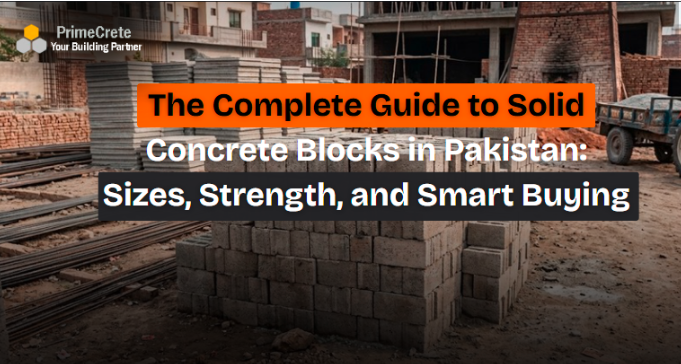
Building a strong home or wall starts with the right materials. If you are planning a construction Solid concrete blocks project in Pakistan, understanding your options helps you save money and avoid costly mistakes. This guide walks you through everything you need to know before you place your order.
What Are Solid Concrete Blocks? Properties and Common Uses
Solid concrete blocks are dense building units made from cement, sand, crushed stone, and water. Unlike hollow versions, these blocks have no gaps inside. That solid core gives them extra weight, strength, and durability, which is why builders across Pakistan trust them for demanding projects.
These blocks resist fire, moisture, and pests far better than many traditional materials. They also hold up well against our hot summers and monsoon rains, so your structure stays stable for decades.
Common Uses
You will find solid concrete blocks used in a wide range of jobs, including:
- Load-bearing walls in homes and commercial buildings
- Boundary walls and perimeter fencing
- Retaining walls that hold back soil
- Foundations and basement walls
- Industrial floors and heavy-duty structures
Because they carry weight so well, engineers often choose them wherever strength matters most.
Solid Concrete Block Sizes in Pakistan: Dimensions in Inches Explained
Getting the size right is half the battle. Concrete block sizes in Pakistan follow fairly standard measurements, though small differences exist between manufacturers.
The most common solid block dimensions you will see are:
- 16 × 8 × 4 inches (a slim block for partition walls)
- 16 × 8 × 6 inches (a popular mid-size option)
- 16 × 8 × 8 inches (a thick block for load-bearing and boundary walls)
The length and height usually stay the same, while the width changes based on how much strength your wall needs. Thinner blocks work well for internal partitions, while wider blocks suit exterior and structural walls. Always confirm exact measurements with your supplier, since a few millimeters can affect your mortar joints and overall count.
Solid Concrete Block Specifications: What to Check Before Buying
Not every block on the market meets the same quality standard. Checking solid concrete block specifications before you buy protects your investment and your building.
Key Points to Inspect
- Density: Higher density usually means a stronger, more durable block.
- Water absorption: Good blocks absorb less water, which prevents cracking and dampness.
- Dimensional accuracy: Uniform sizes make construction faster and neater.
- Surface finish: A smooth, crack-free surface points to careful manufacturing.
- Cement content: A proper cement-to-aggregate ratio gives you reliable strength.
For a deeper breakdown of quality markers, our guide on choosing the right building blocks explains what separates premium units from weak ones.
How Much Does a Solid Concrete Block Weigh? A Guide by Size
Weight tells you a lot about quality. A heavier block often means a denser, stronger product. Knowing the solid concrete block weight also helps you plan transport and labor.
Here is a rough guide by size:
- 16 × 8 × 4 inches: around 12 to 15 kg
- 16 × 8 × 6 inches: around 18 to 22 kg
- 16 × 8 × 8 inches: around 25 to 30 kg
These numbers vary with the mix and moisture content. When a block feels too light for its size, treat it as a warning sign. Light blocks may hide poor compaction or too little cement.
Understanding Solid Concrete Block Compressive Strength
Compressive strength measures how much pressure a block can handle before it cracks. This is the single most important number for structural work.
Strength is measured in pounds per square inch (psi) or megapascals (MPa). For most residential projects, blocks rated between 5 and 7 MPa work well. Heavy load-bearing walls and multi-story buildings may need higher grades.
To confirm you are getting the right grade, ask your supplier for test results. You can compare their figures against the standards set by the Pakistan Standards and Quality Control Authority, which publishes national guidelines for construction materials. Reliable manufacturers test their blocks regularly and share the data openly.
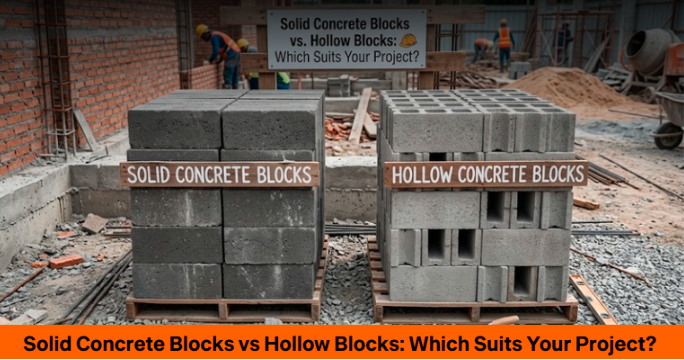
Solid Concrete Blocks vs Hollow Blocks: Which Suits Your Project?
Both block types have their place, so the right choice depends on your goals.
When Solid Blocks Win
Choose solid concrete blocks when you need maximum strength, sound insulation, and load-bearing ability. They shine in foundations, retaining walls, and boundary walls.
When Hollow Blocks Make Sense
Hollow blocks are lighter and cheaper. Their gaps improve thermal insulation and make it easy to run pipes or wiring through the wall. They suit non-load-bearing partitions and projects where budget and weight matter more than raw strength.
If your wall must carry heavy loads or stand up to impact, solid blocks are the safer pick.
Solid Concrete Blocks vs Red Bricks: A Cost and Construction Comparison
Many homeowners in Pakistan still debate between blocks and traditional bricks. Both build strong walls, but they differ in cost and speed.
Construction Speed
Solid concrete blocks are larger than red bricks, so a single block covers more area than several bricks. This means faster laying, fewer mortar joints, and lower labor costs.
Cost and Consistency
Red bricks can vary widely in size and quality from one batch to the next. Concrete blocks offer steady dimensions, which reduces material waste. While the upfront price per block may seem higher, the savings on time and mortar often even things out.
Durability
Concrete blocks resist moisture better and rarely suffer from the salt damage that sometimes affects bricks. For long-term value, they are a strong contender.
Choosing Solid Concrete Blocks for Boundary Walls in Pakistan
Boundary walls face wind, rain, and sometimes physical impact. That is why solid blocks are a favorite for this job.
What to Look For
- Use 16 × 8 × 6 or 16 × 8 × 8 inch blocks for good strength.
- Check that the compressive strength matches your wall height.
- Add proper reinforcement at corners and tall sections.
- Apply a quality plaster or coating to protect against weather.
A well-built boundary wall using quality blocks can stand strong for generations with little maintenance.
How to Choose a Solid Concrete Block Supplier in Pakistan
Your supplier matters just as much as the product. A good partner delivers consistent quality, fair prices, and on-time service.
Smart Selection Tips
- Check reputation: Read reviews and ask other builders for referrals.
- Request samples: Inspect real blocks for finish, weight, and accuracy.
- Ask for test data: Reliable suppliers share compressive strength results.
- Compare pricing fairly: The cheapest option often costs more in repairs later.
- Confirm delivery capacity: Steady supply keeps your project on schedule.
Working with a trusted manufacturer gives you peace of mind from foundation to finish. When quality, strength, and service all line up, your building project starts on solid ground.

[…] For an in-depth breakdown of block types, densities, and strength grades suited to regional climates, see our detailed guide to solid concrete blocks in Pakistan. […]
[…] additional purchasing considerations, PrimeCrete’s guide to solid concrete block sizes, strength, and buying decisions in Pakistan explains relevant unit-selection […]