
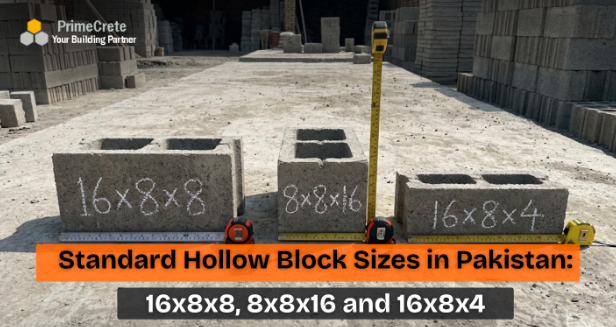
Choosing the right hollow block is one of the first decisions that decides wall thickness, load path, insulation, and cost. On Pakistani sites the three sizes that come up again and again are 16x8x8, 8x8x16, and 16x8x4. They look similar on a quotation, but they are not used in the same way.
This guide explains what each size means on the ground, how builders actually order them, and which wall they belong on.
What a Hollow Block Is in Pakistani Construction
A hollow concrete block is a machine-pressed masonry unit with cores running through its height. Those cores cut weight, improve handling, and create air pockets that slow heat and sound. When the mix, compaction, and curing are controlled, the block still carries load through its face shells and webs.
In Pakistan these units are commonly specified in inches. Metric equivalents sit close to 400 mm × 200 mm × 200 mm for an 8-inch wall block and 400 mm × 200 mm × 100 mm for a 4-inch partition block. Local practice still talks in inches because masons, storekeepers, and BOQs are written that way.
Pak Dream manufactures hollow concrete blocks under the Prime Crete brand at Hattar Industrial Estate, near Islamabad, on Masa Germany plant. The same plant also produces solid concrete blocks when a denser unit is required for foundations or high-load walls.
How Sizes Are Written: 16x8x8 Versus 8x8x16
Why the Same Block Appears Twice
16x8x8 and 8x8x16 are usually the same family of 8-inch wall block. The numbers are length, height, and thickness, but suppliers do not always write them in the same order.
- 16x8x8 is the common Pakistani listing: 16 inches long, 8 inches high, 8 inches thick.
- 8x8x16 is the international CMU listing: 8 inches thick, 8 inches high, 16 inches long.
On site both describe an 8-inch wall unit with a 16-inch face. Confirm three things on the delivery note: length of the face, height of the course, and thickness of the wall. If those three match, the label order does not change the wall.
Nominal size is slightly larger than the actual block so a mortar joint of about 10 mm can sit between units and still keep an 8-inch module. That is why a well-made block is a few millimetres short of the printed size. Tight dimensional control matters more than the order of the digits.
Metric and Modular Planning
A 16-inch face with an 8-inch height lines up with doors, windows, and beam soffits when openings are planned on an 8-inch grid. That is why this module became standard from Islamabad housing to commercial infill walls. Half blocks and cut units still appear at jambs and corners, so a supplier who can hold size within a few millimetres reduces waste and plaster thickness.
16x8x8 Hollow Block: The Everyday 8-Inch Wall
Where 16x8x8 Is Used
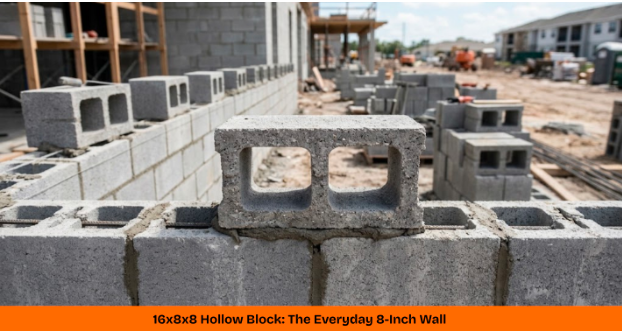
The 16x8x8 hollow block is the default external and internal wall unit for houses, schools, clinics, and mid-rise infill. It gives an 8-inch wall after plaster, which most Pakistani residential drawings still assume.
Typical uses:
- Load-bearing walls in low-rise houses when the engineer has designed for masonry
- Infill walls between RCC columns and beams
- Boundary walls where an 8-inch thickness is specified
- External walls that need better thermal mass than a 4-inch partition
Cores can take vertical reinforcement and grout where the drawing calls for it. That is useful in seismic zones and on longer wall panels. Do not assume every hollow block wall is load-bearing. The structural drawing decides that, not the product name.
Practical Advantages on Site
Masons lay fewer units than brickwork for the same area, so labour and mortar drop. The cores also make the unit lighter than a solid 8-inch block, which speeds lifting and reduces fatigue on upper floors. Thermal and sound performance is better than a thin solid partition because of the air voids, provided joints are full and plaster is continuous.
Market rates move with cement and transport. Recent local guides have placed 16x8x8 hollow units in a broad band around PKR 180–220 per piece, but factory-made blocks with tested strength sit at the quality end of that range and should be compared on compressive strength, water absorption, and size tolerance, not price alone.
8x8x16 Hollow Block: Same Module, Different Label
How to Read a Quotation That Says 8x8x16
If a supplier, catalogue, or imported specification says 8x8x16, treat it as the standard 8-inch × 8-inch × 16-inch masonry unit unless the sheet shows a different height. Ask for:
- Actual measured length, height, and width
- Number of cores
- Face-shell thickness
- Compressive strength on net area
- Water absorption
International loadbearing masonry units are commonly produced to ASTM C90. Prime Crete’s company profile notes production against ASTM C90, ASTM C129, and BS 6073. That matters when a consultant writes “CMU 8x8x16” on a drawing and the contractor is buying local 16x8x8 stock. Matching the standard reduces argument at inspection.
Dimensional rules used worldwide allow only a small deviation from the specified size. Poorly made blocks that wander by more than a few millimetres force thick mortar beds and uneven plaster. That cost appears later, not on the block invoice.
16x8x4 Hollow Block: The 4-Inch Partition Unit
What 16x8x4 Is For
The 16x8x4 block is a 4-inch thick unit with the same 16-inch face and 8-inch course height. It is the partition block. It is not a substitute for an 8-inch external wall unless the engineer has designed a different system.
Use 16x8x4 for:
- Internal room divisions
- Toilet and kitchen partitions
- Non-load-bearing infill where space is tight
- Light walls that will take tiles or gypsum on one or both faces
It saves floor area and weight. It also uses less mortar per square foot of wall face than an 8-inch wall. It does not give the same stiffness, fire rating path, or fixing strength as an 8-inch unit. Heavy cabinets, door frames, and wall-hung fittings need better packing or a thicker wall.
Local price guides often list 16x8x4 hollow blocks lower than the 8-inch unit, commonly in a band near PKR 95–130 per piece, again depending on city, cement cost, and quality.
Quantity Planning for Both Thicknesses
For a 16-inch by 8-inch face, planners often use about 1.125 blocks per square foot of wall, before wastage. For 100 square feet of wall face, many estimators keep around 113 blocks and then add 5–10 percent for cuts and breakage. Thickness changes mortar volume and strength, not the count of faces. Always take off from the drawing, not from a rule of thumb alone.
How to Choose Between 16x8x8, 8x8x16 and 16x8x4
Match Size to the Wall, Not the Quote
Use this simple check:
- External wall or load-bearing masonry: 16x8x8 / 8x8x16
- Internal partition only: 16x8x4
- Foundation or high-load plinth: consider a solid concrete block instead of a hollow unit
- Custom length, density, or strength: ask the plant before the BOQ is locked
Heat, noise, and speed of work favour hollow units. Point load, soil retaining, and some basement walls favour solid units. Mixing both on one project is normal. Mixing sizes on one wall line without a detail is not.
Quality Checks Before You Accept a Truck
Look at three units from different pallets:
- Edges should be sharp and the face flat
- Cores should be clean, not collapsed
- Dimensions should match across the sample
- Colour and texture should be consistent
- Ask for recent compression and absorption results
Water absorption is commonly kept low, often discussed around a 10 percent ceiling in local practice. High absorption blocks drink mortar water and can show damp patches later.
Prime Crete units are produced on automated Masa lines with laboratory checks. Plant location in Hattar supports supply into Islamabad, Rawalpindi, and northern Punjab and Khyber Pakhtunkhwa projects. For specifications and current sizes, start from the Prime Crete homepage and the hollow block product page.
Standards Behind the Sizes
Loadbearing concrete masonry is widely specified to ASTM C90, which sets compressive strength, dimensional tolerance, and minimum face-shell and web thickness for hollow units. A clear technical summary of masonry block dimensions is maintained by Engineering ToolBox. Local drawings may also refer to BS 6073 or project specifications. The label on the pallet should match the clause in the contract, not only the habit of the store.
Quick Answers Contractors Ask
Are 16x8x8 and 8x8x16 different products?
Usually no. They are two ways of writing the standard 8-inch wall block. Measure length, height, and thickness.
Can 16x8x4 replace an external 8-inch wall?
Not as a like-for-like swap. It is a partition size unless the structure is redesigned.
Which size is most common for houses in Pakistan?
The 8-inch hollow block written as 16x8x8 is the usual house wall unit.
Do hollow blocks reduce cost?
They usually reduce labour, mortar, and programme time. Final cost still depends on strength grade, transport, and wastage.
Closing Specification Note
Write the size in full on every BOQ line: length × height × thickness, use, and required strength. Add “hollow concrete block, factory made, tested” if you want machine-pressed units rather than site-cast copies. That single line prevents the most common mix-up between 16x8x8, 8x8x16, and 16x8x4.

[…] Before ordering, compare with PrimeCrete’s standard hollow block sizes in Pakistan. […]