

Walk onto any building site in Pakistan and you’ll spot walls going up fast. But speed often hides costly errors. Hollow block masonry is one of the most popular building methods across the country, yet many walls crack, leak, or weaken within a few years. The reason usually isn’t the block itself. It’s how the block gets used.
This guide breaks down the most common block masonry mistakes made on Pakistani construction sites. You’ll learn what goes wrong, why it matters, and how to fix it before it costs you money.
Here’s what you’ll take away:
- The everyday errors that weaken concrete block walls
- Simple habits that protect your structure for decades
- Practical checks any site supervisor can apply today
Why Hollow Block Quality Matters From Day One
Strong walls start with strong material. On many sites, builders grab whatever blocks are cheapest without checking their strength or finish.
Poor-quality hollow concrete blocks often have uneven sizes, weak edges, and low compressive strength. When you stack these, the wall carries load unevenly. Over time you get cracks, sagging, and repairs that cost far more than good blocks would have.
Using Low-Quality or Undersized Blocks
Cheap blocks made with too much sand and too little cement crumble at the corners. They also absorb water fast, which speeds up damage.
Always ask for blocks tested for compressive strength and made under proper quality control. Machine-pressed units, like those produced with German Masa technology, give you consistent size and density. If you need extra strength for load-bearing sections, compare hollow units against solid concrete blocks and pick what fits the job.
Ignoring the Right Block Type for the Job
Not every wall needs the same block. Boundary walls, partition walls, and load-bearing walls all behave differently.
For lighter, non-load-bearing partitions, Lightweight Concrete Masonry Units reduce dead weight and speed up work. Using the wrong block in the wrong spot puts stress where the wall can’t handle it.
Mortar Mistakes That Weaken the Whole Wall
Mortar holds everything together. Get it wrong and even the best blocks won’t save your wall.
Wrong Mortar Mix Ratio
A very common error on Pakistani sites is guessing the mix instead of measuring it. Too much sand makes weak joints. Too much cement makes the mortar shrink and crack.
Stick to a balanced ratio, usually around 1 part cement to 4 or 6 parts sand depending on the wall type. Mix small batches so the mortar stays fresh and workable.
Poor Joint Thickness
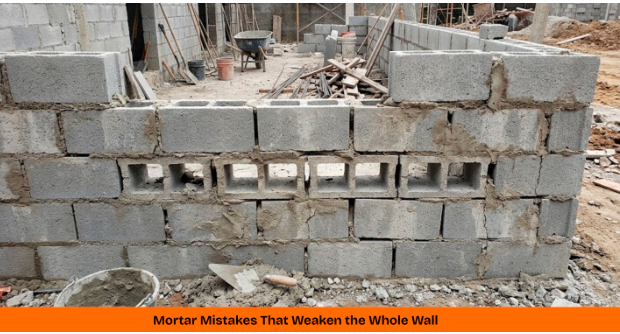
Thick, uneven joints look messy and they weaken the bond. Many masons pile on mortar to hide crooked blocks.
Aim for joints roughly 10mm thick and keep them even. Consistent joints spread the load properly and give you a cleaner, stronger wall.
Skipping Curing and Moisture Control
This is where many good walls quietly fail. Curing gives concrete and mortar the time and moisture they need to reach full strength.
Not Curing the Wall
In Pakistan’s hot climate, mortar dries too fast. When water leaves before the mix sets properly, the joints stay weak and dusty.
Sprinkle water on new concrete block walls for at least seven days. Early curing prevents cracks and adds real strength that you can’t get back later.
Ignoring Moisture and Damp Problems
Rising damp is a silent killer of masonry. Walls built without a damp-proof course pull moisture up from the ground, leading to salt stains, peeling paint, and weak plaster.
Add a proper damp-proof layer at the base. Fill hollow cores with concrete where walls meet the ground or carry heavy loads. This keeps water out and stiffens the wall.
Poor Alignment and Bonding Errors
A wall is only as good as its shape. Small alignment mistakes multiply as the wall rises.
Improper Block Alignment
Blocks laid without checking level and plumb create a wall that leans or bulges. Masons in a hurry often skip the spirit level and rely on their eye.
Check every few courses with a level and string line. Straight walls carry load evenly and plaster goes on smoothly with less waste.
Weak Vertical Joint Bonding
Lining up vertical joints, one directly above another, creates a natural crack line. This is a classic hollow block masonry mistake that shows up as long vertical cracks.
Stagger the joints so each block overlaps the one below. This overlapping bond ties the wall together and spreads stress across a wider area.
Forgetting Reinforcement Where It Counts
Hollow blocks are strong under compression but weak under bending and shaking. In an earthquake-prone country, skipping reinforcement is risky.
No Reinforcement in Key Areas
Many low-cost projects leave out steel bars at corners, around openings, and at wall tops. These are exactly the spots that fail first during ground movement.
Place vertical steel bars inside the hollow cores at corners and jambs, then fill those cores with concrete. Add horizontal reinforcement in bond beams at regular heights. Following recognized guidance, such as the technical standards shared by the Portland Cement Association, helps you reinforce walls the right way.
Weak Support Around Doors and Windows
Openings interrupt the flow of load. Without a proper lintel and support, cracks spread from the corners of doors and windows.
Cast solid, well-reinforced lintels over every opening. Extend them past the edges so the load transfers safely into the surrounding wall.
A Quick Site Checklist for Better Masonry
Before your team lays the next course, run through these fast checks:
- Test your blocks for size, finish, and strength before buying in bulk.
- Measure your mortar mix instead of guessing ratios.
- Keep joints even at about 10mm and stagger vertical joints.
- Cure the wall with water for at least a week.
- Add reinforcement at corners, openings, and wall tops.
- Protect against dampness with a proper base layer.
Build Walls That Last
Most block masonry mistakes on Pakistani sites come from rushing and cutting corners, not from bad luck. Choose quality hollow concrete blocks, mix mortar properly, cure your walls, and reinforce the weak points. Do these few things well and your walls will stay straight, dry, and strong for decades.
Ready to start with material you can trust? Explore Primecrete’s Hollow Concrete Blocks and build with confidence from the first course.
