

Buying good blocks is important for any construction project. Weak or poorly made blocks can cause cracks, uneven plaster, extra mortar use, breakage, and higher repair costs. That is why buyers should check hollow block quality in Pakistan before placing a large order.
When comparing suppliers, start with properly manufactured hollow concrete blocks in Pakistan and inspect the actual batch. Good blocks should have consistent dimensions, clean edges, strong concrete, proper curing, and no major cracks.
Why Hollow Block Quality Matters
Pakistan has hot summers, seasonal rain, and demanding construction conditions. Masonry units must perform well during transport and installation.
High-quality hollow blocks help create straighter walls, even mortar joints, less breakage, and lower material waste. Poor blocks may crumble during handling or require extra mortar to correct uneven sizes.
Check the Size and Shape
Measure Several Blocks
Do not inspect only one sample. Take several blocks from different parts of the batch and compare their length, width, and height.
Good hollow concrete blocks should be reasonably uniform. Large differences can slow masonry work and create uneven joints. Use a measuring tape and compare several pieces instead of trusting the size written on a quotation.
Inspect Edges and Corners
Edges should be properly formed and corners should not be badly broken. Widespread chipped corners may indicate poor production, handling, or curing.
Uniform blocks are easier to align and usually need less correction with mortar or plaster.
Look for Cracks and Weak Surfaces
A good block should not have serious cracks, crumbling faces, loose aggregate, or large uncontrolled holes. The hollow cores should look properly formed, while the surrounding concrete should appear compact.
Do not judge a block only by color. Concrete shade can vary with materials and moisture. Strength, dimensions, and manufacturing quality matter more.
Compare the Weight
Check Similar Blocks Together
Pick up several blocks of the same size and specification. Their weight should feel reasonably similar.
If one is much lighter than others, inspect it carefully for poor compaction, irregular cavities, or inconsistent material.
Weight alone does not prove quality. Different products can have different densities, so compare blocks with the same size and specification.
Ask About Compressive Strength
Compressive strength shows how much pressure a block can handle before failure, especially in structural construction.
Ask whether technical specifications or test reports are available. Do not rely only on claims such as “very strong” or “best quality.”
Pakistan’s Pakistan Standards and Quality Control Authority provides standards-related guidance for civil engineering materials, including masonry products. Your engineer should confirm the required strength and specification before purchase.
Check the Curing Process
Proper Curing Builds Strength
Concrete blocks need time and controlled moisture to develop strength. Blocks sold too soon may crack or break more easily.
Ask how the blocks are cured and when they are ready for dispatch. A reliable supplier should clearly explain its curing and quality-control process.
Inspect the Hollow Cores
Look inside the cavities before buying. The cores should be properly shaped, with reasonably consistent concrete thickness. Very thin sections or badly deformed cavities can be warning signs.
Different walls may require different block sizes and strengths. PrimeCrete’s guide to calculating hollow concrete blocks for a 5 marla house can help estimate quantities for common wall layouts.
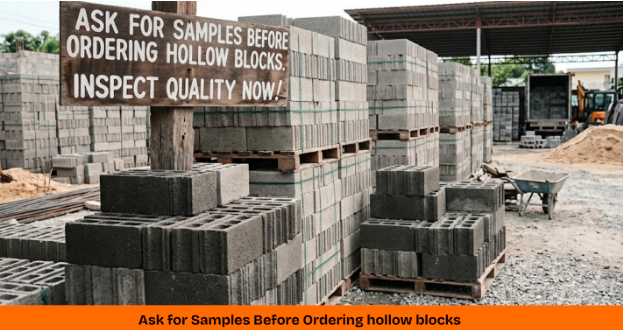
Ask for Samples Before Ordering
Never place a large order based only on photographs or price.
Inspect physical samples for dimensions, edges, cores, surface condition, and consistency. For major projects, request technical details and test information.
When delivery arrives, compare the supplied blocks with your approved sample to identify any major quality difference.
Inspect the Delivery Batch
Check blocks from different areas of the truck.
Look for consistent dimensions, intact corners, uniform cores, similar surfaces, and limited breakage. Discuss widespread damage with the supplier before unloading everything.
Batch consistency matters because thousands of blocks must work together during construction.
Choose the Right Block for the Right Wall
The heaviest or strongest-looking block is not always the correct choice.
Some walls benefit from hollow blocks, while other areas may require denser masonry. Compare solid concrete blocks when your engineer specifies a different masonry type.
PrimeCrete’s guide to solid concrete blocks in Pakistan explains common sizes, uses, and buying considerations.
Always follow project drawings and engineering requirements instead of choosing blocks only by appearance or price.
Do Not Buy Only on Lowest Price
A cheap block can become expensive through breakage, waste, extra mortar, plaster work, labor, or repairs.
Compare overall value. Consider strength, dimensions, curing, delivery condition, supplier reliability, and expected wastage. Better blocks may reduce total construction costs by making masonry work faster and more consistent.
Quick Hollow Block Quality Checklist
What Should You Check Before Buying?
Before approving an order, check uniform size, clean edges, serious cracks, hollow core shape, weight consistency, curing, strength information, batch consistency, wall suitability, and delivery condition.
Frequently Asked Questions
How Can I Identify a Good Hollow Block?
A good hollow block should have uniform dimensions, strong edges, properly formed cavities, compact concrete, and no serious cracks. For structural work, confirm the required compressive strength with your engineer.
Is a Heavier Hollow Block Always Better?
No. Weight alone does not determine quality. Compare products with the same size and specification, and consider density, strength, compaction, and manufacturing quality.
Can Hollow Blocks Be Used for Load-Bearing Walls?
Some hollow blocks may be suitable for structural applications, while others are intended for non-load-bearing walls. Always follow the structural engineer’s specification.
Buying Better Hollow Blocks in Pakistan
Checking hollow block quality before buying is easier than repairing weak masonry later. Start with dimensions, cracks, edges, cavities, weight consistency, curing, and strength information. Then compare the delivered batch with the approved sample.
Across Pakistan, choosing blocks that match the design and come from a consistent manufacturer can reduce waste and improve installation. The best purchase is the block that meets the required specification, arrives in good condition, and performs properly in its intended wall.
