

Pakistani summers don’t knock politely. They kick the door open. In May 2022, Jacobabad hit 51°C during a severe heatwave. Locals there joke that they’d pack a blanket if they ever went to hell. Anyone in Karachi, Lahore or Multan gets the joke, especially after touching a bedroom wall that still feels warm at midnight.
At Primecrete, we supply concrete blocks to Pakistani sites every day. Homeowners keep asking one question: can the wall itself keep a house cooler? It can. Lightweight concrete masonry units are one of the most practical ways to do it.
This guide covers how they work, what the numbers say, and where they make the most sense.
Why Pakistani Buildings Trap So Much Heat
Most of our buildings fight the sun with the wrong armour.
According to a World Bank knowledge note on building energy efficiency, standard walls in Pakistan have a U-value of about 1.89 W/m²·K. Roofs sit around 2.74 W/m²·K. Pakistan’s Energy Conservation Building Code (ECBC-2023) caps walls at 0.57 and roofs at 0.44.
A U-value tells you how much heat passes through one square metre of wall for every degree of temperature difference. Lower is better.
Now the simple maths: 1.89 divided by 0.57 is about 3.3. So a typical Pakistani wall lets in more than three times the heat the code allows. The same World Bank note also points out that local authorities have struggled to enforce the code. That means many new houses still go up with heat-leaky walls.
Heat Moves Through Walls Like Water Through a Sponge
The sun heats the outer face of your wall. That heat then travels inward through the solid material. Physics calls this conduction.
Heat flow grows with the material’s conductivity and the temperature difference. It shrinks as the wall gets thicker. Dense materials give heat an easy road. Porous materials make it take the long way round.
What Makes Lightweight Concrete Masonry Units Different
The secret ingredient is pumice. It’s a volcanic rock packed with tiny air pockets, and still air is a poor conductor of heat.
When manufacturers use pumice as aggregate, the block carries those air voids into your wall. They act as a built-in thermal barrier and slow heat down on its way inside.
The Numbers Behind the Cool
Here’s how Primecrete’s lightweight CMU compares with normal-weight blocks, based on our published product specifications:
| Property | Normal-Weight CMU | Pumice Lightweight CMU |
| Thermal conductivity | 1.60–3.60 W/m·K | 0.20–0.53 W/m·K |
| Unit weight | Over 125 pcf (above 2,000 kg/m³) | Under 105 pcf (800–1,600 kg/m³) |
Let’s run the logic. Compare the best normal block (1.60) with the worst pumice block (0.53). The pumice block still conducts roughly three times less heat. At the far ends of the range (3.60 vs 0.20), the gap reaches about 18 times.
One honest caveat: these figures describe the block material, not the finished wall. Mortar joints, hollow cores, plaster and wall thickness all change the final U-value. Always ask your supplier for tested values and let your designer check the full wall.
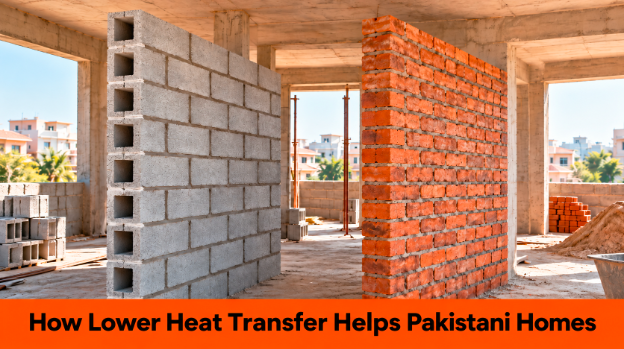
How Lower Heat Transfer Helps Pakistani Homes
Cooler Rooms in the Afternoon
When less heat moves through the wall, less of it reaches your living room. Rooms stay closer to a comfortable temperature through the hottest hours. Your wall stops behaving like a tandoor.
Smaller Load on Your AC
Every unit of heat that stays outside is heat your air conditioner doesn’t have to remove. Less work for the AC means lower cooling costs over the life of the building. With electricity tariffs where they are, that matters every single month.
Comfort in Winter Too
Heat flows both ways. The same air voids that block summer heat also slow heat loss in cold months. So pumice blocks help homes in colder regions hold their warmth for longer.
A Lighter Structure
Lighter blocks reduce the dead load on beams, columns and foundations. They also cut transport and handling effort on site. Your masons will thank you, possibly without complaining for once.
Lightweight CMU vs Other Walling Options
No single block suits every wall. For a detailed look at cost, speed and heat, read our comparison of hollow blocks vs bricks in Pakistan. If you’re weighing aerated blocks, our guide on hollow concrete blocks vs AAC blocks breaks down the trade-offs.
Many projects mix products smartly. Hollow concrete blocks work well for partitions and boundary walls. Solid concrete blocks suit areas that need extra mass and strength. Lightweight concrete masonry units earn their place on the external walls that face the sun.
Where to Use Lightweight Blocks for Best Results
West- and South-Facing External Walls
These walls take the strongest afternoon sun. Put your best thermal performer where the heat hits hardest.
Top-Floor Rooms
Top floors suffer from both walls and roof. Remember, the typical Pakistani roof leaks even more heat than the typical wall. Pair lightweight walls with proper roof insulation, or the ceiling will undo your good work.
Larger Commercial Buildings
ECBC-2023 covers buildings with 200 m² or more of conditioned area, or 300 m² or more of unconditioned area. For these projects, low-conductivity walls make code compliance easier to achieve.
Tips to Get the Most From Your Walls
- Ask for tested density and thermal conductivity data before you buy.
- Keep mortar joints thin and consistent, since mortar conducts more heat than pumice.
- Plaster both faces of the wall to seal gaps and air leaks.
- Use light-coloured exterior paint to reflect sunlight.
- Shade windows, because glass lets in heat that no wall can stop.
Frequently Asked Questions
Are lightweight concrete masonry units strong enough for houses?
Yes. Primecrete designs its pumice CMUs to deliver the required structural strength, along with good fire resistance. For load-bearing walls, confirm the block grade with your structural engineer.
Do lightweight blocks replace insulation completely?
Not always. They cut heat transfer through the block itself. Meeting the ECBC wall limit of 0.57 W/m²·K depends on the complete wall assembly, so let your designer calculate it.
Do they help in winter?
Yes. Low conductivity slows heat moving in either direction, so rooms lose warmth more slowly in cold weather.
Final Thoughts
Pakistan’s heat isn’t going anywhere. Your walls can at least stop inviting it inside. Lightweight concrete masonry units lower heat transfer, ease the load on your AC, and lighten the structure, all from one material choice.
A cheap wall that raises your electricity bill every month isn’t really cheap. Planning a new build or an extension? Contact the Primecrete team for specifications and supply details.

[…] With conductivity as low as 0.20 W/m·K, lightweight concrete masonry units slow down the heat moving through exterior walls. We explain this in detail in our guide on how lightweight concrete masonry units reduce heat in Pakistani buildings. […]
[…] For a deeper analysis of how pumice aggregates enhance thermal and physical performance, see our technical article on how lightweight CMUs reduce heat in Pakistani buildings. […]