
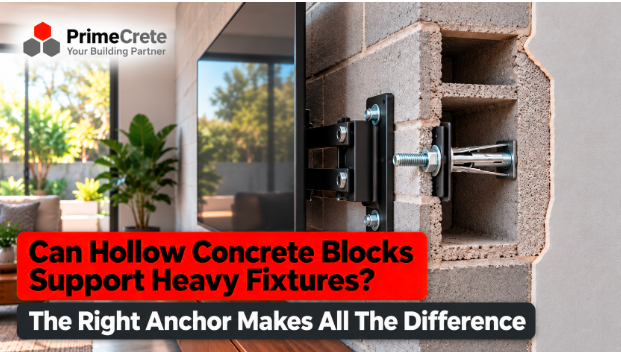
Picture this. You’ve just bought a big new TV, the drill is in your hand, and one question keeps nagging you: will this wall hold it, or will you be sweeping up block dust at 2 a.m.?
At Prime Crete, we manufacture concrete masonry in Hattar, Haripur, so we understand why this question comes up so often. People love hollow concrete blocks for their light weight and speed. Then they start wondering what those empty cores mean for a geyser or a kitchen cabinet.
Here’s the short answer: yes, hollow concrete blocks can support heavy fixtures, as long as you fix into the right spot with the right anchor. The block itself rarely lets you down. The weak link is usually the connection between the anchor and the block’s thin outer wall.
Let’s break it down.
What Makes a Hollow Block Different?
A solid block is concrete all the way through. A hollow block is not. It has open cores that cut weight while keeping structural performance, which is exactly why builders use it for both load-bearing and non-load-bearing walls.
Face Shell, Web and Core
Every hollow block has three zones:
- Face shell: the outer wall of the block, the part you see and drill into.
- Webs: the internal ribs that connect the two face shells.
- Cores (cells): the empty spaces between the webs.
A normal screw goes through the face shell and then hits air. It’s a bit like trying to hang a painting on a cardboard box: the surface holds, but only just. That’s why heavy fixtures need anchors built for hollow material.
What Counts as a “Heavy Fixture”?
In a typical Pakistani home, the usual suspects include:
- Wall-mounted TVs
- Electric or gas geysers
- Kitchen wall cabinets
- Wall-hung washbasins and toilets
- Bookshelves (books are heavier than your intentions to read them)
- Outdoor AC unit brackets
These loads don’t just push down. A loaded shelf also pulls outward on its fixings. Engineers call these forces shear (sliding down) and tension (pulling out). The Concrete Masonry & Hardscapes Association (CMHA) notes that the fastener itself resists most of the shear. Tension, on the other hand, depends on how well the anchor grips the masonry.
How Hollow Concrete Blocks Handle Heavy Loads
Your fixing approach depends on one thing: is there empty space or solid material behind the point where you drill?
Ungrouted Hollow Cells
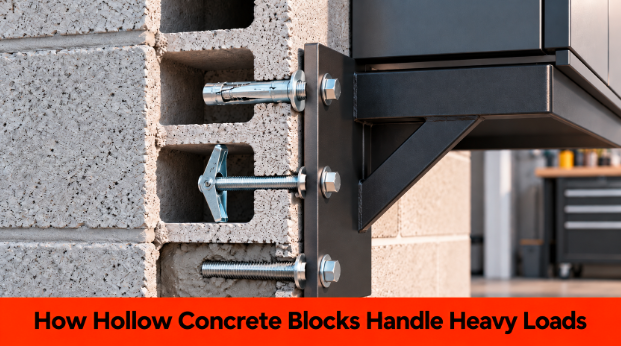
When the core is empty, you need an anchor that locks behind the face shell. According to CMHA, fasteners for masonry generally go into a mortar joint, through the face shell into the hollow core, or into solid or solidly grouted masonry.
The common options for hollow cells are:
- Toggle bolts: A spring-loaded toggle passes through the hole, opens inside the core and bears against the back of the face shell.
- Sleeve anchors: A collapsing sleeve presses against the back of the face shell when you tighten it.
- Adhesive anchors with mesh sleeves: A mesh screen holds the resin in the hole. The resin pushes through the mesh and forms a solid “key” behind the face shell, as the Mason Contractors Association of America explains.
Grouted or Solid Sections
This is where things get serious. When you fill the cores with grout, anchors can go deeper and grip much harder. For your heaviest items, grouted cells or solid units are the smart choice.
The trick is planning. If you know where the geyser will go, ask your mason to grout those cells during construction. You can also build that zone with solid concrete blocks. CMHA also mentions that masons can build wood or metal nailer blocks into the wall as it goes up, so you never have to hunt for a strong spot later.
Choosing the Right Anchor
Here’s a simple guide. Always confirm the actual load rating with the anchor manufacturer’s data sheet.
| Fixture | Best Fixing Zone | Suitable Anchor Type |
| Light mirror or frame | Face shell | Plastic plug with screw |
| TV mount, medium shelf | Face shell or web | Toggle or sleeve anchor |
| Kitchen cabinets | Across several blocks | Toggle bolts or adhesive with mesh sleeve |
| Geyser, wall-hung WC | Grouted cells | Adhesive or expansion anchor rated for grouted masonry |
| AC bracket (outdoor) | Grouted cells | Corrosion-protected anchor rated for grouted masonry |
Why does the manufacturer’s data matter so much? CMHA points out that building codes don’t cover fastener design in detail. Most fasteners are proprietary products, so their pull-out and shear values come from the maker’s own testing.
Installation Mistakes That Bring Things Down
Even a good anchor fails in the wrong hands. Watch out for these.
Using a Wedge Anchor in an Empty Core
Wedge anchors need solid concrete to expand against. In a hollow cell, they either crack the face shell or spin uselessly in the void. Save them for grouted sections.
Hammer Drilling Too Hard
Hammer mode can break out the back of the face shell. The Mason Contractors Association advises checking whether the anchor maker asks for rotation-only drilling. Less drama, more grip.
Ignoring Edge Distance and Spacing
Anchors placed too close to a block edge or to each other can crack or spall the masonry. CMHA lists edge breakout and “back pry-out” among typical failure modes, and it flags pry-out as a particular risk with groups of fasteners set through the face shell of hollow blocks.
Forgetting About Rust
An outdoor AC bracket sees rain and humidity for years. Use galvanized or stainless fixings. CMHA also warns against mixing dissimilar metals, because galvanic corrosion can eat away the weaker one.
Plan Your Fixtures Before You Build
The best time to prepare for heavy loads is before plastering, not after. Mark your TV, geyser and cabinet positions on the drawings. Then grout those cells or place solid units there.
Wall type matters too. A thin interior wall behaves differently from a thick structural one. Our guide on partition walls with 4 inch hollow concrete blocks covers what those lighter walls can handle. If you’re still choosing block types, read our comparison of load bearing vs non-load bearing hollow blocks, or browse our load bearing and non-load bearing bricks.
For anything genuinely heavy, such as a water tank stand or a wall-hung stair, talk to a structural engineer. That’s not caution for its own sake. It’s simply cheaper than repairing a wall.
Frequently Asked Questions
Can I mount a TV on a hollow block wall?
Yes. Use toggle bolts or sleeve anchors rated for hollow masonry, and spread the mount’s screws across more than one block where possible.
Is it safe to hang a geyser on hollow concrete blocks?
It’s safe when you fix it into grouted cells or solid units with anchors rated for that load. Avoid relying only on plastic plugs in an empty face shell.
Should I drill into the mortar joint or the block?
Light items can go into mortar joints. For heavier loads, drill into the block, ideally where the webs meet the face shell or into grouted cells.
Final Verdict
Hollow concrete blocks can carry heavy fixtures safely. Success depends on three things: knowing what’s behind your drill bit, choosing an anchor designed for it, and following the manufacturer’s installation instructions.
Plan early, grout where it counts, and your wall will hold that TV long after the warranty runs out.
