
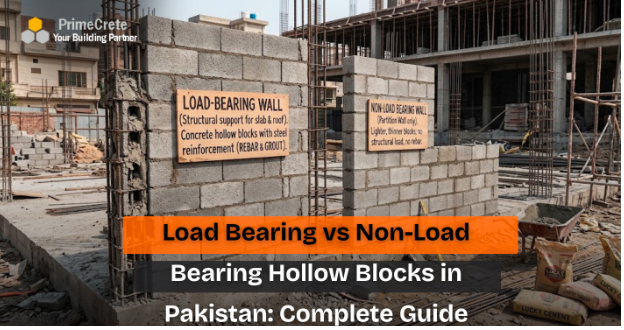
Choosing the right wall block affects the safety, cost, speed, and long-term performance of a building. In Pakistan, builders increasingly use hollow concrete blocks in Pakistan for homes, apartments, commercial buildings, and industrial projects because they are durable, practical, and fast to install.
The main difference is whether a block is load bearing or non-load bearing. Understanding this helps builders, homeowners, and contractors choose the correct unit for each wall.
What Are Load Bearing Hollow Blocks?
Load bearing hollow blocks are concrete masonry units designed to support structural weight in addition to their own weight. A load-bearing wall can transfer loads from roofs, slabs, beams, or upper floors toward the foundation.
Their suitability depends on compressive strength, wall thickness, mortar, reinforcement, building design, and the engineer’s specifications.
Where Are Load Bearing Hollow Blocks Used?
They may be used in structural walls of houses, low-rise buildings, commercial structures, and other masonry systems where the wall forms part of the load-transfer path.
For product-specific options, PrimeCrete also provides load bearing and non-load bearing masonry units for different construction requirements.
What Are Non-Load Bearing Hollow Blocks?
Non-load bearing hollow blocks are used in walls that do not support major structural loads from slabs, beams, roofs, or upper storeys. Their main purpose is to divide spaces, enclose rooms, or fill framed structures.
In reinforced concrete buildings, many block walls act as infill between columns and beams. The concrete frame carries the main building load, while the block wall separates or encloses spaces.
Where Are Non-Load Bearing Blocks Used?
These blocks are suitable for internal partitions, office divisions, apartment room walls, service areas, and infill walls in properly designed reinforced concrete structures.
Load Bearing vs Non-Load Bearing Hollow Blocks: Main Differences
The simplest difference is structural responsibility. A load bearing hollow block wall helps carry building loads, while a non-load bearing hollow block wall mainly divides or encloses space.
Strength Requirements
Load-bearing units generally require higher verified compressive strength because they transfer structural loads. Non-load-bearing units must still be durable and properly manufactured, but they are selected for a different purpose.
For structural walls, the engineer’s specification should control the choice. Pakistan’s Building Code of Pakistan resources include masonry provisions that should be considered with project drawings and applicable standards.
Wall Thickness
Load-bearing walls need enough thickness to meet structural and stability requirements. Non-load-bearing partitions may use thinner blocks where permitted by the design.
Block width should follow wall height, location, exposure, loads, and architectural requirements.
Weight and Handling
Hollow blocks contain internal cavities, so they can reduce masonry weight compared with fully solid units and make handling easier.
For homeowners planning a typical house, PrimeCrete’s guide on calculating hollow concrete blocks for a 5 Marla house in Pakistan explains wall area, common sizes, and approximate quantities.
Cost and Construction Speed
Larger, uniform concrete blocks can cover more wall area per unit, reducing joints and speeding up masonry work. Faster installation can help control labour and mortar costs.
Load-bearing blocks may cost more when a higher structural grade is required. Non-load-bearing blocks can be economical for partitions, but the cheapest block should never replace the grade shown on approved drawings.
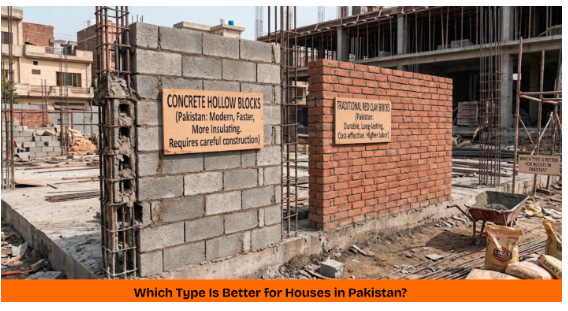
Which Type Is Better for Houses in Pakistan?
Neither type is automatically better. The correct choice depends on the structural system.
For Reinforced Concrete Frame Houses
Many urban houses in Islamabad, Rawalpindi, Lahore, Karachi, and Peshawar use reinforced concrete columns and beams. In such framed systems, many block walls function as non-load-bearing infill.
An engineer should confirm which walls are structural before ordering blocks.
For Load-Bearing Masonry Buildings
If walls are designed to carry floors or roofs, use blocks manufactured and tested for the required load-bearing performance. Mortar, reinforcement, openings, lintels, foundations, and seismic requirements should also follow the structural design.
Where a different wall type is needed, compare hollow units with solid masonry. PrimeCrete’s guide to solid concrete blocks in Pakistan explains common sizes, strength considerations, and typical uses.
How to Choose Quality Hollow Blocks in Pakistan
Whether you need structural or partition blocks, quality control matters. Poorly made blocks can cause alignment problems, excess mortar use, cracks, and inconsistent wall performance.
Check Compressive Strength
Ask the supplier for the required grade and available test information. For structural work, never rely only on appearance or weight.
Check Dimensions and Finish
Good hollow concrete blocks should be consistent in length, height, and width. Straight edges and uniform faces help masons maintain proper joints and wall alignment.
Check for Damage
Avoid blocks with major cracks, broken webs, damaged corners, or visible manufacturing defects.
Match the Block to the Wall
Do not use a partition-grade unit in a wall designed to carry structural loads. Likewise, there is little benefit in paying for a heavier structural unit where the engineer specifies a non-load-bearing partition.
Are Hollow Blocks Suitable for Pakistan’s Climate?
Yes. Properly manufactured concrete hollow blocks can perform well in Pakistan’s hot summers and varied regional conditions. Their cavities may also support improved thermal performance compared with dense solid masonry, depending on the complete wall system.
Wall thickness, insulation, plaster, windows, and roof treatment also affect indoor comfort.
Frequently Asked Questions
Can Hollow Blocks Be Load Bearing?
Yes. Hollow concrete blocks can be load bearing when manufactured to the required strength and used in a properly engineered masonry system.
Can Non-Load Bearing Blocks Be Used for Exterior Walls?
They can be used as exterior infill in some framed structures if the design, weather protection, stability, and applicable requirements allow it. An engineer should confirm the specification.
Which Hollow Block Size Is Best in Pakistan?
There is no single best size. The correct size depends on wall purpose, thickness, structural design, insulation needs, and architectural drawings. Structural and external walls often require thicker units than internal partitions.
Choosing the Right Hollow Blocks for Your Project
The key difference in load bearing vs non-load bearing hollow blocks is whether the wall carries structural weight. Load-bearing units must meet the engineer’s required strength and performance, while non-load-bearing units are mainly used for partitions and infill.
For projects across Pakistan, uniform, properly manufactured blocks can improve construction speed, alignment, and durability. Before ordering, confirm wall types, dimensions, strength requirements, and quantities from approved drawings.
