
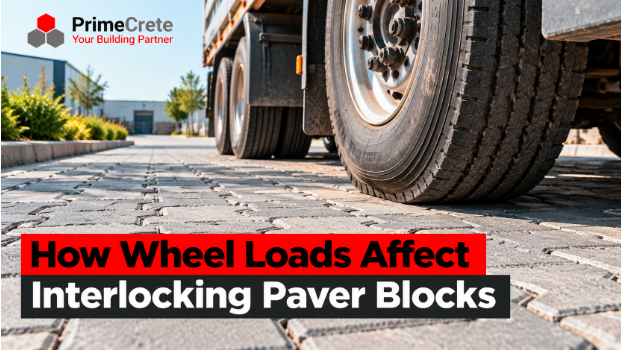
A newly paved commercial parking area may look perfect when the project opens, but repeated truck movements, braking forces, and inadequate ground preparation can cause rutting, settlement, or cracked pavers. Understanding wheel loads on interlocking paver blocks helps contractors choose suitable pavement thickness, foundation materials, and laying patterns. For projects involving vehicles, PrimeCrete interlocking paver blocks should be selected as part of an engineered pavement system rather than simply on colour or shape.
PrimeCrete, a concrete-products brand of Pak Dream (Pvt) Ltd, manufactures paving products at Hattar Industrial Estate using automated MASA Germany machinery. For housing societies, industrial sites, parking facilities, and commercial developments across Pakistan, understanding how traffic loads affect paving performance can prevent premature failures and unnecessary replacement expenses.
How Do Wheel Loads Affect Interlocking Paver Blocks?
Wheel loads create vertical pressure and horizontal forces that transfer through individual pavers, sand-filled joints, bedding, base, and underlying soil. When these pavement layers provide adequate support, they distribute traffic loads and limit deformation.
An interlocking concrete pavement consists of closely fitted precast concrete units arranged in a pattern that develops interaction between neighbouring blocks.
The pavement generally includes:
- Concrete paving blocks
- Jointing sand
- Bedding sand
- Compacted aggregate base
- Granular sub-base where required
- Prepared subgrade
- Edge restraints
- Drainage provisions
The pavers form the wearing surface, but the foundation layers play a major role in supporting repeated traffic.
If the underlying soil settles, surface pavers can tilt or move even when their laboratory compressive strength meets the specification.
What Is Wheel Load in Pavement Engineering?
Wheel load is the portion of vehicle weight transmitted to the pavement through an individual wheel or wheel assembly. It differs from total vehicle weight and must be assessed with axle arrangement, tyre pressure, and traffic frequency.
Consider a hypothetical vehicle with a gross weight of 2,000 kg.
Its static gravitational force is approximately:
W=mg
W=2,0009.81=19,620N
Therefore:
W=19.62kN
If the weight were distributed equally over four wheels, the nominal load per wheel would be:
19.624=4.905kN
The approximate wheel load would be 4.9 kN per wheel.
However, actual wheel loads are rarely distributed perfectly evenly.
Front and rear axle loads differ, and dynamic effects can increase local loading during movement.
For heavy vehicles, pavement engineers must also consider axle configuration and repeated load applications.
Why Does Tyre Pressure Matter?
Tyre pressure influences the size and shape of the contact area through which a wheel transfers load to the pavement surface. Higher contact pressures can increase local stresses, although the actual pressure distribution is not perfectly uniform.
A simplified relationship is:
P=FA
Where:
- P = average contact pressure
- F = applied wheel force
- A = tyre contact area
Suppose a wheel applies 5,000 N across an assumed contact area of 0.025 m².
P=5,0000.025
P=200,000Pa=200kPa
This is a simplified average-contact-pressure calculation, not a complete pavement stress analysis.
Tyre stiffness, inflation pressure, wheel geometry, pavement interaction, and dynamic forces affect the real contact pressure distribution.
Why Heavy Vehicles Create Greater Risks
Commercial trucks and industrial vehicles may generate higher wheel loads and more frequent loading cycles than passenger cars.
Slow-moving or stationary industrial equipment may also concentrate load in limited areas.
A paving system suitable for a residential driveway should not automatically be used under container trucks, loading docks, or heavy forklift traffic.
How Thick Should Interlocking Paver Blocks Be for Vehicles?
Paver thickness must match the expected traffic, the concrete unit specification, and the engineered base and subgrade design. Thickness alone cannot establish pavement load capacity.
Common industry starting points include:
| Paver thickness | Typical preliminary application | Design consideration |
| 60 mm | Pedestrian zones and some light-vehicle areas | Confirm loading and project standard |
| 80 mm | Driveways, parking, and many vehicular pavements | Often considered for repeated vehicle use |
| 100 mm | Selected heavy-duty applications | Requires full pavement design |
These are indicative selection ranges, not guarantees that a particular thickness can carry a stated vehicle load.
For example, an 80 mm paver installed over unstable soil may perform worse than a thinner paver in a properly engineered light-duty pavement.
Actual suitability depends on traffic repetitions, axle loads, bedding, joint performance, base stiffness, and subgrade strength.
What Compressive Strength Should Concrete Pavers Have?
Compressive strength is an important unit-quality characteristic, but it is not the same as the traffic-bearing capacity of the complete pavement.
ASTM C936/C936M is a widely used specification for solid concrete interlocking paving units.
A commonly referenced ASTM C936 requirement is an average compressive strength of 55 MPa (8,000 psi) with an individual-unit minimum of 50 MPa (7,200 psi), subject to the applicable edition and test methodology.
These are specification reference values and not verified PrimeCrete test results.
The relevant testing framework is provided by ASTM C140/C140M for sampling and testing concrete masonry and related units, which includes an annex for interlocking paving units covered by ASTM C936/C936M.
Another widely used specification framework is BS EN 1338 for concrete paving blocks.
Projects should not combine acceptance criteria from ASTM and European standards without defining the governing standard and test methods.
Why Compressive Strength Alone Is Not Enough
A paver can pass a compression test yet experience premature service failure because of:
- Poor support under the unit
- Uneven bedding
- Inadequate edge restraint
- Weak foundation materials
- Poor drainage
- Repeated wheel loading beyond the design
- Excessive local movement
Engineers must evaluate the complete pavement system rather than relying solely on unit test certificates.
Why Is Paver Sub-Base Compaction Important?
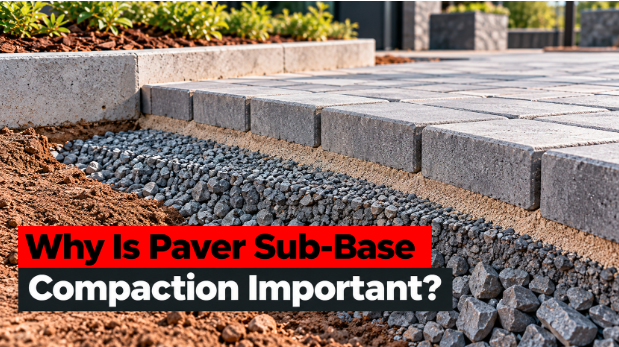
Paver sub-base compaction controls how well the supporting layers resist settlement and permanent deformation under traffic.
A weak or poorly compacted foundation allows wheel loads to create ruts and depressions in the finished surface.
In Pakistan, poor compaction can become especially damaging when monsoon rainfall saturates an inadequately drained pavement.
Understanding the Pavement Layers
Simplified interlocking pavement section — not to scale
Interlocking concrete pavers
Jointed bedding sand layer
Compacted aggregate base
Granular sub-base, if specified
Prepared and compacted subgrade
Layer thicknesses and materials must follow the approved pavement design.
Why Soil Conditions Matter
The same paver may perform differently on two sites.
For example, a site with firm, well-drained subgrade may require a different foundation design from a site containing uncontrolled fill or water-sensitive clay.
A pavement engineer may use parameters such as the California Bearing Ratio (CBR) or other geotechnical test results to evaluate supporting ground conditions.
The design must also consider drainage, traffic repetitions, and material properties.
Which Paver Laying Pattern Performs Best Under Wheel Loads?
A herringbone pattern is often preferred for rectangular concrete pavers in vehicular areas because it improves resistance to horizontal movement and works effectively with the interlocking pavement system.
Common patterns include:
Herringbone Pattern
The herringbone pattern arranges rectangular pavers at alternating angles.
It can improve resistance to the forces generated when vehicles brake, accelerate, or turn.
Both 45-degree and 90-degree herringbone arrangements appear in vehicular paving applications.
Stretcher Bond Pattern
Stretcher bond uses rows of offset pavers.
It is common in pedestrian and landscaping applications, but its performance under significant vehicular forces depends on alignment, restraint, and design.
Basketweave Pattern
Basketweave produces a decorative arrangement.
It may suit selected lower-traffic areas, although appearance alone should not determine the pattern for heavy-duty pavement.
PrimeCrete’s guide to the best paver block pattern for car parking provides a more detailed comparison of laying arrangements.
How Do Turning and Braking Forces Damage Pavers?
Vehicle wheels do not apply purely vertical loads.
When a vehicle brakes or turns, tyre forces create horizontal stresses at the pavement surface.
These forces may cause:
- Joint widening
- Block rotation
- Lateral creep
- Movement near pavement edges
- Distortion around turning areas
- Localized displacement near loading bays
The problem often becomes noticeable near gates, ramps, petrol stations, and sharp corners.
Why Edge Restraints Matter
Concrete kerbs and other approved restraints prevent pavers from moving outward.
Without adequate restraint, repeated horizontal forces can open joints and weaken interlock.
A properly compacted foundation cannot fully compensate for missing edge support.
Can Heavy Wheel Loads Crack Concrete Pavers?
Yes. Heavy wheel loads can contribute to cracking, especially where the pavement has inadequate support, unsuitable paver units, or loading that exceeds the engineered design.
However, not every crack indicates an excessively heavy vehicle.
Common Causes of Cracking
Insufficient base support: A soft area beneath a paver can allow bending under vehicle loads.
Poor bedding preparation: Uneven bedding creates concentrated contact points.
Incorrect paver selection: A unit unsuitable for the application may not withstand the anticipated loading and repetitions.
Missing edge restraint: Lateral displacement can introduce movement and uneven support.
Material defects: Units with poor compaction, inadequate curing, or other manufacturing defects may fail prematurely.
PrimeCrete’s existing guide, Can Interlocking Paver Blocks Crack Under Cars?, discusses the causes of driveway-related paver failures.
How Does Monsoon Rain Affect Heavy-Duty Paver Pavements?
Rainwater can reduce pavement performance when drainage defects allow saturation, erosion, pumping of fine materials, or loss of subgrade strength.
Interlocking concrete pavers have joints that can admit water.
Unless the system is specifically designed as a permeable pavement, contractors should not assume that water passing through joints will drain safely into the ground.
The pavement design needs adequate surface drainage and appropriate management of water within the pavement structure.
Common Rain-Related Failures
Poorly drained pavements may develop:
- Settled patches
- Uneven blocks
- Loss of jointing sand
- Localized erosion
- Water ponding
- Loss of support near kerbs and drains
Regular maintenance should include inspecting drainage outlets, joint material, edge restraints, and settlement after heavy rainfall.
How Should Contractors Specify Pavers for Different Traffic Areas?
A proper specification should identify the intended vehicles and traffic intensity before selecting materials.
| Application | Key design considerations |
| Residential driveway | Passenger cars, occasional deliveries, drainage |
| Commercial parking | Repeated vehicle movement, turning, braking |
| Housing society street | Axle loads, vehicle frequency, utility trenches |
| Petrol station | Turning loads, drainage, fuel exposure considerations |
| Industrial yard | Heavy axles, forklifts, concentrated loads |
| Loading dock | Slow-moving trucks, high repetitions, concentrated loading |
A petrol station, for example, may experience frequent turning and braking near fuel pumps.
An industrial yard may receive relatively slow but heavy vehicle movements.
These applications can require different pavement designs despite using similar-looking concrete pavers.
What Should Buyers Check Before Ordering Heavy-Duty Concrete Pavers?
Before purchasing heavy-duty concrete pavers, contractors should review the approved drawings, traffic requirements, and product specifications.
A practical checklist includes:
- Confirm the intended vehicle categories and axle loads.
- Establish design traffic and expected repetitions.
- Verify actual paver dimensions and thickness.
- Obtain the relevant laboratory test reports.
- Check the specified product standard.
- Confirm laying pattern and joint requirements.
- Review bedding sand grading and thickness.
- Check aggregate base and sub-base specifications.
- Confirm subgrade preparation and acceptance testing.
- Include drainage and edge restraints in the design.
- Plan delivery inspections and replacement allowances.
- Review maintenance access and expected service conditions.
The BSI standards development programme for modular paving installation identifies installation-related standards work that may be relevant when establishing specification requirements.
For larger commercial projects, buyers should also request evidence that the proposed pavement assembly is suitable for the actual loading rather than relying on a product label such as “industrial grade.”
Frequently Asked Questions
Can 60 mm paver blocks carry cars?
They may be suitable for some light-vehicle applications under an appropriate design, but thickness alone cannot confirm load capacity.
Are 80 mm pavers suitable for commercial parking?
They are commonly considered for vehicular paving, subject to traffic loads, foundation design, and the applicable product standard.
Do 100 mm pavers prevent cracking?
No. Thicker units may suit more demanding designs, but they still need adequate bedding, base strength, jointing, and edge restraint.
What causes paver blocks to sink under vehicle tyres?
Common causes include weak subgrade, insufficient compaction, water-related loss of support, and poorly constructed pavement layers.
Can interlocking pavers handle truck traffic?
Yes, engineered interlocking concrete pavement systems can support truck traffic. The pavement must be designed for the anticipated axle loads, traffic repetitions, and ground conditions.
Does concrete strength determine the maximum vehicle weight?
Not by itself. Complete pavement capacity depends on unit quality, thickness, base construction, subgrade, drainage, and cumulative traffic effects.
Conclusion
Wheel loads on interlocking paver blocks affect far more than the visible concrete surface.
Traffic stresses pass through the joints, bedding, base, and supporting soil. When one layer lacks sufficient strength or support, the pavement can develop cracks, settlement, joint movement, or surface deformation.
For Pakistan’s residential driveways, housing society roads, parking areas, petrol stations, and industrial facilities, a successful project begins with appropriate traffic assessment and engineered pavement construction.
PrimeCrete manufactures interlocking concrete paving products for a range of residential, commercial, and infrastructure applications.
Contact PrimeCrete to discuss the required paver type, dimensions, specifications, and project-based quotation.
