
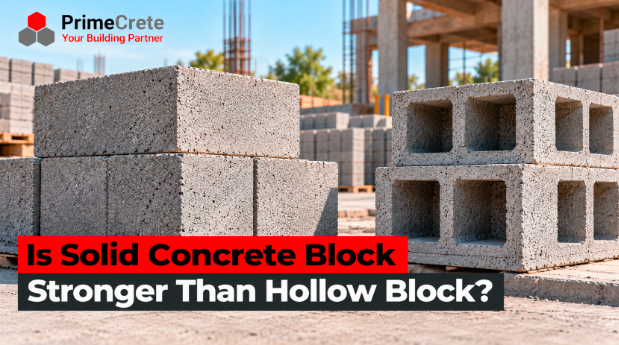
A contractor selecting masonry for a boundary wall, residential building, or commercial project often faces the same question: are solid concrete blocks stronger than hollow concrete blocks? The answer affects structural design, wall weight, material quantities, labour costs, and construction safety. Before placing an order, buyers should examine the specifications of the solid concrete blocks manufactured by PrimeCrete rather than assume that heavier blocks always provide better performance.
PrimeCrete, a concrete-products brand of Pak Dream (Pvt) Ltd, manufactures concrete masonry products at Hattar Industrial Estate in Haripur, Khyber Pakhtunkhwa. Its products serve residential, commercial, and infrastructure construction. This guide explains the engineering differences between solid and hollow blocks, relevant strength standards, common applications, and practical considerations for Pakistani construction projects.
Are Solid Concrete Blocks Stronger Than Hollow Blocks?
Solid concrete blocks are not automatically stronger than hollow concrete blocks. A solid unit generally contains more concrete and weighs more when both units use similar materials and dimensions. However, actual compressive strength depends on the concrete mix, manufacturing process, curing, geometry, and tested net cross-sectional area.
A properly manufactured hollow block can meet the same loadbearing masonry-unit strength requirements as a solid block.
What Makes a Concrete Block Strong?
The main factors influencing concrete block strength include:
- Concrete mix design: Cement content, aggregate grading, water control, and admixtures influence strength.
- Compaction: Consistent vibration and compression reduce unwanted voids.
- Curing: Adequate curing allows cement hydration and strength development.
- Block geometry: Wall thickness, webs, cores, and total cross-sectional area influence load resistance.
- Manufacturing consistency: Controlled production reduces variation between batches.
A solid block with poor curing may perform worse than a properly manufactured hollow block.
Understanding Compressive Strength
Compressive strength measures the stress a masonry unit can resist under a compressive load before failure.
Engineers normally express this property in megapascals (MPa) or pounds per square inch (PSI).
1 MPa ≈ 145 PSI.
Under ASTM C90, a commonly referenced benchmark for loadbearing concrete masonry units is an average net-area compressive strength of 13.8 MPa (2,000 PSI) for three tested units, subject to the applicable edition and its individual-unit requirements.
Both solid and hollow units can meet this benchmark. ASTM C90 does not require a masonry unit to be solid to qualify for loadbearing applications.
The authoritative ASTM C90 specification for loadbearing concrete masonry units covers both types.
Solid Concrete Block vs Hollow Concrete Block: Key Differences
Both products use cementitious concrete, but their internal configurations create different handling and construction characteristics.
| Property | Solid concrete block | Hollow concrete block |
| Internal structure | Predominantly solid | Contains formed hollow cores |
| Unit weight | Usually higher | Usually lower |
| Concrete consumption | Generally greater | Generally lower |
| Loadbearing suitability | Possible with compliant units | Possible with compliant units |
| Reinforcement placement | May require special detailing | Cores may accommodate reinforcement |
| Handling | Heavier for equivalent dimensions | Often easier |
| Thermal performance | Depends on density and wall assembly | Cores can influence heat transfer |
| Typical uses | Walls, foundations where specified, heavy-duty masonry | Partitions, infill, engineered loadbearing walls |
This comparison assumes broadly similar external dimensions and concrete density.
Does More Concrete Mean More Strength?
Not necessarily.
Consider two blocks with the same exterior dimensions. The solid block has more material, so its total compressive failure load may be higher if the material strengths are otherwise equal.
However, compressive strength is a stress measurement, not simply the total force required to crush a block.
For hollow masonry units, net-area strength calculations account for the actual concrete-bearing area, excluding the hollow cores.
Consequently, comparing a solid unit’s gross-area value directly with a hollow unit’s net-area value can produce a misleading result.
Which Concrete Block Is Better for Loadbearing Walls?
Both solid concrete blocks and suitable hollow concrete blocks can serve in loadbearing walls when their specifications meet the structural design.
The engineer must assess more than unit strength.
Solid Blocks in Structural Applications
Solid blocks may offer practical benefits where the design requires dense masonry, suitable bearing details, or particular fixing arrangements.
Typical applications include:
- Boundary and perimeter walls
- Loadbearing masonry walls
- Selected foundation masonry
- Industrial buildings
- Areas requiring robust local detailing
However, solid masonry does not eliminate the need for reinforced-concrete elements, movement joints, or appropriate foundation design.
For example, a tall boundary wall exposed to wind may require reinforced columns, continuous foundations, and horizontal reinforcement regardless of the block type.
Hollow Blocks in Structural Applications
Properly designed hollow masonry can provide reliable structural performance.
Hollow cores may accommodate vertical reinforcing steel and grout, enabling engineers to create reinforced masonry elements.
These structural benefits depend on the complete assembly, including grout strength, steel placement, anchorage, mortar, and construction quality.
A hollow block should never be treated as structurally suitable solely because it appears substantial.
For additional purchasing considerations, PrimeCrete’s guide to solid concrete block sizes, strength, and buying decisions in Pakistan explains relevant unit-selection factors.
How Do Solid and Hollow Blocks Compare in Weight?
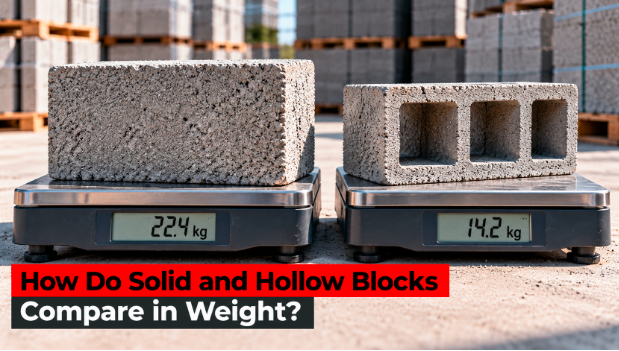
A solid concrete block usually weighs more than a hollow unit made with concrete of similar density.
Consider an illustrative unit with dimensions of 400 × 200 × 200 mm.
Its gross volume is:
0.40.20.2=0.016m3
At an assumed dry concrete density of 2,200 kg/m³, a completely solid rectangular unit would weigh approximately:
0.0162200=35.2kg
If a hollow unit with the same external dimensions contained 50% net concrete volume, its estimated dry weight would be:
35.20.50=17.6kg
These figures are illustrative calculations, not PrimeCrete product weights. Real products have dimensional tolerances, face shells, webs, varying aggregate densities, and moisture content.
Why Does Block Weight Matter?
Unit weight influences:
- Structural dead load
- Foundation design
- Material transportation
- Manual handling
- Installation productivity
- Construction logistics
For a multi-storey project, cumulative masonry dead load can become a significant design consideration.
Do Solid Concrete Blocks Offer Better Thermal Insulation?
A solid block does not automatically provide better insulation.
Thermal performance depends on concrete density, aggregate composition, wall thickness, cavities, insulation, finishes, and the complete wall assembly.
Dense concrete generally conducts heat more readily than lightweight concrete with a porous aggregate structure.
Hollow cores can alter heat transfer, but their benefit depends on cavity geometry and the complete wall construction.
In Islamabad, Lahore, and other Pakistani cities experiencing high summer temperatures, architects should examine wall-assembly thermal resistance rather than select blocks based on their appearance.
Exterior insulation, reflective roof finishes, suitable glazing, and shading can also significantly affect indoor comfort.
How Should Contractors Test Concrete Block Strength?
Contractors should request representative laboratory results rather than judge masonry-unit strength by colour, surface texture, or weight.
ASTM C140/C140M provides procedures for sampling and testing concrete masonry units, including dimensional measurements, compression, absorption, and density.
The ASTM C140/C140M testing standard helps establish consistent test methods.
Important Tests Before Bulk Procurement
| Test | Purpose |
| Compressive strength | Evaluates resistance to compression |
| Dry density | Establishes masonry-unit weight classification |
| Water absorption | Assesses absorption characteristics |
| Dimensional accuracy | Checks compliance with specified dimensions |
| Visual inspection | Identifies cracks, damaged corners, and manufacturing defects |
A project submittal should identify the exact product, specified standard, relevant edition, test results, and approved application.
ASTM C129 applies to specified nonloadbearing dry-cast units and should not replace ASTM C90 where loadbearing performance is required.
Which Blocks Are More Economical in Pakistan?
The cheapest block per piece does not necessarily create the least expensive wall.
The final installed cost depends on unit dimensions, block consumption, mortar, labour, transportation, breakage, and structural requirements.
Compare the Cost per Square Metre
Suppose a wall uses nominal 400 × 200 mm modules.
The theoretical block quantity is:
10.40.2=12.5blocks/m2
For a 100 m² wall:
10012.5=1,250blocks
This assumes that the specified 400 × 200 mm dimensions already include the intended mortar-joint module.
Contractors must deduct openings and add an appropriate cutting and breakage allowance.
The final estimate should also consider mortar, handling, waste, and any reinforcement or grouting.
PrimeCrete’s solid concrete block wall cost estimation guide provides additional planning considerations for Pakistani projects.
Common Mistakes When Selecting Solid or Hollow Blocks
Selecting Blocks Based Only on Weight
Heavy units are not necessarily stronger. Weight alone cannot verify concrete quality or compressive performance.
Ignoring the Structural Drawing
Contractors sometimes substitute hollow blocks for solid blocks without engineering approval.
Such changes can affect wall dead load, reinforcement, connections, and structural behaviour.
Comparing Different Strength Measurements
Gross-area strength and net-area strength are not interchangeable.
Always confirm the testing method and reported basis.
Using Weak Mortar
Even strong masonry units can perform poorly when the mortar is unsuitable or joints lack proper workmanship.
Ignoring Moisture Exposure
Boundary walls and exterior masonry exposed to monsoon rainfall require suitable caps, flashings, waterproofing details, and drainage.
Frequently Asked Questions
Are Hollow Blocks Weaker Than Solid Blocks?
Not necessarily. Hollow blocks can achieve the required compressive strength for loadbearing construction when manufactured and tested to an appropriate standard.
Which Block Is Better for a 5-Marla House?
The best option depends on the structural system, wall thickness, loading, and engineer’s specifications. Lightweight or hollow units may be useful in reinforced-concrete frame construction, while other applications may specify solid masonry.
Can Solid Blocks Be Used for Boundary Walls?
Yes. However, wall height, wind exposure, foundation conditions, columns, and reinforcement still require appropriate design.
Is a 2,000 PSI Hollow Block Acceptable for Loadbearing Work?
A reported 2,000 PSI net-area compressive strength may meet the average unit-strength benchmark associated with ASTM C90, but one number alone does not establish product compliance or structural suitability.
Conclusion: Which Concrete Block Should You Choose?
The choice between solid concrete blocks and hollow concrete blocks should depend on tested strength, density, wall function, structural requirements, and total installed cost.
Solid blocks typically offer greater material mass, while hollow blocks can reduce weight and provide opportunities for reinforced masonry construction.
For construction projects in Pakistan, PrimeCrete can assist contractors, architects, and procurement teams with product selection and quotations based on project-specific requirements.
