
When estimating masonry for a house, apartment building, or commercial project in Pakistan, block weight matters as much as unit dimensions. Heavy masonry increases the loads transferred to slabs, beams, columns, and foundations. Contractors comparing conventional units with PrimeCrete lightweight concrete masonry units should understand the difference between normal-weight concrete masonry units, lightweight alternatives, and the actual weight of an individual block.
PrimeCrete is a concrete-products brand of Pak Dream (Pvt) Ltd, with manufacturing operations at Hattar Industrial Estate, Haripur. Its masonry product range includes normal-weight and lightweight construction solutions. This article explains concrete masonry density classifications, calculates approximate weights for common block sizes, and shows how weight affects material selection, structural loads, logistics, and construction costs in Pakistan.
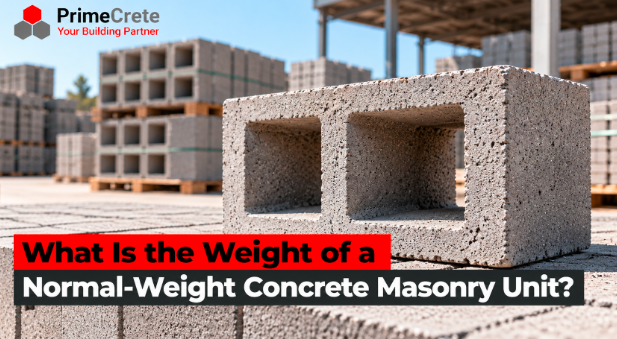
What Is the Weight of a Normal-Weight Concrete Masonry Unit?
A normal-weight concrete masonry unit (CMU) has an oven-dry concrete density of at least 2,000 kg/m³ (125 lb/ft³) under the commonly used ASTM density classification.
However, the weight of an individual block depends on external dimensions, net concrete volume, and moisture content.
For example, a nominal 400 × 200 × 200 mm hollow block with an assumed 50% solid volume and a dry concrete density of 2,200 kg/m³ would weigh approximately 17.6 kg.
A block with different core dimensions or density could weigh considerably more or less.
What Is a Concrete Masonry Unit?
A concrete masonry unit, or CMU, is a manufactured concrete building unit used to construct walls and other masonry elements.
Manufacturers produce CMUs using cementitious binders, aggregates, water, and, where appropriate, admixtures.
CMUs are available in several configurations, including solid, hollow, lightweight, medium-weight, and normal-weight units.
Normal-Weight, Medium-Weight, and Lightweight CMUs
ASTM C90 recognizes three density classifications based on oven-dry concrete density.
| Classification | Oven-dry density |
| Lightweight CMU | Less than 1,680 kg/m³ (105 lb/ft³) |
| Medium-weight CMU | 1,680 to less than 2,000 kg/m³ (105 to less than 125 lb/ft³) |
| Normal-weight CMU | At least 2,000 kg/m³ (125 lb/ft³) |
These classifications refer to the density of the concrete material, not the overall external volume of a hollow block.
ASTM C90 provides the relevant masonry-unit framework, while ASTM C140/C140M provides measurement and testing procedures.
How Do You Calculate the Weight of a Concrete Block?
The basic calculation multiplies concrete density by the actual volume of concrete within the unit.
\[ \text{Weight (kg)}=\text{Concrete volume (m}^3\text{)}\times\text{Density (kg/m}^3\text{)} \]
For a completely solid rectangular block, calculate the volume by multiplying length, width, and height.
For a hollow block, subtract the internal core volume or use the manufacturer’s measured net volume.
Example 1: Solid Concrete Block
Assume a block measuring:
- Length: 400 mm
- Height: 200 mm
- Width: 100 mm
- Density: 2,200 kg/m³
Convert dimensions into metres:
0.40.20.1=0.008m3
Estimated dry weight:
0.0082200=17.6kg
Example 2: Hollow Concrete Block
Assume external dimensions of 400 × 200 × 200 mm.
Gross volume:
0.40.20.2=0.016m3
Suppose the block’s face shells and webs occupy 50% of the gross volume.
Net concrete volume:
0.0160.50=0.008m3
Estimated dry weight:
0.0082200=17.6kg
Both examples weigh approximately the same despite having different thicknesses and internal configurations.
That illustrates why external dimensions alone cannot predict block weight reliably.
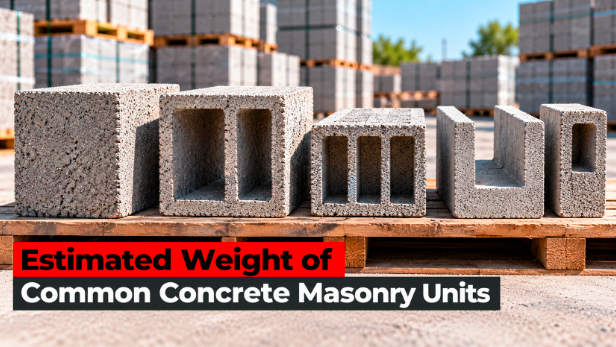
Estimated Weight of Common Concrete Masonry Units
The following table uses an assumed dry concrete density of 2,200 kg/m³ for all units.
For hollow units, the calculations assume a 50% solid-volume fraction.
| Actual dimensions | Type | Illustrative dry weight |
| 400 × 200 × 100 mm | Solid | 17.6 kg |
| 400 × 200 × 150 mm | Solid | 26.4 kg |
| 400 × 200 × 200 mm | Solid | 35.2 kg |
| 400 × 200 × 100 mm | Hollow | 8.8 kg |
| 400 × 200 × 150 mm | Hollow | 13.2 kg |
| 400 × 200 × 200 mm | Hollow | 17.6 kg |
These figures are calculations based on stated assumptions, not measured PrimeCrete specifications or guaranteed product weights.
Actual units may use different dimensions, shell thicknesses, core arrangements, aggregates, and moisture levels.
What Is the Difference Between Normal-Weight and Lightweight Concrete Blocks?
The principal difference is concrete density, although strength, absorption, thermal characteristics, and construction costs can also vary.
Normal-Weight Concrete Masonry
Normal-weight concrete blocks generally use conventional aggregates such as crushed stone and sand.
Their relatively high density contributes to greater unit mass.
Potential applications include conventional masonry construction, engineered loadbearing walls, partitions, and boundary walls.
The specific structural application depends on demonstrated strength and the wall design.
Lightweight Concrete Masonry
Lightweight concrete masonry units use materials or manufacturing approaches that reduce concrete density.
PrimeCrete’s lightweight product page describes units incorporating natural pumice aggregate.
Pumice contains internal pores that can reduce density and thermal conductivity.
However, the exact thermal and structural performance of any product requires its own test data.
Why Lightweight Blocks Are Useful in Pakistan
For projects with substantial partition-wall areas, reducing masonry weight can decrease total dead load.
That benefit may be relevant for:
- Multi-storey residential buildings
- Commercial offices
- Hospitals and educational buildings
- Renovation projects
- Reinforced-concrete framed structures
Engineers must still verify the required strength, wall connections, sound insulation, and fire-resistance requirements.
Lightweight does not automatically mean nonloadbearing.
How Does Concrete Block Weight Affect Structural Dead Load?
Dead load refers to the relatively permanent weight of structural and nonstructural building components.
Walls contribute dead load to the supporting structure.
Consider a wall area of 100 m² using a nominal 400 × 200 mm block module.
Theoretical consumption:
10012.5=1,250blocks
If the dry weight of each block is 17.6 kg:
1,25017.6=22,000kg
The block-only mass is approximately 22 metric tonnes.
If an alternative compliant masonry unit weighs 12 kg:
1,25012=15,000kg
The difference is:
22,000-15,000=7,000kg
That represents 7 metric tonnes less block mass across the example wall area.
However, a complete wall dead-load calculation must also include mortar, plaster, grout, reinforcement, finishes, and relevant moisture conditions.
The structural engineer must calculate the actual impact on the building.
Does Higher Block Weight Mean Greater Compressive Strength?
No. Concrete density and compressive strength are different material properties.
A normal-weight block can have relatively low compressive strength if manufacturing or curing is inadequate.
A lightweight block can meet loadbearing requirements when its mix design, geometry, and production quality achieve the necessary performance.
The important distinction is between:
- Density: Mass per unit volume of concrete.
- Compressive strength: Resistance to compressive stress.
- Unit weight: Weight of an individual block.
- Wall dead load: Weight of the completed wall assembly.
Engineers should avoid using one of these measurements as a substitute for another.
The ASTM C90 masonry-unit specification covers normal-weight, medium-weight, and lightweight units, while the ASTM C140/C140M test methods describe procedures for measuring density and compressive strength.
How Does Block Weight Affect Construction Costs?
Heavier units can increase costs associated with transportation, handling, and lifting.
However, a cheaper lightweight unit is not guaranteed to produce a cheaper wall, and a heavier unit is not automatically less economical.
Transport Costs
Truck capacity depends on legal payload limits, vehicle configuration, and loading arrangements.
Heavy masonry may reach vehicle weight limits before available loading space is fully occupied.
Labour Productivity
Individual unit weight influences handling difficulty and installation workflow.
Large or heavy blocks may require mechanical assistance or special handling procedures.
Structural Implications
Reduced masonry dead load may influence member sizing in some designs, but that outcome requires structural analysis.
Contractors should not assume they can reduce slab, beam, or column dimensions simply by changing block type.
For estimating guidance, PrimeCrete’s solid concrete block wall construction cost guide explains additional cost factors.
Its complete guide to solid concrete blocks in Pakistan also covers unit selection and specification considerations.
What Should Contractors Check Before Ordering CMUs?
Procurement teams should request the exact dimensions, average dry unit weight, concrete density classification, compressive-strength test results, and applicable product standard.
Confirm Whether the Quoted Weight Is Dry or Wet
Blocks can absorb moisture during storage and transportation.
A wet unit may weigh more than its oven-dry equivalent.
For accurate structural calculations, engineers should use the specified design density and relevant wall-assembly loads rather than relying only on a supplier’s informal per-piece estimate.
Verify Loadbearing Suitability
If the wall contributes to the building’s structural load path, confirm that the specified units comply with the approved masonry design.
Review Delivery Quantities
A quantity surveyor should convert wall areas into block counts using actual modular dimensions, deduct openings, and include realistic allowances.
Frequently Asked Questions
How Much Does an 8-Inch Concrete Block Weigh?
An 8-inch nominal hollow block has no universal weight. Its mass depends on dimensions, core volume, density, and moisture content. The manufacturer’s measured dry unit weight provides the most reliable answer.
What Is the Density of Normal-Weight CMU?
Under ASTM density classification, normal-weight CMU has an oven-dry concrete density of at least 2,000 kg/m³, equivalent to approximately 125 lb/ft³.
Are Lightweight Concrete Blocks Weaker?
Not necessarily. Strength depends on the specific product and its test results rather than density classification alone.
Can Lightweight Blocks Reduce Building Loads?
Yes. A lighter masonry system can reduce wall dead load, but any resulting structural-design changes require engineering approval.
Conclusion
The weight of a normal-weight concrete masonry unit depends on unit dimensions, concrete density, internal geometry, and moisture content.
Normal-weight concrete has a density of at least 2,000 kg/m³, but individual hollow units may weigh substantially less than solid units of identical external dimensions.
For construction projects in Pakistan, PrimeCrete offers masonry product options that contractors can evaluate according to structural requirements, handling conditions, and construction budgets.
