
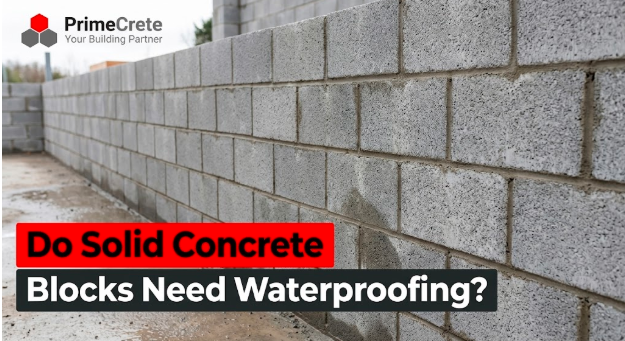
A boundary wall in Rawalpindi goes up in solid concrete blocks, gets plastered, gets painted and looks finished. Then the first heavy monsoon spell arrives, and within weeks a damp band creeps up from the base and white salt marks bloom along the plinth. The owner blames the blocks. Usually, nobody ever designed the wall to handle water.
At PrimeCrete, we manufacture solid concrete blocks for load-bearing walls, foundations, basements and boundary walls, and the waterproofing question comes up on almost every site. This guide explains when solid blocks need waterproofing, when plaster and good detailing are enough, and what to specify for walls above ground, at plinth level and below ground in Pakistani conditions.
The Short Answer
Not always, but more often than people expect. Solid concrete blocks are dense, yet still porous. Above-ground exterior walls usually rely on plaster, a breathable paint or water repellent, sound mortar joints and good detailing. Walls in contact with soil, such as basements, retaining walls and foundation walls, need a dampproofing or waterproofing system plus drainage. A damp-proof course at plinth level stops ground moisture rising into the wall.
Why Solid Concrete Blocks Still Absorb Water
A solid concrete block is a concrete masonry unit (CMU) with no cores, or only minimal voids, made from cement, aggregates and water that a block machine compacts and vibrates into a dense unit. Dense does not mean waterproof. Hardened concrete contains a network of fine capillary pores, and water travels through them.
Standards accept this openly. ASTM C90, the specification for loadbearing concrete masonry units, covers both hollow and solid units and caps average water absorption by density class: 18 lb/ft³ (about 288 kg/m³) for lightweight units, 15 lb/ft³ (about 240 kg/m³) for medium-weight units and 13 lb/ft³ (about 208 kg/m³) for normal-weight units. Those limits screen out poorly compacted or under-cured blocks, but they also confirm that every compliant block absorbs some water.
Absorption Is Not the Same as Leakage
Absorption measures how much water a block soaks up when immersed. Leakage describes water passing through a finished wall, and it depends on the whole assembly. The Concrete Masonry & Hardscapes Association (formerly NCMA) states in its technical note on water repellents for concrete masonry walls that water penetration resistance depends on wall design, design for movement, workmanship, maintenance and the use of water repellents.
In practice, rainwater usually finds the weak points first: unfilled or raked mortar joints, hairline shrinkage cracks, gaps around window frames, flat parapet and boundary-wall tops, and the junction where the wall meets the ground. The same leakage paths explain why water enters hollow concrete block walls, so switching from hollow to solid blocks will not cure a badly detailed wall.
When Does a Solid Block Wall Need Waterproofing?
The right protection depends on where the wall sits and what kind of water reaches it.
| Wall location | Main water source | Typical protection |
| Exterior wall above ground | Wind-driven monsoon rain | Cement-sand plaster, breathable exterior paint or clear repellent, full mortar joints, window sills with drips |
| Plinth and wall base | Rising ground moisture, rain splash-back | Damp-proof course at plinth level, ground sloped away from the wall |
| Boundary wall | Rain on both faces and the top, ground moisture | Sloped coping, plaster on both faces, DPC |
| Basement or retaining wall | Damp soil, groundwater under pressure | Exterior dampproofing or waterproofing, drainage, free-draining backfill |
| Bathroom or water-tank wall | Direct water from use | Wet-area waterproofing behind tiles, as specified |
| Interior partition | Usually none | No waterproofing needed |
Protecting Above-Ground Walls From Monsoon Rain
For most houses in Islamabad, Lahore or Peshawar, a well-applied cement-sand plaster is the first line of defence. Paint or a water repellent then reduces how much rain the plaster and blocks soak up.
The CMHA technical note gives several rules that matter on Pakistani sites:
- Keep coatings breathable. Treatments that block water vapour tend to blister and peel once moisture builds up behind the surface.
- Repair cracks first. Penetrating repellents such as silanes and siloxanes line the pores but do not bridge cracks or voids.
- Apply on a clean, dry wall. Allow three to five days after rain or cleaning before applying a repellent, so avoid treating walls in the middle of a monsoon spell.
- Respect fresh mortar. On new work, choose a repellent that resists alkalinity, or let the wall weather for about six months.
- Plan for maintenance. Surface repellents need reapplication after a period of years.
Integral water repellents, added to the concrete mix at the block plant, work only when the same admixture also goes into the site mortar. Ask your supplier whether treated units are available before you specify them.
Below Ground: Dampproofing, Waterproofing and Drainage
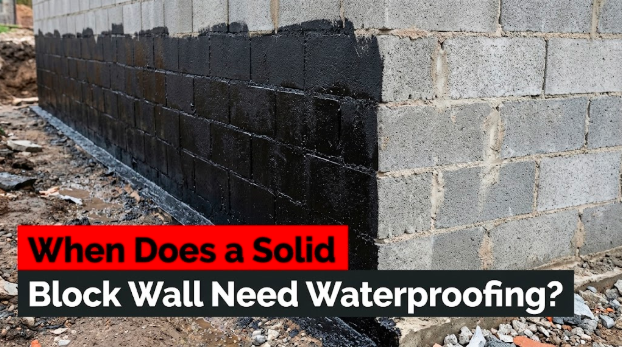
Basement walls and retaining walls face a harder job. Soil moisture constantly migrates from the damp ground toward the drier interior, and the CMHA guidance on preventing water penetration in below-grade concrete masonry walls describes protection as a continuous barrier to both water and water vapour, normally applied to the outside face.
The distinction matters. Dampproofing resists soil moisture where no water pressure builds up. Waterproofing resists water under hydrostatic pressure, which can occur where the water table is high or where a sloping plot funnels monsoon runoff against the wall. A drain at footing level and free-draining backfill relieve that pressure. Your structural engineer or waterproofing consultant should select the system; plaster and paint on the inside face are not a substitute.
Checklist Before You Build
- Confirm whether each wall is above ground, at plinth level or retaining soil.
- Specify a damp-proof course at plinth level and slope the ground away from the wall.
- Ask for water absorption and compressive strength test results, not just a visual check. Under-cured units absorb more water, so learn how to spot weak or under-cured solid concrete blocks before you accept a delivery.
- Insist on full, tooled mortar joints rather than raked or hollow joints.
- Detail copings, sills and drips so water runs off, not into, the wall.
- Choose breathable, alkali-resistant exterior coatings.
Common Mistakes to Avoid
- Painting over a damp wall. Trapped moisture lifts the paint, and the salt stains return.
- Treating the inside face of a basement wall only. Water still saturates the blocks from the soil side.
- Skipping the DPC to save a day. Rising damp then wicks up the wall for the life of the building.
- Expecting a sealer to fix cracks. Penetrating repellents do not bridge them; repair first.
Frequently Asked Questions
Are solid concrete blocks waterproof?
No. They are dense and durable, but concrete is porous, and standards such as ASTM C90 set maximum absorption limits rather than requiring zero absorption.
Do solid blocks need waterproofing for a boundary wall?
Usually they need a DPC at the base, a sloped coping on top and plaster on both faces. A full waterproofing membrane is rarely needed unless the wall also retains soil.
Is plaster enough to stop damp?
Plaster handles rain on above-ground walls when it is crack-free and well cured. It does not stop rising damp or groundwater pressure.
Are solid blocks better than hollow blocks in wet areas?
Solid blocks have no cores to collect water, but performance still depends on joints, detailing and protection. Neither type replaces proper waterproofing below ground.
Conclusion
Solid concrete blocks do not need waterproofing by default, but the wall they build often does, depending on where it sits. Match the protection to the water source: plaster and breathable treatments above ground, a DPC at plinth level, and a proper dampproofing or waterproofing system with drainage below ground. Start with well-made, properly cured blocks and verified test data. PrimeCrete can help contractors, developers and homeowners review solid block options and supply requirements for projects across Pakistan.
