
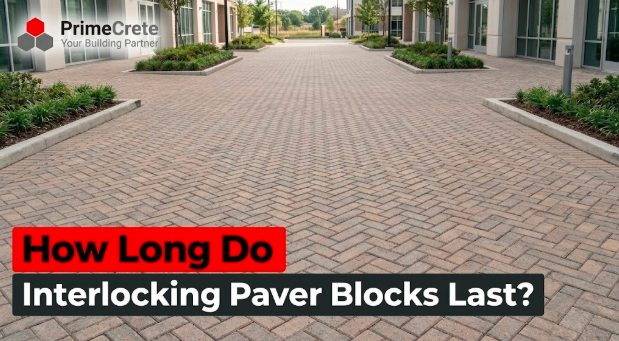
Two housing-society streets in Islamabad get paved in the same year with similar-looking blocks. A decade later, one still carries traffic smoothly. The other has ruts at every gate, loose blocks near the drains and a wavy surface that looks tired. Same product category, very different life. The difference almost always sits below and around the pavers, not in the brochure.
At PrimeCrete, we manufacture interlocking paver blocks for driveways, parking areas, footpaths, petrol stations and housing-society roads. This guide explains how long interlocking pavers realistically last, what shortens or extends that life in Pakistani conditions, and what to check before you buy and install.
The Short Answer
A well-designed and properly built interlocking concrete pavement is typically designed for 20 to 40 years of service, and individual pavers often outlast that because they can be lifted and reused. Real life depends on paver quality, thickness, base design, compaction, drainage, edge restraint, traffic and maintenance. A poorly built paver surface can fail within one or two monsoons, even with good blocks.
Paver Life vs Pavement Life
People ask “how long do pavers last?” but two different things are being measured.
Paver life is how long the individual concrete unit resists wear, cracking and surface damage. Quality pavers are dense, strong units, and the unit itself is rarely the first part to fail.
Pavement life is how long the whole system, including pavers, bedding sand, joint sand, base, subgrade and edge restraints, stays smooth and serviceable. The Concrete Masonry & Hardscapes Association (CMHA, formerly ICPI) notes in its guide to the structural design of interlocking concrete pavement that the design life of these pavements is typically 20 to 40 years, chosen by the designer based on traffic and budget.
That distinction matters when you compare quotes. A cheaper paver on a well-built base can outperform a premium paver laid on loose fill.
What Field Evidence Shows
Long-term case studies support these design lives. In North Bay, Canada, the city paved a one-kilometre stretch of its main street with interlocking concrete pavement in 1983. A 20-year case study published through the Transportation Association of Canada reports that the pavement reached its 20-year design life while carrying around 8,000 vehicles a day, with minimal distress and very little maintenance, and engineers expected it to keep performing for many more years.
Pakistan has no freeze-thaw cycles like Canada, but it brings its own stresses: intense heat, heavy monsoon runoff, overloaded delivery vehicles and, in many places, weak or poorly compacted subgrades.
What Decides How Long Your Pavers Last
| Factor | Why it matters |
| Paver strength and absorption | Dense, well-cured units resist wear and breakage |
| Paver thickness | Thicker units spread vehicle loads and resist rotation |
| Base and sub-base | Carries the load; weak base causes ruts and sinking |
| Compaction | Loose layers settle under traffic and rain |
| Bedding sand | Uneven or thick bedding causes dips |
| Joint sand | Locks pavers together so they share load |
| Edge restraint | Stops pavers creeping outward |
| Drainage | Water softens the base and washes out sand |
| Traffic type | Truck turning and braking stress the surface most |
Paver Quality
In international practice, ASTM C936 sets the benchmark for solid interlocking concrete paving units, requiring an average compressive strength of at least 55 MPa (8,000 psi), with no single unit below 50 MPa, and average water absorption of no more than 5%. Those numbers reflect how dense and durable a paver must be to handle traffic. Mix quality and curing drive both properties, which is why it pays to understand how concrete mix quality affects paver life. Ask suppliers for test results against the standard your project specifies.
Thickness and Traffic
Common industry practice uses about 60 mm pavers for footpaths, patios and light residential driveways, and 80 mm or more for streets, commercial parking and areas with regular heavy vehicles. Industrial yards, petrol stations and bus routes need an engineered pavement design. Choosing a thin paver for a route used by water tankers or construction trucks is one of the fastest ways to shorten pavement life.
Base, Drainage and Edges
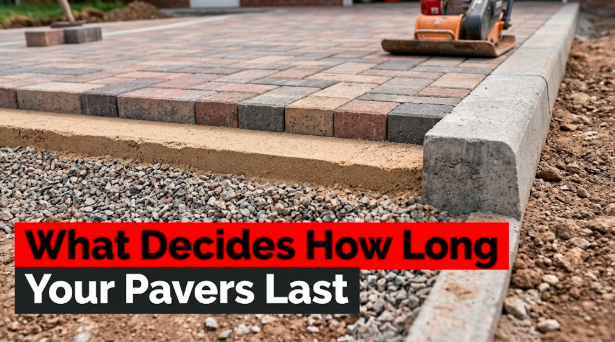
Most early failures in Pakistan trace back to what lies underneath. Common causes include:
- Pavers laid on loose soil or construction rubble
- Sub-base placed in one thick layer instead of compacted lifts
- No slope, so monsoon water ponds and softens the base
- Missing or weak kerbs, letting edge pavers spread
- Joints left half-empty, so pavers rock and chip
A paver surface can survive years of traffic and still sink in a month if someone treats sub-base compaction as an optional hobby.
Signs Your Paver Surface Needs Attention
- Ruts in wheel paths, usually a base or subgrade problem
- Sinking near drains or gutters, often from water washing out bedding sand
- Wide or empty joints, which reduce interlock
- Rocking or chipped edges, a sign of poor jointing or edge restraint
- Cracked units, typically point loads, thin pavers or voids underneath; see whether interlocking paver blocks can crack under cars
How Maintenance Extends Paver Life
Pavers are low-maintenance, not no-maintenance. CMHA describes routine care as sweeping, topping up joint sand and removing weeds, with sealers needing renewal every few years if used.
The big advantage is repair. When a section settles, crews can lift the pavers, correct the base, relay the same units and compact them, leaving no visible patch. A poured slab usually needs cutting and recasting. That reuse is why interlocking pavement often has a longer useful life than its original design period.
A practical routine for Pakistani sites:
- Inspect after every monsoon for low spots and washed-out joints
- Refill joint sand when joints drop noticeably
- Clear drains and channels before the rains
- Lift and relay settled areas early, before they spread
Frequently Asked Questions
Do interlocking pavers last longer than concrete slabs?
They often deliver longer useful service because damaged areas can be lifted and relaid with the same units. Actual life depends on design, construction and traffic for both systems.
Can pavers last 50 years?
The units themselves can remain usable for decades, especially if reinstated after base repairs. Pavement design lives are typically quoted at 20 to 40 years.
Why did my new paver driveway sink after one monsoon?
Usually poor base compaction, bedding sand washout or ponding water. The pavers are rarely the root cause.
What thickness should I use for a driveway?
About 60 mm is common for light residential driveways. Use 80 mm or more where heavier vehicles regularly enter.
Conclusion
Interlocking paver blocks can deliver decades of service, but the paver only provides part of that lifespan. The base, compaction, drainage, edge restraint and maintenance provide the rest. Specify strong, low-absorption pavers of the right thickness for the traffic, insist on a properly compacted and drained base, and inspect after each monsoon. PrimeCrete can help homeowners, contractors and developers choose the right paver for driveways, parking and road projects across Pakistan.
