
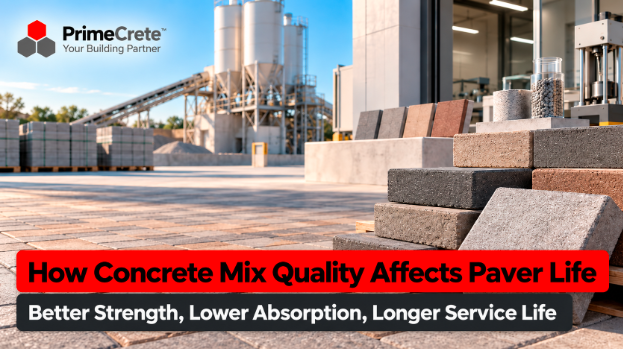
Two driveways go down on the same street in the same week. Five years later, one still looks sharp. The other looks like it lost a wrestling match with the monsoon. Same pattern, same cars, same weather. So what went wrong?
Nine times out of ten, the answer started long before installation day, inside a mixer. That is why concrete mix quality matters more than colour, shape or even price per piece. At Prime Crete, we run automated batching, mixing and pressing lines from Masa Germany and test our units in an on-site lab. Over 20+ years, one lesson keeps repeating itself: a paver can only last as long as the mix behind it.
In this guide, we break down how cement, water, aggregates and curing shape paver life. You will also learn which standards matter and how to spot a weak block before you pay for it, whether you are buying interlocking paver blocks for a home driveway or a busy factory yard.
What Concrete Mix Quality Really Means
A paver is simply a small, dense piece of concrete. And concrete follows a simple recipe: cement and water form a paste, and that paste glues sand and crushed stone together.
Here is the surprising part. According to the American Cement Association, cement typically makes up only 10 to 15 percent of a concrete mix by volume. Small share, huge responsibility. As cement reacts with water, it binds the aggregates into a rock-like mass. Get that reaction wrong, and the whole paver pays for it.
The Four Things That Decide Quality
- Cement: the binder that holds everything together.
- Water: it starts the chemical reaction, but too much of it weakens the result.
- Aggregates: sand and crushed stone that form the paver’s skeleton.
- Curing: the time and moisture the paver needs to actually gain strength.
Good concrete mix quality means the right materials, in the right proportions, in every single batch. Consistency matters as much as the recipe itself. One great batch followed by three average ones still gives you a patchy driveway.
How Concrete Mix Quality Affects Paver Life
Every weak paver has a backstory. Usually, it involves one of the four factors below.
Water-Cement Ratio: The Silent Strength Killer
The American Cement Association puts it plainly: with everything else equal, less water gives you stronger concrete. The same source notes that a low water-cement ratio and suitable aggregates reduce concrete’s permeability.
Why do some producers add extra water anyway? It makes the mix easier to handle. But that convenience costs you later. Extra water leaves behind tiny pores as it dries, and those pores let moisture, dirt and oil sneak in.
Think of it like biryani. Extra water goes in easily, but nobody is happy with the result.
Aggregate Quality: The Skeleton Inside Every Paver
Aggregates make up most of a paver, so their quality shows up fast. Clean, hard, well-graded sand and stone pack tightly and bond well with the cement paste.
Poor aggregates can also cause chemical trouble. The American Cement Association explains that alkalis in concrete can react with reactive silica in certain aggregates. This reaction forms a gel that swells with moisture and can crack the concrete. Choosing non-reactive aggregates is one of the common fixes.
Compaction and Pressing: Squeezing Out the Weak Spots
Pavers use a stiff, low-water mix that machines press and vibrate into moulds. Strong compaction pushes out trapped air and creates a dense block.
Uneven pressure creates uneven pavers. One block comes out dense; its neighbour comes out porous. That is why automated pressing lines, like the Masa systems we use, focus on uniformity in every cycle.
Curing: Where Strength Is Actually Earned
A freshly pressed paver is not finished. Concrete keeps hardening over time, and it gains most of its strength in the first few weeks. The American Cement Association lists proper curing as a key factor in strength, right next to quality materials and good mix design.
Rushing this stage is like pulling a cake out of the oven halfway through. It looks fine on top and disappoints underneath. If you want to see what weak curing looks like in practice, read our guide on how to spot weak or under-cured concrete blocks.
Paver Standards That Prove a Good Mix
You can’t see concrete mix quality with your eyes. You can, however, measure it. The most widely cited benchmark is ASTM C936, the American standard for solid interlocking concrete paving units.
According to the Concrete Masonry & Hardscapes Association (CMHA), ASTM C936 requires the following:
| Property | ASTM C936 Requirement | Why It Matters for Paver Life |
| Compressive strength | Average of at least 8,000 psi (55 MPa) | Resists cracking under wheels and heavy loads |
| Water absorption | Average no greater than 5% | Lower absorption means fewer pores for water and stains |
| Length and width | Within ±1.6 mm | Keeps joints even and the interlock tight |
| Height | Within ±3 mm | Prevents trip edges and rocking blocks |
Here is a fun fact. The American Cement Association says high-strength concrete typically means 8,000 psi or more. So a paver that meets ASTM C936 is basically high-strength concrete you park your car on.
Thickness Matters Too
A great mix in the wrong size still struggles. CMHA recommends 60 mm units for pedestrian areas, driveways and areas with limited vehicle use. For streets and industrial pavements, it recommends units at least 80 mm thick, ideally laid in a herringbone pattern.
Planning a yard for heavy vehicles? Our article on whether interlocking paver blocks can handle truck loads covers that question in detail.

Signs of a Poor Concrete Mix in Pavers
You don’t need a lab coat to catch the obvious red flags. A few minutes with a delivery sample can save you years of repairs.
Quick Checks You Can Do on Site
- Crumbly edges: corners chip or break off when two pavers knock together lightly.
- Dusty surface: rub the top with your thumb. If sand comes off easily, the surface is weak.
- Uneven sizes: stack a few pavers side by side. Visible size differences lead to messy joints later.
- Fast water soaking: pour a little water on the surface. If it vanishes almost instantly, the paver may be too porous. Treat this as a hint, not a lab result.
- Hairline cracks: any crack before installation will only grow after it.
Ask for Real Test Reports
A genuine manufacturer keeps records. Ask for compressive strength and water absorption results, along with the standard they tested against. If a supplier changes the subject, change your supplier.
The same rule applies to the rest of your paving system. CMHA calls edge restraints a key part of interlocking pavements, so your kerb stone blocks deserve the same scrutiny. The same goes for grass pavers that carry cars over open, planted ground.
Final Thoughts: Long Paver Life Starts in the Mixer
Pavers rarely fail overnight. They fail slowly, one dusty edge and one sunken corner at a time, until the whole surface looks tired. Almost every one of those failures traces back to the mix: too much water, poor aggregates, weak compaction or rushed curing.
The good news? You can avoid all of it. Choose pavers that meet a recognised standard, match the thickness to your traffic, and buy from a producer who shows you real test results.
At Prime Crete, we build every batch around controlled mixing, machine pressing and lab testing, because we know concrete mix quality decides paver life. Ready to plan your project? Contact our team for sizes, specifications and a quote.

[…] strength depends on the concrete mix, compaction during manufacture and curing. Our article on how concrete mix quality affects paver life explains […]