

A driveway should withstand regular vehicle movement without developing tyre ruts, uneven surfaces, or standing water after heavy rain. Traditional concrete paving offers a durable surface but limits opportunities for vegetation. For homeowners and contractors who want a greener alternative, properly installed grass pavers for driveways can combine vehicle-supporting concrete grids with grass or gravel-filled openings.
At PrimeCrete, the concrete-products brand of Pak Dream (Pvt) Ltd, concrete paving products are manufactured using automated MASA Germany technology. For projects across Pakistan, understanding grass paver installation, sub-base preparation, drainage, and vehicle-loading requirements helps create attractive driveways that remain functional through summer heat and monsoon rainfall.
How Do You Install Grass Pavers for a Driveway?
To install grass pavers for driveways, excavate the existing ground, prepare and compact the subgrade, construct a suitable granular base, add a level bedding layer, position the pavers, install edge restraints, and fill the openings with the specified soil or aggregate.
The quality of the foundation is essential. Even strong concrete grid pavers can settle or crack when installed over weak or poorly compacted soil.
A typical installation sequence includes:
- Measure and mark the driveway.
- Evaluate soil and drainage conditions.
- Excavate to the designed depth.
- Compact the exposed subgrade.
- Construct a suitable granular sub-base.
- Place and level the bedding material.
- Install concrete grass pavers.
- Secure the driveway edges.
- Fill the openings and establish vegetation.
- Inspect the completed installation before allowing traffic.
The required layer thicknesses depend on the actual driveway loads and ground conditions.
What Are Grass Pavers and How Do They Work?
Grass pavers, also called concrete grid pavers, are precast concrete units containing openings that can accommodate vegetation or granular filling.
The concrete ribs form a load-bearing grid, while the openings allow plants to grow or water to enter the surface.
Compared with continuous concrete slabs, properly designed grass-paver systems can provide more opportunities for infiltration and vegetation.
However, their performance depends on the entire pavement assembly.
What Standard Applies to Concrete Grass Pavers?
ASTM C1319 — Standard Specification for Concrete Grid Paving Units covers concrete grid pavers intended for applications including vehicle trafficways, parking areas, and soil stabilization.
When selecting products, contractors should verify the applicable specification, product geometry, thickness, compressive strength, and other required properties.
A product described as suitable for driveways should still have appropriate documentation for its intended loading conditions.
How Deep Should the Base Be for Grass Pavers?
Grass paver base thickness depends on soil strength, vehicle weight, traffic frequency, drainage requirements, and the paving system.
For preliminary residential planning, an engineered arrangement might include the following components.
| Pavement layer | Illustrative thickness or requirement |
| Concrete grass paver | Manufacturer’s specified product thickness |
| Bedding layer | Approximately 20–40 mm, where the selected system permits |
| Compacted granular base | Approximately 150–250 mm for some light-duty applications |
| Prepared subgrade | Compacted to the specified acceptance criteria |
These figures are preliminary planning examples, not universal construction requirements or PrimeCrete product specifications.
Poor ground conditions or frequent heavy-vehicle traffic may require substantially different construction.
Why Is Subgrade Compaction Important?
Subgrade compaction increases the stability of the soil supporting the paving layers.
Where the project uses density-based acceptance criteria, laboratory testing can establish a reference maximum dry density.
ASTM D698 — Standard Test Methods for Laboratory Compaction Characteristics of Soil describes a standard-effort laboratory procedure for evaluating soil moisture-density relationships.
The engineer must establish the required field compaction level and select an appropriate test method for the soil type.
A blanket percentage should not replace geotechnical or pavement design requirements.
Step-by-Step Grass Paver Installation for Residential Driveways
Step 1: Measure and Plan the Driveway
Measure the driveway’s length and width before ordering materials.
Identify:
- Vehicle entry and turning locations
- Driveway slope
- Existing drainage outlets
- Soil conditions
- Underground services
- Adjacent boundary walls and landscaped areas
A 5-marla house may have limited turning space, while a larger residential plot may accommodate multiple parking positions.
The pavement design should reflect the actual wheel paths and loading rather than the plot size alone.
Step 2: Excavate the Existing Surface
Remove grass, topsoil, roots, loose fill, and other unsuitable materials.
Excavate sufficiently to accommodate the designed granular layers, bedding, and paver thickness while achieving the required finished elevation.
Do not install concrete grass grids directly over an existing lawn.
Organic topsoil can compress and lose stability when repeatedly subjected to vehicle loads.
Step 3: Prepare and Compact the Subgrade
Inspect the exposed soil for soft spots and unstable material.
Remove unsuitable material and replace it with an engineered, compactable fill where required.
Compact the formation using equipment appropriate for the area and soil conditions.
For weak or water-sensitive soil, the designer may specify geotextile separation, stabilization, drainage improvements, or additional granular material.
Step 4: Install the Granular Sub-Base
Place the approved crushed stone or granular material in manageable layers.
Compact each layer according to the specified method.
The aggregate grading must match the intended system.
For an infiltration-focused pavement, an open-graded aggregate base may be required. A conventional dense-graded base can behave differently and should not be substituted without design review.
In Pakistan’s monsoon climate, drainage capacity is particularly important.
Step 5: Provide a Suitable Bedding Layer
Spread the specified bedding aggregate or sand over the prepared base.
Level it using appropriate screeding equipment.
Avoid excessive bedding thickness because loose bedding material can migrate or deform under traffic.
The exact bedding material must follow the grass-paver manufacturer’s installation guidance and pavement design.
Step 6: Lay the Grass Pavers
Start from a stable, straight reference edge.
Position the units in the specified pattern and maintain consistent alignment.
Use suitable cutting equipment around corners, inspection covers, gates, and drainage structures.
Do not force cracked or damaged units into the installation.
Where compaction or seating of the finished units is required, use only the equipment and procedures approved for that grid-paver system.
Step 7: Install Edge Restraints
Driveway edge restraints prevent paving units from spreading or moving laterally.
Suitable details may include precast concrete kerbs or engineered concrete edging.
Edge restraints become especially important where cars turn, brake, or cross near the pavement boundary.
Without adequate restraint, the paving units can separate and lose alignment.
Step 8: Fill the Grass Paver Openings
Fill the openings according to the selected system.
For vegetated installations, use suitable growing media and an appropriate grass variety.
For gravel-filled installations, use the approved aggregate grading.
The fill level should follow the paver manufacturer’s guidance so that the concrete ribs support tyres without exposing the growing medium to excessive direct wheel loading.
Step 9: Establish the Grass
Choose grass suitable for the available sunlight, local temperature, and expected traffic frequency.
Newly planted areas require suitable watering and establishment before regular use.
Excessive watering can create muddy conditions, especially when the underlying drainage system is inadequate.
A grass-paver driveway should not be opened to full traffic until the installation and vegetation meet the specified acceptance requirements.
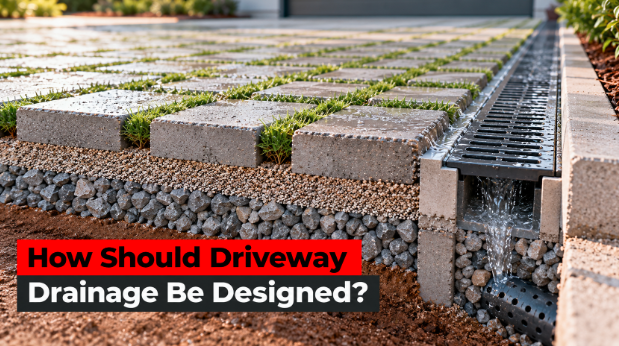
How Should Driveway Drainage Be Designed?
Grass paver drainage depends on rainfall intensity, soil infiltration capacity, pavement slope, aggregate storage capacity, and the availability of an outlet.
A permeable surface does not guarantee that water will infiltrate through an impermeable clay subgrade.
An engineer may specify:
- Surface falls toward suitable outlets
- Permeable granular storage layers
- Subsurface drainage pipes
- Overflow arrangements
- Separation from building foundations
- Protection from sediment-laden runoff
As an illustrative grading calculation, a 1% fall over 6 m produces a 60 mm elevation difference.
The required slope must follow the site drainage design.
For common drainage and maintenance failures, PrimeCrete’s Do Grass Pavers Get Muddy? explains how installation quality influences surface performance.
How Many Grass Pavers Are Needed for a Driveway?
Calculate grass paver quantity using the net paved area and actual dimensions of the selected product.
Consider a hypothetical driveway measuring:
- Length: 6 m
- Width: 4 m
- Total area: 24 m²
Assume, only for this example, a paver with an overall plan dimension of 400 × 400 mm.
Area per unit:
0.40 × 0.40 = 0.16 m²
Number of pavers:
24 ÷ 0.16 = 150 units
Adding an illustrative 5% cutting and breakage allowance:
150 × 1.05 = 157.5
The preliminary order becomes 158 units.
This is not a confirmed PrimeCrete paver dimension or a universal waste allowance.
Actual quantities should use the selected product’s declared coverage and the project’s layout.
What Common Grass Paver Installation Mistakes Should Be Avoided?
Typical grass paver driveway failures result from unsuitable construction details rather than the appearance of the units.
Common mistakes include installing grids over uncompacted topsoil, using inadequate granular support, omitting edge restraints, ignoring drainage, and selecting pavers without verified suitability for vehicle loads.
Another common mistake involves filling the openings incorrectly or opening a grass-filled driveway to regular traffic before vegetation has established.
Before procurement, consult PrimeCrete’s grass paver quality inspection guide for practical checks covering concrete ribs, dimensions, and product condition.
Frequently Asked Questions
Can grass pavers support cars?
Yes, appropriately designed concrete grid paving systems can support passenger vehicles. Suitability depends on the paver properties, base construction, and expected traffic.
Can grass pavers be laid directly on soil?
Direct placement on untreated topsoil is generally unsuitable for vehicle driveways. A stable, engineered foundation is normally necessary.
Are grass pavers suitable for heavy vehicles?
Some engineered systems may accommodate heavier traffic, but this requires suitable pavement design and product verification.
Do grass pavers prevent driveway flooding?
They can help manage runoff when the complete pavement and drainage system has sufficient capacity. They cannot prevent flooding where inflow exceeds the system’s drainage or storage capacity.
Conclusion
Successful grass paver installation for driveways requires more than laying concrete grids and adding soil.
Stable subgrade preparation, suitable granular support, controlled bedding, proper edge restraints, and effective drainage all contribute to long-term performance.
PrimeCrete offers concrete grass pavers for residential, commercial, and landscape applications in Pakistan. Contractors and homeowners should confirm product specifications, expected loads, and local ground conditions before preparing their quantities and requesting a quotation.
