
Anyone planning a 5-marla, 10-marla, or 1-kanal residential build in Lahore, Rawalpindi, Islamabad, or Peshawar knows that brick procurement forms one of the largest early material line items in the Bill of Quantities (BOQ). For decades, kiln-fired red clay bricks (Awwal ent) have been the default choice. However, soaring imported coal prices, frequent seasonal brick kiln shutdowns due to anti-smog environmental regulations, and severe quality variations have pushed builders to seek modern, industrial alternatives.
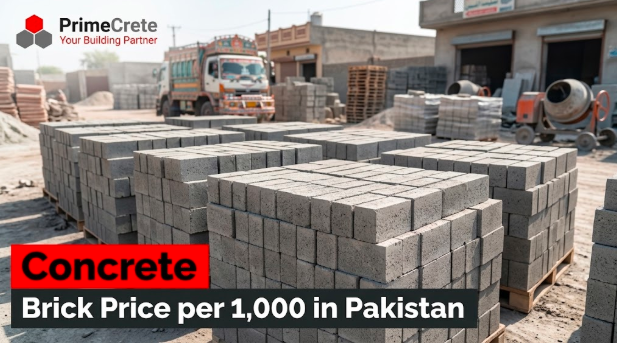
Engineered concrete bricks have rapidly emerged as the preferred replacement for traditional clay units across residential housing societies and commercial developments. Sourcing machine-made concrete bricks manufactured under precision hydraulic pressure from automated producers like PrimeCrete provides sharp dimensional regularity and consistent compressive strength. Yet for quantity surveyors and project owners evaluating their preliminary budgets, understanding the true financial comparison requires looking past the invoice price per 1,000 units to evaluate total “in-wall” installed costs.
The Short Answer
As of 2026, factory-direct machine-made concrete brick prices in Pakistan generally range between PKR 13,500 and PKR 16,500 per 1,000 bricks ex-factory, depending on compressive strength (2,000 to 3,500+ psi), dimensions, and order volume. While this price is competitive with traditional Grade-1 red clay bricks (which typically fluctuate between PKR 14,000 and PKR 17,500 per 1,000 units), concrete bricks reduce total wall construction costs by 15% to 22% through thinner mortar joints, reduced plaster thickness, and near-zero site transit breakage.
Current Price Drivers for Concrete Bricks in Pakistan
Unlike red clay bricks-whose prices surge wildly based on international coal rates and seasonal kiln closures-concrete brick pricing is tied to industrial raw materials:
- Cement Price Fluctuations: Because Portland cement is the binding agent, retail cement price shifts directly influence concrete brick manufacturing costs.
- Aggregates and Stone Dust: High-quality limestone dust, fine sand (such as Chenab or Lawrencepur grades), and graded stone chips control density and compressive strength.
- Hydraulic Plant Automation: Machine-compacted concrete bricks formed using multi-cavity German machinery require less manual labor per unit than traditional kiln molded bricks, ensuring consistent production speed regardless of weather.
- Transit Distance and Delivery Access: Transportation is quoted per thousand bricks or per truckload (typically 3,500 to 5,000 bricks per 6-wheeler truck). Deliveries from industrial hubs like Hattar Industrial Estate to Islamabad, Rawalpindi, or Taxila incur significantly lower freight costs than long-haul shipments.
For an overview of how automated production compares across heavier structural masonry profiles, see the PrimeCrete blog for comprehensive product comparisons.
The “In-Wall” Cost Reality: Concrete Bricks vs. Traditional Red Clay Bricks
Looking solely at the initial purchase price of 1,000 bricks creates a misleading budget estimate. A quantity surveyor evaluates installed masonry cost, which incorporates mortar bedding, site breakage, and exterior plaster requirements.
| Cost & Performance Factor | Machine-Made Concrete Bricks | Traditional Red Clay Bricks (Awwal Ent) | Practical Financial Impact |
| Ex-Factory Price (per 1,000) | PKR 13,500 – 16,500 | PKR 14,000 – 17,500 | Comparable or slightly lower initial purchase price. |
| Site Breakage & Wastage | 1% to 2% (high edge strength) | 8% to 12% (soft under-fired bricks) | You must purchase 1,100 clay bricks to yield 1,000 usable units. |
| Dimensional Regularity | Exact (steel mold tolerance 1.5 mm) | Uneven, warped, bowed faces | Concrete bricks require far less leveling mortar. |
| Bedding Mortar Thickness | 8 mm to 10 mm | 12 mm to 18 mm | Concrete bricks save 25% to 35% on cement-sand mortar. |
| Plaster Render Thickness | 10 mm to 12 mm (flat wall plane) | 18 mm to 25 mm (to cover surface unevenness) | Concrete bricks cut plaster material and labor by 40%. |
| Efflorescence (Kallarr) Risk | Near Zero (clean washed aggregate) | High (alkali salts in local kiln soil) | Eliminates costly salt-damp repairs and paint flaking. |
| Water Absorption Rate | 6% to 10% | 15% to 22% | Concrete bricks do not pull moisture out of setting mortar. |
Detailed Cost Calculation: 100 Sq. Ft. of 9-Inch Masonry Wall
To demonstrate how the economics translate to real site conditions, let us compare the materials and labor required to construct 100 square feet of 9-inch thick double-wythe brick wall in Pakistan:
Basic Assumptions:
- Standard nominal brick dimensions: 9″4.25″2.75″
- Wall area: 100sqft (9 inches thick)
- Theoretical unit requirement: ~950 bricks (accounting for standard joint thickness)
===========================================================================
MATERIAL & LABOR BREAKDOWN (100 SQ FT OF 9″ WALL)
===========================================================================
1. TRADITIONAL RED CLAY BRICK WALL:
– Bricks required (including 10% breakage): 1,050 bricks @ PKR 16/brick = PKR 16,800
– Mortar (1:4 cement-sand mix @ 15 mm joints): 4.5 bags cement + sand = PKR 6,500
– External & Internal Plaster (20 mm thick average to level bumps): = PKR 7,800
– Mason and Labor Laying Charges: = PKR 4,200
————————————————————————
TOTAL COST PER 100 SQ FT (RED CLAY): = PKR 35,300
2. MACHINE-MADE CONCRETE BRICK WALL:
– Bricks required (including 2% breakage): 970 bricks @ PKR 15/brick = PKR 14,550
– Mortar (1:4 cement-sand mix @ 8-10 mm joints): 3.0 bags cement + sand = PKR 4,400
– External & Internal Plaster (10-12 mm uniform coat): = PKR 4,800
– Mason and Labor Laying Charges: = PKR 4,200
————————————————————————
TOTAL COST PER 100 SQ FT (CONCRETE BRICK): = PKR 27,950
===========================================================================
NET SAVINGS WITH CONCRETE BRICKS: ~PKR 7,350 per 100 sq ft (~20.8% Savings)
Across a standard double-storey 10-marla residential home requiring approximately 35,000 to 45,000 bricks, switching to machine-made concrete bricks can save a builder between PKR 250,000 and PKR 350,000 in combined brick wastage, mortar cement, and plastering coats.
To explore movement joint detailing and prevent micro-cracking across long continuous masonry walls, consult our technical guides on the PrimeCrete resources hub.
Technical Specifications That Govern Concrete Brick Quality
Purchasers must be careful not to confuse industrial, high-strength concrete bricks with cheap roadside wet-cast blocks. Quality and price are governed by verified international standards:
1. Concrete Masonry Strength Benchmarks
Under standardized concrete masonry benchmarks such as the ASTM C90 Standard Specification for Loadbearing Concrete Masonry Units, units must meet rigorous minimum compressive strength, dimensional stability, and water absorption limits. High-performance concrete bricks manufactured by automated plants consistently achieve 2,500 to 3,500+ psi, far exceeding ordinary roadside clay bricks, which often struggle to achieve 1,200 psi.
2. Physical Tolerances and Durability
Unlike handmade clay bricks that deform during kiln firing, machine-compacted concrete units undergo hydraulic compression in precision-machined steel molds. This produces flat faces and square arrises (1.5 mm tolerance), allowing masons to place rapid, level courses that reduce mortar wastage and eliminate heavy plaster leveling screeds.
Common Purchasing & Budgeting Mistakes to Avoid
- Comparing Only “Per-Thousand” Sticker Prices: Evaluating bricks exclusively on initial unit cost without calculating required mortar bags, plaster volume, and broken brick dump costs.
- Buying Uncured Roadside Concrete Bricks: Purchasing cheap bricks from informal yards that use poor cement ratios and manual tampers. These bricks lack hydraulic compaction, remain highly porous, and crumble when handled.
- Forgetting Unloading and Stacking Charges: Transportation quotes in Pakistan often include transit but exclude manual labor for unloading (utrai) and stacking inside the plot. Always verify whether the quote is “at site” or “unloaded.”
- Soaking Concrete Bricks Like Red Bricks: Subcontractors accustomed to clay bricks frequently submerge concrete bricks in water tanks. Concrete bricks should never be soaked; over-saturating them leads to excessive drying shrinkage as the wall cures in hot weather.
Multi-Stakeholder Checklist for Ordering Concrete Bricks
For Quantity Surveyors & Procurement Managers
- Specify required minimum compressive strength (e.g., 2,500psi).
- Calculate exact wall square footage rather than guessing based on plot marla size.
- Apply a 2% breakage allowance for machine-made units instead of the standard 10% used for kiln bricks.
- Clarify whether freight and unloading labor are included in the vendor invoice.
For Contractors & Site Supervisors
- Inspect delivery batches for sharp, chip-free edges and flat bedding faces.
- Instruct masons to maintain thin 8–10 mm mortar joints rather than standard thick clay-brick joints.
- Store pallets on flat, elevated timber or plastic sheets to prevent mud contamination during rain.
For Homeowners & Private Builders
- Request a factory visit or third-party compressive test report from the supplier.
- Demand automated machine-pressed bricks manufactured with high-tonnage hydraulic compression.
- Coordinate deliveries in phases (e.g., foundation phase, ground floor phase, first floor phase) to avoid site congestion.
Frequently Asked Questions
Are concrete bricks cheaper than red clay bricks in Pakistan?
On a direct purchase basis, concrete bricks are priced competitively with Grade-1 (Awwal) red clay bricks, typically ranging between PKR 13,500 and PKR 16,500 per 1,000 units. However, concrete bricks are significantly cheaper on an installed “in-wall” basis. Because they are geometrically uniform, they require 25% less mortar, reduce plaster thickness by nearly half, and suffer virtually no site breakage.
How many concrete bricks are needed for a 5-marla house?
A standard double-storey 5-marla house with a covered area of 1,800 to 2,000 sq ft generally requires approximately 18,000 to 24,000 bricks, depending on architectural layout, room count, and whether structural columns or load-bearing brick walls are used. With machine-made concrete bricks, you only need to order a 2% safety margin for wastage, compared to 10% with clay bricks.
Do concrete bricks develop efflorescence (kallarr)?
No. High-quality concrete bricks manufactured from washed aggregates and pure Portland cement do not contain the soluble salts found in the agricultural topsoil used by traditional brick kilns. This prevents unsightly white salt powder (kallarr) and prevents paint from bubbling and peeling off interior walls.
Can concrete bricks be used for load-bearing walls?
Yes. Concrete bricks offering compressive strengths of 2,500 to 3,500+ psi are higher than most traditional red clay bricks. When laid with appropriate cement-sand mortar (1:3 or 1:4 mix), they easily support two- to three-storey load-bearing residential structures.
Smarter Building Economics with PrimeCrete
Selecting masonry materials in Pakistan is no longer just about habit; it is a financial and structural calculation. Machine-made concrete bricks eliminate the price volatility, environmental impact, and physical defects of traditional red clay kilns, giving property owners and civil contractors a cleaner, stronger, and more cost-effective walling unit.
PrimeCrete produces construction-grade concrete bricks using automated German MASA technology in Hattar Industrial Estate, Haripur. Engineered under intense hydraulic compaction with calibrated aggregate gradations, our bricks meet ASTM and BS 6073 standards for dimensional accuracy, low water absorption, and high compressive strength.
Contact the PrimeCrete sales team today to request current per-thousand price quotes, calculate delivery freight to Islamabad, Rawalpindi, or surrounding regions, and schedule bulk dispatches for your construction project.
