
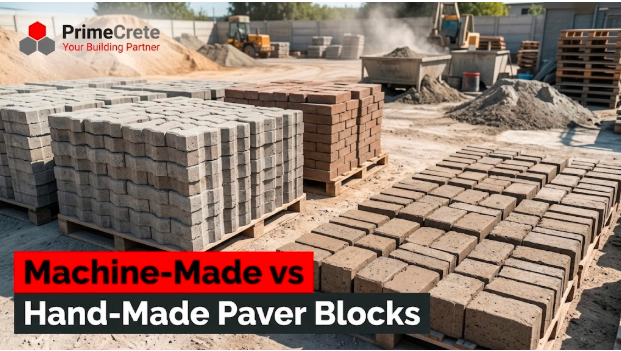
A newly paved driveway or commercial parking area in Lahore, Islamabad, or Peshawar can look sleek on day one, yet show fractured edges, surface pitting, and sunken tire ruts within twelve months. In most cases across Pakistan, premature pavement failure traces back to an early procurement decision: choosing low-cost, hand-made rubber-mold pavers instead of factory-engineered machine-pressed units.
When property owners and site engineers evaluate paving options, hand-made pavers often look visually comparable to industrial units while sitting on display pallets. However, the internal density, hydration chemistry, and mechanical load-transfer capacity of the two products are fundamentally different. Specifying industrial interlocking paver blocks manufactured under multi-ton hydraulic pressure from automated producers like PrimeCrete ensures high compressive strength and exact dimensional tolerance, delivering pavements that withstand intense vehicular loads, summer heatwaves, and monsoon deluges without deformation.
The Short Answer
Machine-made paver blocks are vastly superior to hand-made pavers in compressive strength, durability, abrasion resistance, and dimensional accuracy. Machine-made units achieve compressive strengths between 5,000 and 8,000+ psi using zero-slump semi-dry concrete under simultaneous hydraulic pressure and high-frequency vibration. Hand-made (vibro-cast) pavers rarely exceed 1,500 to 2,500 psi because they rely on wet-slump concrete poured into plastic or rubber molds, resulting in high porosity, surface chipping, and rapid tire wear under vehicular traffic.
Manufacturing Differences: Automation vs. Manual Casting
The vast gap in performance begins on the factory floor with the physical compaction process and water-cement ratio.
1. Machine-Made Pavers (Zero-Slump Compaction)
Industrial manufacturing plants utilize semi-dry, “earth-moist” concrete mixtures with an exceptionally low water-cement (w/c) ratio of 0.28 to 0.35.
The concrete mix is fed into hardened steel mold cavities and compacted simultaneously using:
- High-frequency table vibration (3,000 to 4,500 RPM) to fluidize the fine aggregates and eliminate microscopic entrapped air.
- Heavy hydraulic pressing (exerting 20 to 30+ tons of downward force) to mechanically force aggregate particles into physical interlock.
This intensive dual-action compaction achieves maximum packing density, allowing blocks to be instantly stripped from molds and transferred to controlled steam or moisture-curing chambers.
2. Hand-Made / Vibro-Cast Pavers (Wet-Slump Pouring)
Hand-made or “rubber mold” pavers are produced in informal roadside workshops using wet concrete (w/c ratio often exceeding 0.55 to 0.65).
The wet slurry must be fluid enough to be poured manually into individual plastic or silicon molds placed on an eccentric vibrator table. While vibration drives some air bubbles to the surface, the excess water required for workability remains trapped inside. As the water evaporates during outdoor air-curing, it leaves a honeycomb of open capillary pores, resulting in high water absorption, poor abrasion resistance, and weak cement paste.
Performance Comparison: Machine-Made vs. Hand-Made Pavers
The table below contrasts standard physical properties under established international testing benchmarks:
| Performance Metric | Machine-Made Interlocking Pavers | Hand-Made (Vibro-Cast) Pavers | Engineering Consequence |
| Compressive Strength | 5,000 to 8,000+ psi (35 to 55+ MPa) | 1,500 to 2,500 psi (10 to 17 MPa) | Hand-made units fracture under heavy vehicle axle loads. |
| Water Absorption Rate | 3% to 5% | 10% to 16% | High absorption makes hand-made pavers soak up monsoon moisture, leading to soft matrix degradation. |
| Abrasion Resistance | High (conforms to ASTM C936 / BS EN 1338) | Very Low; powdery surface erosion | Hand-made surfaces lose color and expose raw aggregate after 1–2 years of tire turning. |
| Dimensional Tolerance | Exact (1.0mm to 1.5mm) | Irregular (3.0mm to 5.0mm) | Uneven hand-made edges prevent tight joint sand interlock, causing shifting. |
| Chamfer & Edge Quality | Clean, precision-molded chamfers | Ragged, sharp, brittle edges | Hand-made edges chip and spall under wheel contact. |
| Color Durability | Integral mineral oxide pigments through body | Thin top slurry layer (paint/pigment wash) | Hand-made surface color peels or fades under direct sunlight. |
The Interlocking Mechanism: Why Dimensions Matter
The engineering strength of an interlocking concrete block pavement does not rely on unit strength alone. It depends on inter-block load transfer, governed by:
- Rotational Interlock: Resistance to tipping under eccentric wheel loads.
- Vertical Shear Interlock: Transferring wheel loads across adjacent units via jointing sand.
- Horizontal Translation Interlock: Preventing the whole pavement surface from creeping forward under vehicle braking or accelerating torque.
For effective load distribution, pavers must maintain a uniform joint width of 2 mm to 3 mm, completely filled with dry, angular joint sand.
- With Machine-Made Pavers: Precision steel molds produce identical dimensions. The uniform joint allows frictional interlock to distribute concentrated axle loads outward at a 45-degree angle, reducing vertical pressure on the sub-base.
- With Hand-Made Pavers: Rubber molds warp and stretch after repeated pours. Masons encounter gaps varying from 1 mm to 8 mm across the same laying face. Wide joints wash out during rain, eliminating frictional interlock. Individual blocks then absorb the entire wheel load independently, leading to cracked units and sunken tire depressions.
For further insights into masonry tolerances and sub-base stability, explore technical resources on the PrimeCrete blog.
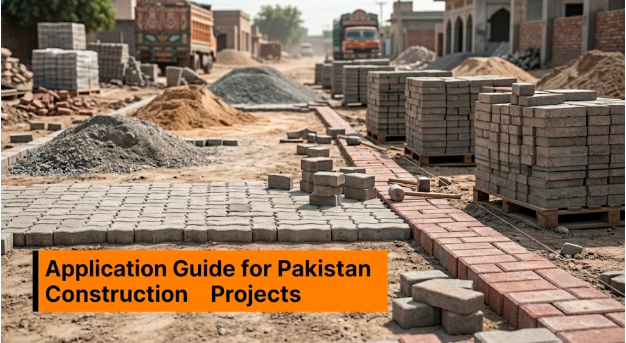
Application Guide for Pakistan Construction Projects
Choosing the correct paver depends directly on expected wheel loads, traffic frequency, and site conditions:
1. Pedestrian Paths, Walkways & Garden Terraces
- Recommended Paver: 50 mm to 60 mm thickness.
- Load Requirement: Pedestrian and light bicycle traffic only.
- Hand-made pavers are sometimes used here purely for decorative garden borders, but machine-made 50 mm units offer far superior slip resistance, level walking surfaces, and longevity.
2. Residential Driveways & Car Porches (5-Marla to Kanal Houses)
- Recommended Paver: 60 mm Machine-Made Interlocking Pavers (Unipaver / Zig-Zag, Rectangular, or I-Shape).
- Load Requirement: Sedans, SUVs, light pickup trucks, and occasional water tankers.
- Hand-made pavers invariably fail in car porches where tires turn repeatedly while maneuvering, grinding away the smooth top surface and snapping block edges.
3. Commercial Parking, Housing Society Streets & Commercial Plazas
- Recommended Paver: 60 mm to 80 mm Machine-Made Interlocking Pavers.
- Load Requirement: Constant vehicle turnaround, delivery trucks, and high-density traffic.
- Machine-pressed units deliver the high tensile splitting strength (>3.6MPa under BS EN 1338) required to resist vehicle braking and steering shear forces.
4. Heavy Industrial Yards, Petrol Pumps & Logistics Terminals
- Recommended Paver: 80 mm Machine-Made Heavy-Duty Pavers (Minimum 7,000+ psi).
- Load Requirement: 40-foot container trucks, loaded oil tankers, and heavy machinery.
- Hand-made pavers will disintegrate within weeks under these axle loads. Fully engineered machine-compacted pavers on a rigid crushed-stone sub-base are mandatory.
To evaluate sub-base compaction and perimeter edge restraint detailing, review our guides on the PrimeCrete resources hub.
The True Cost: Upfront Savings vs. Total Lifecycle Cost
Hand-made pavers frequently attract budget-conscious buyers with a lower sticker price, often quoted 15% to 25% cheaper per square foot than certified machine-made units.
However, real lifecycle economics tell an entirely different story:
===========================================================================
5-YEAR FINANCIAL REALITY (1,500 SQ FT RESIDENTIAL DRIVEWAY)
===========================================================================
1. HAND-MADE / RUBBER-MOLD PAVERS:
– Initial Material Purchase: = PKR 110,000
– Installation & Bedding Sand: = PKR 45,000
– Year 2 Repairs (Replacing cracked units, resetting ruts): = PKR 35,000
– Year 4 Complete Pavement Overhaul (Surface eroded & broken): = PKR 130,000
————————————————————————
TOTAL 5-YEAR EXPENDITURE: = PKR 320,000
2. MACHINE-MADE AUTOMATED PAVERS:
– Initial Material Purchase: = PKR 140,000
– Installation & Bedding Sand: = PKR 45,000
– 5-Year Maintenance (Periodic sand replenishment): = PKR 8,000
————————————————————————
TOTAL 5-YEAR EXPENDITURE: = PKR 193,000
===========================================================================
NET FINANCIAL ADVANTAGE: Machine-made saves ~PKR 127,000 over 5 years.
Investing slightly more in certified machine-made pavers upfront prevents the recurring expense and visual frustration of digging up cracked blocks every two to three years.
Common Installation Mistakes That Ruin Good Pavers
Even high-strength machine-made pavers will fail if fundamental civil installation rules are ignored on site:
- Skipping Edge Restraints: Installing pavers without cast-in-place concrete edge curbs (kerb stones). Without firm lateral containment, outer pavers push outward, joints open, and the entire interlock collapses.
- Using Soil or Raw Silt Instead of Coarse Sand: Bedding pavers on wet mud or fine clay silt instead of clean, washed coarse sand (0 to 4 mm). Mud liquefies under rainwater, causing blocks to sink unevenly.
- Over-Compacting Bedding Sand Before Laying: The 25–30 mm bedding sand layer must be struck off loose and uncompacted; compaction is performed after the pavers are placed using a plate vibrator, which beds the units and draws sand up into the joints.
- Neglecting Slope and Surface Drainage: Failing to build a minimum 1.5% to 2.0% cross-slope to direct heavy monsoon runoff toward perimeter drainage channels.
Multi-Stakeholder Checklist for Paving Procurement
For Civil Consultants & Specifiers
- Specify paver thickness based on traffic load (60 mm for light/medium vehicular; 80 mm for heavy-duty commercial).
- Demand proof of compliance with ASTM C936 (minimum 8,000 psi compressive strength and $\le 5\%$ water absorption) or BS EN 1338.
- Require mechanical compaction data and reject wet-slump rubber-mold units on commercial tenders.
For Contractors & Site Supervisors
- Inspect delivery lots for consistent chamfer geometry and dimensional uniformity.
- Verify that joint sand is completely dry, angular, and free of clay or plastic fines.
- Use a rubber-padded plate compactor (plate weight 75 to 100 kg) to avoid scuffing paver faces during final compaction.
For Homeowners & Private Builders
- Don’t be misled by the initial glossy sheen on wet-cast hand-made pavers—that surface wears off quickly.
- Select machine-pressed interlocking shapes (such as Uni-paver/Zig-Zag or I-section) for driveways where turning wheels generate high shear.
- Ensure your contractor installs concrete edge curbs around all open lawn boundaries before laying the paving field.
Frequently Asked Questions
Why do hand-made paver blocks fade and lose their color so quickly?
Hand-made pavers typically rely on a thin, wet cement-pigment slurry poured into the bottom of the mold before backfilling with coarse concrete. This top layer has a high water-cement ratio, making it weak and porous. Under sunlight, ultraviolet degradation breaks down organic dyes, while vehicle tire friction rapidly abrades the thin color film, exposing raw dull concrete beneath.
Which is better for a car porch: 60 mm or 80 mm pavers?
For standard residential car porches and driveways carrying cars, SUVs, and light delivery vans, 60 mm machine-made pavers provide ample load capacity (exceeding 5,000 to 6,000 psi). An 80 mm paver is recommended only if the driveway regularly handles heavy water delivery tankers, construction trucks, or if ground subgrade conditions are particularly poor.
Can hand-made pavers be used for heavy vehicle parking?
No. Hand-made (vibro-cast) pavers have an average compressive strength of only 1,500 to 2,500 psi and lack internal aggregate interlock. Heavy axle loads from trucks, buses, or loaded pickups will shear paver corners and crack blocks in half within weeks of use. Heavy vehicular areas require certified 80 mm machine-made pavers achieving 7,000+ psi.
How do I visually tell the difference between machine-made and hand-made pavers?
Look at the side edges and bottom texture. Machine-made pavers have uniform dimensions, crisp molded chamfers, and a textured, gravelly, semi-dry appearance on their sides and base. Hand-made pavers typically show smooth, shiny, or plastic-like faces from the mold, irregular air-bubble pinholes on the sides, and uneven, rounded edges.
Engineering Long-Lasting Pavements with PrimeCrete
A durable pavement is an engineered civil system where every component—from the compacted subgrade to the interlocking surface unit—must perform under load. Choosing automated machine-made interlocking pavers eliminates the unpredictable quality, weak compressive strength, and rapid deterioration associated with manual roadside casting, ensuring a beautiful, load-bearing surface that lasts for decades.
PrimeCrete manufactures premium heavy-duty and medium-duty interlocking concrete paver blocks at Hattar Industrial Estate, Haripur. Using automated German MASA hydraulic machinery, our pavers are compacted under intense multi-axis vibration and multi-ton hydraulic pressure to achieve verified compressive strengths between 5,000 and 8,000+ psi, meeting ASTM C936 and BS EN 1338 international benchmarks.
Contact PrimeCrete’s paving technical team today to request product catalogs, review laying patterns, calculate square-foot material quantities, or request delivery schedules for your project.
