
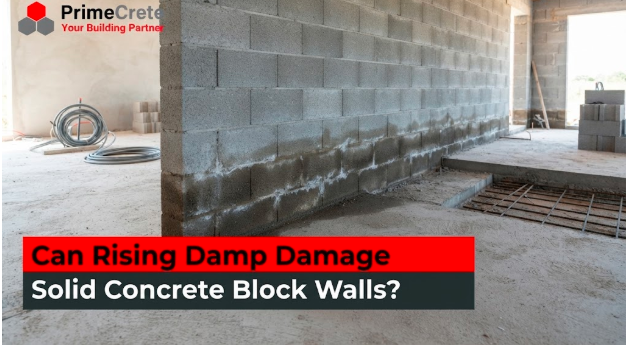
Ground-level moisture intrusion represents one of the most persistent structural threats to residential and commercial structures across Pakistan. When sub-surface groundwater migrates vertically through masonry footings, structural engineers and civil contractors frequently ask whether rising damp in solid concrete block walls can compromise structural integrity. Selecting factory-manufactured, dense solid concrete blocks significantly reduces water transmission rates compared to traditional porous masonry, yet unmitigated subterranean moisture remains an aggressive mechanism of long-term deterioration if basic waterproofing barriers fail.
Manufactured under precision vibration and hydraulic compression at the automated Hattar Industrial Estate facility, PrimeCrete provides high-density masonry units engineered to resist extreme environmental exposure across Islamabad, Rawalpindi, Lahore, and Peshawar. Understanding the physical mechanics of capillary suction, salt crystallization, and mortar degradation allows builders, quantity surveyors, and homeowners to protect loadbearing boundary walls and plinth structures throughout the monsoon seasons and high water table zones.
Direct Answer: Can Rising Damp Damage Solid Concrete Block Walls?
Yes, rising damp in solid concrete block walls can cause severe long-term damage, primarily through sub-surface salt crystallization (subflorescence), internal mortar joint degradation, and plaster delamination. While dense solid concrete blocks possess lower capillary suction than traditional red clay bricks, persistent moisture drawing upward from untreated soil dissolves ground salts (chlorides and sulfates) that expand upon drying, exerting hydraulic pressure up to 100 MPa inside microscopic pores. Without a certified damp proof course (DPC), continuous capillary action weakens interfacial mortar bond strength, stains paint finishes, and promotes hazardous internal mold growth.
The Physics of Capillary Action in Concrete Block Masonry
Capillary rise in masonry occurs when adhesive forces between water molecules and pore surfaces exceed the cohesive forces holding liquid water together. According to Jurin’s Law, capillary rise height is inversely proportional to pore radius:
$$h = \frac{2\gamma \cos\theta}{\rho g r}$$
Where:
- $h$ = height of the capillary rise
- $\gamma$ = surface tension of water
- $\theta$ = contact angle of the meniscus
- $\rho$ = liquid density
- $g$ = acceleration due to gravity
- $r$ = effective pore radius
Because dry-cast concrete produced on automated German MASA plants features tightly compacted aggregate gradation, its pore size distribution is markedly smaller and less interconnected than hand-molded red clay bricks. However, smaller capillaries generate higher theoretical capillary suction pressures, drawing moisture up to 1.0 to 1.5 meters above finished ground level if ground water tables sit near the plinth line.
Material Performance Comparison
| Performance Metric | Machine-Vibrated Solid Concrete Blocks | Traditional Red Clay Bricks (Class First) | Structural & Practical Impact |
|---|---|---|---|
| Water Absorption (24-hr Cold) | 5% to 8% by dry weight (ASTM C140 standards) | 15% to 22% by dry weight | Low absorption delays core moisture saturation across monsoons. |
| Capillary Rise Velocity | Low to Moderate (0.2 to 0.5 mm/min) | Severe / Rapid (1.5 to 3.2 mm/min) | Solid blocks substantially retard upward water transmission rates. |
| Salt Crystallization Resistance | High (Dense matrix resists internal bursting) | Poor (Prone to surface crumbling / shora) | Prevents progressive loss of structural cross-section in plinth courses. |
| Compressive Strength | 1,800 to 2,200+ PSI (12.4 to 15.2 MPa) (ASTM C90) | 1,000 to 1,200 PSI (6.9 to 8.3 MPa) | Maintains load-bearing capacity under moist conditions. |
| Pore Distribution Profile | Discontinuous, micro-pore matrix | Open, interconnected capillary network | Reduces overall capillary draw capacity. |
The 4 Primary Mechanisms of Structural & Aesthetic Damage
1. Salt Crystallization and Internal Spalling (Shora)
As ground moisture evaporates through external wall surfaces, dissolved soil-borne sulfates transform from liquid solution into solid crystal hydrates. When sodium sulfate converts to thenardite and mirabilite, it expands in volume by up to 300%. This subflorescence exerts tensile stress exceeding the 2.0 to 3.5 MPa tensile capacity of concrete, creating micro-fissures and crumbling. Read more in our guide on efflorescence prevention in concrete masonry.
2. Mortar Bed Joint Leaching
Site-mixed mortar typically batched at 1:4 or 1:6 cement-to-sand ratios suffers accelerated binder breakdown when constantly waterlogged. Carbonic acid dissolved in groundwater reacts with free calcium hydroxide in the hydration paste, forming soluble calcium bicarbonate that leaches away, eroding horizontal bed joints and reducing the wall’s shear capacity.
3. Thermal Conductivity Increase & Indoor Moisture
Water has a thermal conductivity nearly 20 times higher than trapped air. Saturated solid blockwork loses up to 50% of its thermal resistance, driving up cooling loads in Punjab and Khyber Pakhtunkhwa summers. The resulting interior dampness fosters harmful mold colonies on gypsum skim coats.
4. Plaster Blistering and Finishes Failure
Damp masonry forces conventional cement-sand plaster (typically applied at 12 to 15 mm thickness) to debond. Osmotic vapor pressure forces paint layers to bubble, craze, and flake within weeks of seasonal monsoon showers.
Pakistan Site Realities: Why Boundary Walls and 5-Marla to 1-Kanal Plots Suffer
In Pakistani residential developments across DHA, Bahria Town, and CDA Sectors, boundary walls and ground floors face intense damp-rise pressure due to distinct construction oversights:
- Flooding the Plinth Zone: Homeowners frequently saturate flowerbeds placed directly against exterior plinth walls, introducing artificial perched water tables above the plinth beam.
- Missing Vertical DPC: Contractors routinely pour a horizontal concrete DPC but omit the vertical bitumen barrier between external grade levels and interior finished floor levels (FFL).
- Punctured Membrane Barriers: Careless backfilling with aggregate-rich uncompacted fill often rips 500-gauge polyethylene damp-proof membranes.
- Low-Grade Fill Materials: Use of unwashed, silt-heavy canal sand or local pit run containing active salts accelerates salt-damp degradation.
- Monsoon Inundation: Poor regional storm drainage creates localized ponding against perimeter footings for multiple weeks.
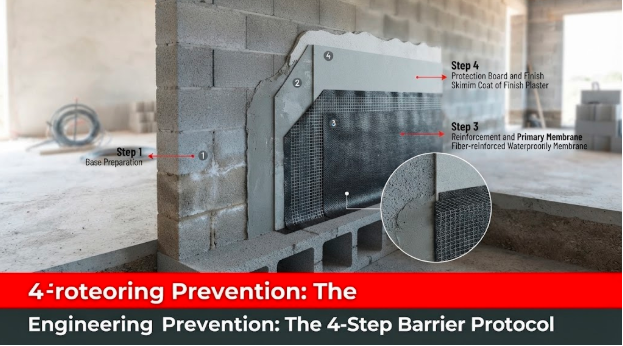
Engineering Prevention: The 4-Step Barrier Protocol
To ensure lifetime protection against rising damp under the Pakistan Engineering Council building provisions, implement this 4-step barrier system during substructure execution:
Step 1: Install High-Density Horizontal DPC
Cast an unbroken 38 mm to 50 mm thick horizontal damp proof course across all loadbearing and non-loadbearing solid block walls at plinth level. Use a rich 1:1.5:3 or 1:2:4 concrete mix incorporating an integral waterproofing admixture (e.g., crystalline silane/siloxane capillary blocker at 2% by cement weight). Review our detailed layout drawings in the damp proof course installation standards.
Step 2: Apply Dual-Coat Elastomeric Bitumen
Cover the cured DPC surface with two continuous coats of hot-applied bitumen (grade 10/20 or 60/70) applied at a minimum coverage rate of 1.5 kg/m², immediately followed by 0.25 mm (500-gauge) virgin polyethylene sheeting.
Step 3: Extend Vertical DPC to Finished Ground Level
Extend the bituminous water barrier downward along the external face of the plinth masonry to at least 150 mm below natural ground level to block lateral moisture ingress from saturated turf.
Step 4: Specify Factory-Vibrated Solid Blocks
Use factory-engineered units displaying minimum compressive strengths of 1,800 to 2,000 PSI and maximum 24-hour cold water absorption under 7% tested per ASTM C140.
Technical Submittal & Procurement Checklist
Use this checklist during structural submittals, testing verification, and procurement of masonry units for loadbearing substructure applications:
| Specification Parameter | Technical Benchmark Requirement | Compliance Standard | Verification Method |
|---|---|---|---|
| Compressive Strength | Average $\ge$ 1,900 PSI (Individual unit $\ge$ 1,700 PSI) | ASTM C90 / ASTM C140 | 5-unit sample hydraulic press laboratory test |
| Water Absorption Cap | Maximum 7% by dry weight ($\le$ 10 lb/ft³ / 160 kg/m³) | ASTM C140 | 24-hour immersion followed by oven-dry weighing |
| Unit Density | Normal Weight Concrete ($\ge$ 2,000 kg/m³) | ASTM C90 | Density calculation via physical dimensions |
| Dimensional Tolerance | Length, width, height variations within $\pm$ 2.0 mm | ASTM C90 | Vernier caliper verification on randomized samples |
| Visual Core Density | Absence of honeycombing, void cracks, or aggregates separation | Factory QA/QC | Visual site inspection upon lot delivery |
| DPC Membrane Integrity | Continuous 500-gauge polyethylene sheet + dual-layer bitumen | PEC Guidelines | Pre-pour and pre-backfill physical sign-off |
Frequently Asked Questions
Q: Can liquid chemical DPC injection repair damp in solid concrete block walls?
A: Yes. Hydrophobic silane-siloxane micro-emulsions injected at 100 mm to 120 mm intervals along horizontal mortar joints line internal block pores, creating a durable water-repellent zone without altering structural load capacity.
Q: Does rising damp weaken the structural compressive strength of solid blocks?
A: Water saturation alone typically reduces compressive strength by 10% to 15% due to pore water pressure. However, cyclic salt crystallization inside lower-grade blocks causes irreversible internal fissuring that permanently degrades structural capacity.
Q: What mortar mix ratio best resists rising moisture below plinth level?
A: Specify a dense 1:3 or 1:4 cement-to-well-graded-sand mortar modified with a polymeric waterproofing additive. Never use lean 1:6 or 1:8 mixes below plinth level.
Q: How high can rising damp ascend in solid concrete blockwork?
A: Under typical conditions with fine-pore mortars and untampered soil contact, capillary action can elevate water tables 1.0 to 1.5 meters vertically above the soil line if no functioning DPC exists.
Q: Why is vertical DPC critical if horizontal DPC is already installed?
A: Horizontal DPC only arrests vertical capillary rise from beneath the beam. It cannot prevent lateral moisture migration if outdoor planters, footpaths, or turf stand higher than the plinth level.
