

Imagine ordering 10,000 concrete blocks for a housing project in Islamabad. The first 4,000 arrive on time, fit neatly into the masonry layout, and meet the required specifications. Three weeks later, another shipment arrives. The blocks look similar, but some dimensions differ. Your masons adjust the joints, progress slows, and the site engineer starts asking questions.
The problem may not be the material itself. It may be how you planned the purchase.
For contractors buying solid concrete blocks in Pakistan, ordering everything in one batch can simplify procurement and improve consistency. However, purchasing the entire quantity at once does not necessarily mean every block should arrive on the same day.
At Prime Crete, operated by Pak Dream (Pvt) Ltd, we manufacture concrete masonry products using automated production equipment at our Hattar facility. Our solid concrete blocks serve construction projects requiring specified strength, uniform dimensions, and dependable material supply.
So, should you place one large order or purchase blocks gradually? The answer depends on production consistency, project duration, storage capacity, and delivery costs.
Should You Order All Solid Concrete Blocks in One Batch?
For projects with finalized specifications and predictable quantities, placing one consolidated order can be a practical strategy. It allows the contractor and manufacturer to agree on product requirements, pricing, production allocation, and delivery schedules early.
However, three purchasing arrangements are often confused:
- Single purchase order: The buyer commits to a total quantity under one commercial agreement.
- Single production batch: The blocks come from a defined manufacturing lot or production run.
- Single delivery: The supplier transports the entire quantity to the site at once.
These are not interchangeable.
A manufacturer may supply a large purchase order through several production batches. Similarly, a verified production lot may be dispatched in stages if the supplier has suitable storage and handling arrangements.
The objective should not simply be to receive every block together. It should be to maintain consistent quality and reliable supply throughout construction.
Why Production Batch Consistency Matters
Concrete masonry manufacturing involves controlled proportions of cement, aggregates, and water, followed by mixing, compaction, and curing.
Even when manufacturers follow the same nominal mix design, differences in raw materials, moisture conditions, equipment settings, and curing can influence finished units.
1. Consistent Block Dimensions Improve Masonry Work
A masonry wall relies on predictable unit dimensions and properly controlled mortar joints.
If blocks from separate shipments vary beyond permitted tolerances, workers may need additional adjustments during installation.
That can affect:
- Wall alignment and course levels
- Mortar joint uniformity
- Cutting and fitting requirements
- Installation productivity
- Finishing quality
A well-controlled manufacturing process helps minimize these variations.
Prime Crete uses automated batching and pressing technology to support dimensional uniformity. However, buyers should still confirm the applicable tolerances and acceptance procedures for their projects.
2. Compressive Strength Must Remain Within Specifications
Not every solid concrete block has the same compressive strength.
A block intended for a structural masonry wall may require different performance from one specified for a non-load-bearing application.
The strength requirement must come from the approved engineering specification, not from assumptions about the block’s weight or appearance.
For quality verification, ASTM C140/C140M provides established procedures for sampling and testing concrete masonry units, including measurements of dimensions, compressive strength, absorption, and density.
ASTM Store
The Concrete Masonry & Hardscapes Association’s testing guidance also explains why representative sampling matters when evaluating a lot of masonry units.
CMHA
For projects requiring documented performance, ask the manufacturer about test records and lot identification before approving dispatch.
3. Consistent Production Does Not Mean Identical Blocks
One production batch can reduce some sources of variation, but it does not eliminate the need for inspection.
Even units manufactured together may contain defects or dimensional variations.
Likewise, blocks from different production dates can meet the same specification when the manufacturer maintains appropriate process controls and testing.
The real requirement is specification compliance, not merely a matching production date.
Does Ordering Solid Concrete Blocks in Bulk Reduce Construction Costs?
Potentially, yes. But a discounted block price does not automatically mean a lower delivered project cost.
Large orders may give contractors opportunities to negotiate quantities, manufacturing schedules, and commercial terms. The actual savings depend on the supplier’s quotation and delivery arrangement.
Consider this hypothetical purchase for a housing project in Rawalpindi.
| Cost component | One bulk delivery | Phased deliveries |
| Blocks required | 10,000 | 10,000 |
| Assumed unit price | PKR 110 | PKR 112 |
| Material cost | PKR 1,100,000 | PKR 1,120,000 |
| Total transportation | PKR 65,000 | PKR 90,000 |
| Assumed storage and extra handling | PKR 45,000 | PKR 10,000 |
| Estimated total | PKR 1,210,000 | PKR 1,220,000 |
Illustrative scenario only. These are hypothetical figures, not verified Prime Crete prices or current Pakistani market quotations. Actual quantities, freight, unloading, storage, and breakage costs will vary.
In this scenario, a bulk delivery saves PKR 10,000. But the saving is small compared with the entire material budget.
An unexpected unloading delay, damaged pallets, or additional storage expenses could easily change the outcome.
For contractors working across multiple sites, the better question is:
What is the total usable-block cost at the point of installation?
This includes transport, handling, storage losses, rejected units, and procurement administration—not just the ex-factory price.
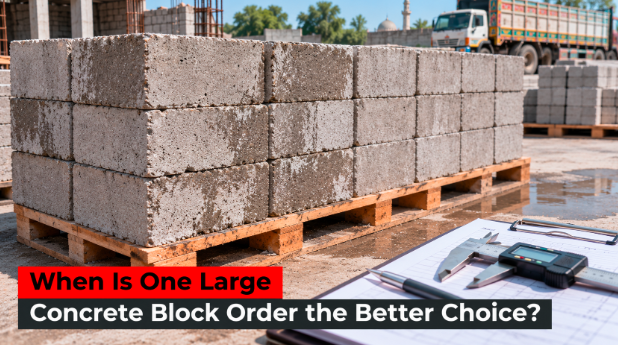
When Is One Large Concrete Block Order the Better Choice?
A consolidated order becomes particularly useful when the project has clearly defined masonry requirements.
The BOQ Is Finalized
A reliable bill of quantities gives the procurement team a reasonable estimate of total block demand.
Before committing to a full order, confirm wall dimensions, openings, block sizes, and the expected allowance for cutting and breakage.
Unapproved design changes can leave the site with surplus blocks or unsuitable stock.
The Supplier Can Confirm Production Capacity
A supplier should be able to explain how the required volume will be produced and delivered.
For example, a purchase order for 30,000 blocks may cover several manufacturing runs rather than a single uninterrupted batch.
Ask whether the supplier can maintain the approved specification across those runs and provide identifiable lot records where required.
There Is Adequate Site Storage
Receiving a large quantity can be convenient when the site has safe unloading access, firm storage areas, and sufficient space.
However, a congested construction site may suffer more from early deliveries than it gains from them.
For detailed stacking and protection practices, see our guide on how to store solid concrete blocks correctly on site.
When Should Contractors Choose Phased Deliveries?
Phased delivery is often a better arrangement for large developments with long construction schedules.
Consider a contractor building several residential blocks over six months.
Delivering all the masonry units during the first week might create serious space and handling problems. Instead, the procurement team can agree on the total requirement and request dispatches according to approved construction milestones.
Example: A 24,000-block delivery plan
| Construction stage | Planned quantity |
| Initial masonry works | 6,000 |
| Second construction phase | 8,000 |
| Third construction phase | 6,000 |
| Final allocation | 4,000 |
| Total | 24,000 |
Illustrative scheduling example; not a recommended universal project quantity.
This arrangement can reduce on-site inventory while preserving a consolidated purchasing agreement.
However, it also requires supplier coordination. The buyer should establish lead times, delivery notice periods, minimum dispatch quantities, and procedures for changing the schedule.
If one production lot must be reserved for the whole project, confirm whether the manufacturer can physically hold that stock and what storage charges or restrictions apply.
How to Prevent Quality Differences Between Deliveries
A properly written purchase order is often more valuable than a verbal promise that the blocks will all be the same.
Define the Product Precisely
Include the approved block dimensions, specified strength, quantity, applicable standards, and any required testing or certification.
Do not assume that two blocks described as “solid” automatically share identical performance requirements.
Our guide on solid concrete block specifications explains the material properties buyers should verify before approving a purchase.
Require Documented Quality Checks
For major projects, agree on what quality evidence the supplier must provide.
Depending on the contract, this may include production-lot references, laboratory reports, dimensional inspection records, and dispatch documents.
The engineer should determine the relevant testing frequency and acceptance criteria.
Inspect Each Delivery
Even after approving the initial batch, inspect subsequent shipments.
Check the delivery quantity, product identification, dimensions, visible cracking, and handling damage.
A few broken corners do not necessarily indicate inadequate compressive strength, but widespread defects should trigger further investigation.
Our article on how to identify weak or under-cured solid concrete blocks covers the warning signs that deserve closer inspection.
Field observations help identify concerns, but they cannot replace laboratory strength testing.
Should You Mix Solid Blocks, Hollow Blocks and Concrete Bricks in One Purchase Order?
A project may require different masonry products for different functions.
For example, a contractor might specify solid concrete blocks for particular structural or heavy-duty masonry applications while using hollow concrete blocks for approved wall designs where reduced weight or other performance characteristics are beneficial.
Some developments may also use concrete bricks for specified masonry details.
A combined purchase order can simplify supplier coordination. However, each product should have its own quantity, technical specification, and delivery identification.
Do not substitute one masonry product for another without the designer’s approval.
For projects where reducing building dead load is important, lightweight concrete masonry units may also be evaluated against the design requirements.
The procurement advantage comes from consolidating administration, not treating different products as interchangeable.
What Should Be Included in a Bulk Block Purchase Order?
Before approving a large order, the contractor, quantity surveyor, and supplier should agree on the essential commercial and technical requirements.
A useful purchase order should cover the following:
- Exact product description and approved dimensions
- Total quantity and any permitted variation
- Required strength classification and test documentation
- Applicable project standards and acceptance criteria
- Production-lot identification and traceability requirements
- Delivery dates, quantities, and unloading responsibilities
- Unit price, freight charges, taxes, and payment terms
- Handling of damaged, rejected, or nonconforming units
- Arrangements for delayed delivery or design changes
- Any supplier storage commitment for reserved stock
A written agreement cannot prevent every disruption. It does make responsibilities clearer when something unexpected happens.
For Pakistani projects where transportation distances and site conditions vary considerably, these details deserve attention before the first truck leaves the factory.
Final Recommendation: One Order, Controlled Quality, Planned Deliveries
So, should you order solid concrete blocks in one batch?
For projects with confirmed specifications, a consolidated purchase can provide better commercial visibility and more predictable procurement planning.
However, insisting that every block come from one physical production run is not always necessary or practical.
What matters is that the supplied units consistently meet the engineer’s approved requirements, regardless of whether the manufacturer uses one production lot or several.
For many larger projects, the most balanced approach is to agree on the total order, establish measurable quality controls, and schedule deliveries according to construction progress.
At Prime Crete, our manufacturing operations at Hattar support concrete masonry supply for construction projects across Pakistan. Contractors can discuss their required specifications, estimated quantities, and delivery plans with our team before placing an order.
The right block matters. So does the way you order it.
Frequently Asked Questions
Is it cheaper to buy solid concrete blocks in bulk in Pakistan?
Bulk orders may qualify for more favorable commercial terms, but savings depend on the quotation, transport distance, delivery frequency, and storage costs. Compare total project costs before deciding.
Can concrete blocks from different batches have different strengths?
Yes. Manufacturing and curing variations can affect results. However, units from separate batches can still satisfy the same approved strength requirements when production and quality controls are effective.
Does one purchase order guarantee one manufacturing batch?
No. A purchase order covers the commercial agreement. A manufacturer may fulfil it using several production runs unless a particular lot requirement has been agreed upon.
Can I order all the blocks but receive them in stages?
Yes, where the supplier offers that arrangement. Confirm production allocation, storage responsibilities, dispatch schedules, and any additional costs before finalizing the agreement.
Is it better to order extra solid concrete blocks?
A reasonable allowance for cutting, breakage, and approved site changes can help prevent shortages. The appropriate percentage should come from project conditions and quantity-surveying calculations rather than a universal assumption.
What is the biggest mistake when ordering concrete blocks?
Focusing only on the quoted price per block. Contractors should also examine product specifications, quality evidence, transport arrangements, usable quantities, and delivery reliability.
