
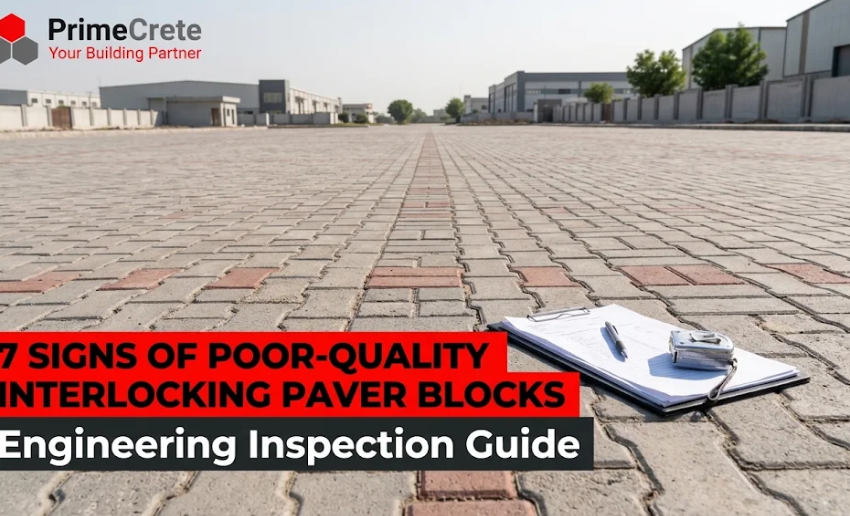
The structural integrity of paved surfaces depends directly on the compaction density, aggregate gradation, and hydration cycle of each paving unit. When sourcing materials for heavy-duty driveways, industrial yards, or municipal footpaths, installing substandard concrete units leads to premature surface spalling, sinkholes, and structural cracking within months of trafficking. At Prime Crete, manufacturing standards adhere to strict mechanical and chemical durability criteria to eliminate premature batch failures.
Evaluating whether a batch of interlocking paver blocks meets structural standards requires understanding the difference between cosmetic variations and material flaws. Knowing how to detect poor-quality interlocking paver blocks protects civil contractors and property owners against structural failure before laying the blocks. To review engineered technical specifications, dimensional tolerances, and bulk availability for your site, consult our certified interlocking paver blocks product directory.
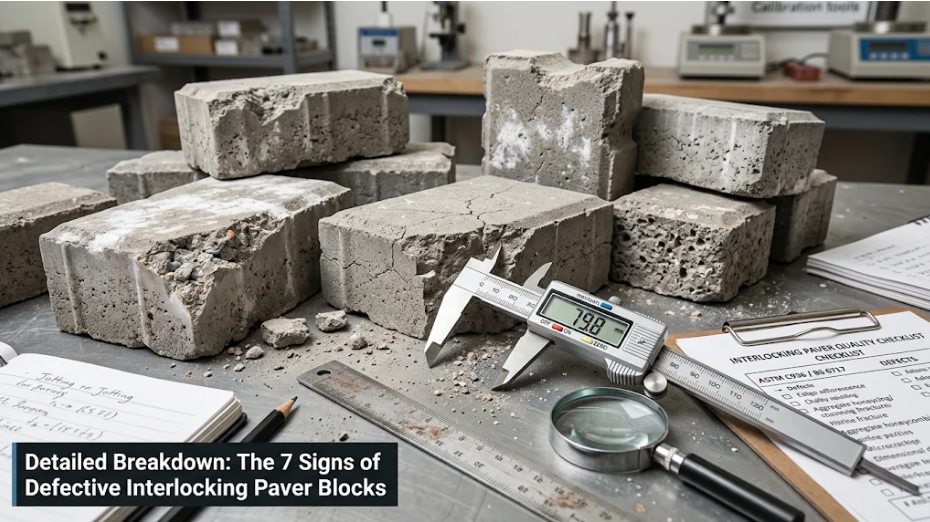
Substandard concrete pavers fail because of low hydraulic press compaction, improper aggregate gradation (excessive silt/pit sand), low cement-to-water ratios, and insufficient curing. The 7 primary signs of defective pavers are:
- Edge Chipping (Spalling): Broken chamfers from fragile edges under minor friction.
- High Water Absorption (>5% to 7%): Porous cement paste absorbing excessive water.
- Surface Dusting (Powdering): Weak wear layer disintegrating under shoe or tire abrasion.
- Persistent Efflorescence: Deep salt leeching from unwashed, brackish local sand.
- Rapid UV Color Fading: Loss of shade within 90 days from cheap organic dye powders.
- Hairline Compressive Cracks: Structural failure under loads below 5,000–8,000 PSI.
- Dimensional Variations (>±2 mm): Uneven heights and distorted edges that prevent joint interlock.
Detailed Breakdown: The 7 Signs of Defective Interlocking Paver Blocks
1. Premature Edge Chipping and Chamfer Spalling
The chamfer (the beveled top edge of the block) distributes shear stress when vehicular tires brake or turn. In poor-quality interlocking paver blocks, these edges chip away during transit, manual handling, or immediately after plate compaction.
Edge spalling points to two root causes:
- Inadequate vibration-compression tonnage during pressing, leaving the perimeter under-densified.
- An aggregate mix lacking graded stone fines (crush dust), forcing the block to rely solely on unbonded sand at its perimeter.
High-grade pavers feature crisp, well-defined chamfers capable of withstanding rough handling without corner fractures.
2. Excessive Water Absorption Exceeding 5% to 7%
High porosity compromises concrete durability. Under the ASTM International standard C936, the average water absorption rate of solid interlocking concrete pavers must not exceed 5%, with no individual unit exceeding 7%.
Substandard units produced by unmonitored local suppliers often reach absorption levels of 10% to 14%. When porous pavers encounter monsoon rains or brackish groundwater, moisture migrates into the inner voids. This prompts:
- Internal dissolution of calcium hydroxide.
- Rapid colonization by moss, lichen, and algae.
- Sub-base saturation that leads to rutting and uneven settlement.
To preserve sub-base integrity and allow natural surface drainage without compromising block density, compare standard blocks with permeable concrete grass paver blocks.
3. Surface Dusting and Low Abrasion Resistance
If scraping a steel key, screwdriver, or coin across the top surface scratches a groove or dislodges loose sand grains, the wear layer lacks proper binding.
Surface dusting occurs when an excess water-cement ratio (w/c>0.45) forces free water to bleed upward toward the mold face during compaction. This carries fine silt to the top while depriving the cement matrix of hydration density. Under everyday foot traffic or low-speed vehicle maneuvers, this top layer flakes into fine powder. Residential driveways require durable 60mm interlocking paver blocks produced with a dedicated face-mix layer containing hard granite or quartz sand fines to guarantee abrasion resistance under British Standard BS EN 1338.
4. Chronic Efflorescence from Unwashed Aggregates
While temporary, minor white haze (calcium carbonate formation) can occur naturally during early curing, chronic efflorescence indicates inferior raw ingredients.
In low-cost manufacturing yards across Pakistan, producers cut costs by utilizing unwashed riverbed sand (such as untreated Ravi or Chenab pit sand) that contains high concentrations of soluble salts, alkalis, and organic clay. When water penetrates the block, it dissolves these internal salts and carries them to the surface. As the moisture evaporates, it leaves behind a chalky crust that discolors the paved surface and gradually weakens the internal cement paste.
Before laying pavers, ensure your contractor prepares an open-graded bedding layer by reviewing our complete guide to interlocking paver block installation.
5. Rapid Color Fading from Inferior Pigments
Color vibrancy should last for decades. High-grade colored interlocking paver blocks rely on synthetic iron oxide pigments (red, yellow, black) conforming to ASTM C979. These mineral oxides bond with the cement matrix and remain inert under ultraviolet (UV) exposure.
Substandard manufacturers substitute these minerals with cheap organic printing pigments, textile dyes, or low-grade surface slurries. Within 30 to 90 days of sun exposure:
- Vibrant reds shift to dull, chalky pinks.
- Charcoal pavers fade into patchy light gray.
- Rainwater washes pigment out of unsealed surface pores, creating an uneven, stained finish.
6. Hairline Micro-Fissures and Low Compressive Strength (<5,000 PSI)
Heavy vehicular traffic requires high compressive resistance. According to ASTM C936, solid concrete pavers must deliver a minimum average compressive strength of 8,000 PSI (55 MPa), with no single unit falling below 7,200 PSI (50 MPa).
Inferior blocks manufactured with manual compaction machines or demolded wet rarely exceed 2,500 to 3,500 PSI. Under the point load of a parked SUV or light delivery truck, these blocks develop diagonal hairline fractures across their center, ultimately snapping into loose fragments. For logistics yards, commercial petrol stations, and cargo access roads, always specify 80mm heavy-duty interlocking pavers engineered to withstand sustained axle loads.
7. Dimensional Inconsistency and Distorted Edges (>±2 mm)
For interlocking mechanics to function properly, wheel loads must transfer horizontally from one block to the next through sand-filled joints. This structural action requires tight dimensional tolerances:
- Length & Width: Within 1.6mm (1/16in.).
- Thickness (Height): Within 3.2mm (1/8in.).
Low-cost yards often use worn cast-iron or distorted rubber molds. When pavers vary in thickness by 5 mm to 10 mm:
- Pavers will not sit flush on the screeded sand bed, creating trip hazards.
- Plate compactors shatter high-standing blocks during initial vibration.
- Joint spacing becomes irregular, allowing individual blocks to rotate, creep, and shift out of alignment under braking tires.
To plan your project layout accurately and calculate required wastage allowances, refer to our guide on how to calculate paver blocks required per square foot.
On-Site Field Tests: How to Inspect Paver Blocks Before Laying
You do not need a compression-testing laboratory to detect low-grade units. Run these three straightforward field checks on delivered palettes:
The Acoustic Ring Test
Pick up two random blocks from the center of a pallet and strike them firmly against each other:
- High-Quality Paver: Produces a clear, metallic, high-pitched ringing sound, signaling high density, complete hydration, and an absence of internal air pockets.
- Poor-Quality Paver: Produces a dull, hollow thud. This indicates high internal void ratios, poor compaction, or micro-fissuring.
The Water Droplet Permeability Test
Pour half a glass of clean water onto the dry top surface of the paver:
- Pass: Water forms beads on the surface or spreads outward, taking several minutes to soak into the microscopic capillaries.
- Fail: Water absorbs immediately, disappearing like a sponge within 5 to 10 seconds. This indicates high porosity that will fail ASTM water-absorption thresholds.
The Scratch & Edge-Impact Check
Attempt to carve into the chamfer or corner edge with a flathead screwdriver or carpenter’s nail:
- Pass: The metal leaves only a faint mark without dislodging sand or aggregates.
- Fail: The tool easily cuts a gouge into the edge, causing sand grains to crumble away under light hand pressure.
Structural Comparison: High-Density Pavers vs. Substandard Blocks
Understanding the technical differences between high-performance and inferior pavers highlights where cost cuts occur:
| Performance Metric | Certified High-Strength Pavers | Substandard Local Tuff Tiles | Impact of Poor Quality |
| Compressive Strength | 7,000 to 8,500+ PSI (50–60 MPa) | 2,500 to 4,000 PSI (17–27 MPa) | Cracking under light delivery trucks |
| Water Absorption | $\le 5\%$ (Conforming to ASTM C936) | 9% to 15% | Accelerated weathering, salt attack |
| Manufacturing Method | Automated high-tonnage vibro-hydraulic press | Manual drop-hammer or vibrating table | Uneven density, internal honeycombing |
| Pigment Type | Synthetic inorganic iron oxide (ASTM C979) | Organic dye powders or surface wash | Severe color fading within 3 to 6 months |
| Aggregate Selection | Washed silica sand + graded micro-crush | Unwashed pit sand + high silt content | Surface dusting and chronic efflorescence |
| Curing Process | Controlled steam or 28-day water curing | Sun-dried without curing covers | Incomplete hydration, brittle core |
Structural performance principles apply across all precast building components. For a deeper look at concrete density and load distribution, read our solid concrete blocks vs hollow blocks comparison.
Avoiding Installation Failures: Material Defects vs. Base Settlement
Civil engineers frequently inspect paved sites where clients mistake poor ground preparation for defective paving units. Distinguishing between manufacturing defects and installation errors is straightforward:
- It is a Material Defect if: Individual blocks crack while neighboring blocks remain level, the top wear surface powders, colors fade unevenly, or corners chip while the pavement stays flat.
- It is an Installation Defect if: Groups of intact pavers sink together (rutting), wide gaps open between rows, or water pools across large sections. These symptoms point to an uncompacted sub-grade, washed-out bedding sand, or missing edge restraints.
By identifying the early signs of poor-quality interlocking paver blocks and sourcing certified units designed for your site’s specific axle loads, you ensure a durable, low-maintenance surface that lasts for decades.
