
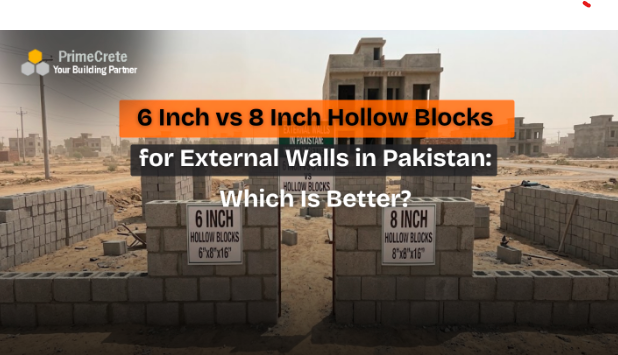
For most external walls in Pakistan, 8 inch hollow blocks are the more practical choice because their added thickness generally improves wall stiffness, thermal comfort, sound control, and weather performance. 6 inch hollow blocks can still work for non-load-bearing external infill walls when the structural design, wall height, supports, and exposure conditions allow them.
Thickness is not the only issue. Block strength, density, mortar, reinforcement, plaster, waterproofing, wall height, and the building structure all affect performance. Start with quality hollow concrete blocks that match the engineer’s specifications.
What Is the Difference Between 6 Inch and 8 Inch Hollow Blocks?
A 6 inch block makes a wall roughly 150 mm thick, while an 8 inch block makes a wall roughly 200 mm thick. Exact dimensions can vary by manufacturer, so confirm the actual size before ordering.
| Factor | 6 Inch Hollow Block | 8 Inch Hollow Block |
| Wall thickness | About 150 mm | About 200 mm |
| Weight | Generally lighter | Generally heavier |
| Handling | Easier | Requires more effort |
| Space use | Saves wall thickness | Uses more floor area |
| Thermal and sound buffer | Good when designed well | Usually better with added thickness |
| Exterior use | Selected non-load-bearing walls | Commonly preferred for external walls |
If you are estimating a house, PrimeCrete’s guide on calculating hollow blocks for a 5 Marla house explains why different wall sizes should be counted separately.
Which Size Is Better for External Walls in Pakistan?
Why 8 Inch Hollow Blocks Are Commonly Preferred
External walls face sun, rain, wind, temperature changes, plaster loads, fixtures, and occasional impact. An 8 inch hollow block wall provides a more substantial envelope for exposed elevations, taller walls, and projects where comfort and durability matter.
For homes in Islamabad, Rawalpindi, Haripur, Lahore, Peshawar, Multan, Karachi, and other Pakistani cities, 8 inch hollow blocks are often a sensible starting point for outer walls. The final choice should still follow structural and architectural drawings.
When 6 Inch Hollow Blocks Can Work
A 6 inch hollow block wall can be suitable as a non-load-bearing infill in a reinforced concrete frame when properly supported and approved by the project engineer. It can also help where reducing wall weight or preserving usable floor space is important.
Using 6 inch blocks only to reduce cost is not sensible if the wall is tall, highly exposed, load bearing, poorly supported, or expected to deliver stronger thermal and acoustic performance.
Structural Strength: Thickness Is Only One Factor
A thicker wall is not automatically a stronger structural wall. Compressive strength, block density, mortar, reinforcement, grouting, wall slenderness, connections, openings, and support conditions all matter.
In many Pakistani buildings, masonry is infill inside a reinforced concrete frame. In other projects, some walls may carry loads. That difference changes the required block grade and detailing. External masonry should match the engineer’s drawings rather than a general rule from a supplier or contractor.
Project teams should also refer to the Building Code of Pakistan – 2021 and applicable engineering specifications before finalizing structural masonry.
Thermal Comfort in Pakistan’s Climate
Pakistan has hot summers in many regions, while Islamabad, Rawalpindi, Haripur, northern Punjab, and Khyber Pakhtunkhwa can also experience cold winter periods. A good exterior wall should help slow heat transfer in both directions.
An 8 inch hollow block generally gives a longer heat-transfer path than a 6 inch unit made from the same material. Hollow cores can also help reduce heat movement. However, aggregate type, density, plaster, insulation, wall finish, orientation, and direct sun exposure affect actual performance.
Where energy efficiency is a major goal, builders can compare standard units with PrimeCrete’s lightweight concrete masonry units, which are designed to reduce weight and improve thermal performance.
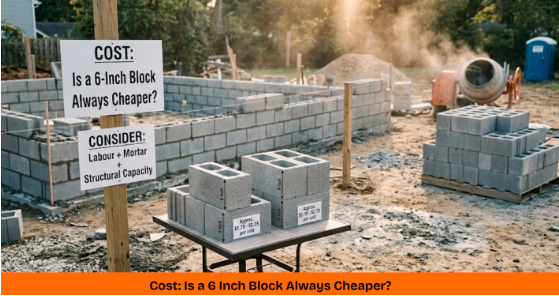
Cost: Is a 6 Inch Block Always Cheaper?
A 6 inch hollow block generally uses less material and is lighter to transport and handle, so its initial cost may be lower. However, the lowest block price is not always the lowest completed-wall cost.
Compare blocks, mortar, reinforcement, plaster, waterproofing, labor, transport, and insulation together. If the design needs an 8 inch wall, choosing a thinner block only to save money can create extra work later.
For related material planning, PrimeCrete’s guide to solid concrete blocks in Pakistan explains where dense solid units may be more suitable than hollow units.
How to Choose the Right Block for Your Project
Choose 8 Inch Blocks for More Demanding Exterior Walls
An 8 inch hollow block is usually better when the wall is highly exposed, relatively tall, expected to improve indoor comfort, or needs stronger acoustic performance. It is also a common choice when the design calls for a more substantial external envelope.
Choose 6 Inch Blocks Where the Design Allows a Lighter Wall
A 6 inch hollow block can make sense for non-load-bearing infill walls with proper framing and support, especially when reducing dead load or preserving usable space matters. The engineer should confirm the block grade, wall height, restraint, and connection details.
FAQs About 6 Inch vs 8 Inch Hollow Blocks
Is 6 Inch Hollow Block Good for an External Wall?
Yes, it can be suitable for a properly supported, non-load-bearing exterior wall when the engineer approves the design. It should not be selected only because it is lighter or cheaper.
Is an 8 Inch Hollow Block Better for a House in Pakistan?
For many residential external walls, 8 inch hollow blocks are the more robust choice because they provide greater thickness for weather exposure, thermal comfort, and sound control. Structural approval is still required.
Which Block Is Better for a 5 Marla House?
For a typical framed 5 Marla house, thicker blocks are commonly used on outer walls and thinner blocks on internal partitions. The exact choice depends on the plan, structural system, wall height, and project specifications.
What Is the Best Final Choice?
If both sizes meet the required strength grade, choose 8 inch hollow blocks for external walls when durability, comfort, and a more substantial wall are priorities. Choose 6 inch hollow blocks where the design specifically supports a thinner external wall. Match block size, grade, mortar, reinforcement, and finishes to engineer-approved drawings.
