
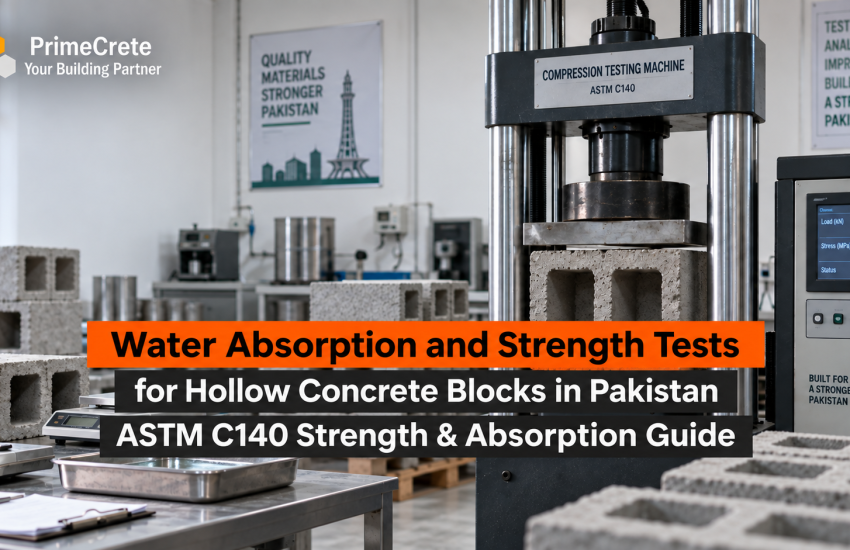
A wall is only as reliable as its weakest unit, and on many Pakistani sites that unit is never tested. Hollow concrete blocks arrive on a truck, get laid, and the first real quality check is a crack or a damp patch months later. For engineers specifying masonry in Lahore’s monsoon humidity or Peshawar’s seismic belt, two laboratory numbers separate a compliant block from a liability: net-area compressive strength and water absorption. This guide explains how both tests work, which limits apply, and how to build acceptance testing into your BOQ and site QA plan. Manufacturers such as PrimeCrete publish lot-wise test data for exactly this reason: a certificate turns a purchase into a verifiable specification.
How Compressive Strength and Absorption Tests Work
Both tests follow ASTM C140, the standard method covering sampling, dimensions, compressive strength, absorption and density of concrete masonry units (ASTM C140). A test lot needs six units of identical size and configuration: three for compression and three for absorption. The absorption specimens cannot be reused for strength testing, because immersion and oven-drying change moisture content and distort the compression result.
Compressive strength. The technician measures each unit, caps the bearing faces to create a level surface (ASTM C1552), and loads it with the cores vertical, the same orientation as in a wall. Failure load divided by net cross-sectional area gives the strength in MPa. This distinction matters in quotations: hollow units commonly have a net area of only 50-60% of gross area, so a figure quoted on gross area is not comparable to a net-area figure. Always ask which basis a supplier is using.
Water absorption. Specimens are immersed for 24 hours, weighed saturated and suspended in water, then oven-dried at roughly 100-115 °C until successive weighings two hours apart differ by no more than 0.2%. Absorption is the water gained relative to dry mass, and the C90 limit is expressed in kg/m³ using the net volume from the immersed weight.
Why absorption matters here. Low absorption reflects dense, well-compacted concrete with low permeability. In Pakistan that translates directly into resistance to monsoon wind-driven rain, efflorescence, and salt-laden ground moisture that attacks masonry at plinth level. For seismic zones, unit strength also feeds the design masonry strength (f’m) when the unit-strength method is used, so a weak lot undermines the structural calculation, not just the durability.
Acceptance Limits and Specification Benchmarks
The benchmarks below reflect recent editions of ASTM C90 for load-bearing units. Confirm the current edition and your project specification before issuing acceptance criteria.
| Property | Lightweight | Medium-weight | Normal-weight |
| Oven-dry density | < 1,680 kg/m³ | 1,680-2,000 kg/m³ | ≥ 2,000 kg/m³ |
| Max. average absorption (avg. of 3 units) | 288 kg/m³ | 240 kg/m³ | 208 kg/m³ |
| Min. average net-area compressive strength (avg. of 3) | 13.8 MPa (2,000 psi) | 13.8 MPa | 13.8 MPa |
| Min. individual unit strength | 12.4 MPa (1,800 psi) | 12.4 MPa | 12.4 MPa |
| Test method | ASTM C140 | ASTM C140 | ASTM C140 |
Non-load-bearing partition units fall under ASTM C129, which sets lower strength requirements, so never accept a C129 certificate for a structural wall.
Reading the results together. A block can pass on strength and still fail absorption. When it does, the usual causes are low compaction energy, excess water in the mix, short curing, or porous aggregate. Treat that as a production-quality warning, because the same lot will likely show scatter in dimensions and durability too.
Contrast with hand-made clay brick. Traditional Awwal eent varies from kiln to kiln and even within one firing, and it rarely ships with a lot-wise certificate. Machine-compacted concrete units, produced under controlled mixes and curing, allow you to specify, sample and reject on numbers rather than on a mason’s judgement.
Project Execution: Turning Test Data into Site Decisions
Testing only protects a project if it is tied to procurement. For structural walls that carry floor or roof loads, specify load-bearing hollow concrete blocks with a certificate that reports both net-area strength and absorption per ASTM C90 for each delivered lot, issued by an accredited or university materials laboratory.
A practical site protocol for engineers and QS teams:
- Write it into the BOQ. State the required density class, minimum strength, maximum absorption, and the lot size that triggers a sample set of six units.
- Sample at delivery, not at the factory gate only. Pull units from the stack on site, tag them, and send them to the lab before the wall reaches the first slab.
- Hold the lot. Do not lie from pending results. A failed batch discovered after three storeys of masonry costs far more than the 2-3 days it takes to wait.
- Store correctly. Keep blocks off wet ground and under cover; avoid soaking units before laying.
- Keep the record. File certificates with the as-built dossier for client and consultant audits.
Economics support this discipline. Consistent units reduce mortar wastage from irregular joints, lay faster than brick, and lower foundation dead load compared with solid clay masonry. Their hollow cores also improve thermal and acoustic performance in Pakistan’s hot summers. Those savings are only realised when the delivered units actually meet the certified numbers.
Frequently Asked Questions
What is the minimum compressive strength for load-bearing hollow concrete blocks?
Recent editions of ASTM C90 require an average net-area compressive strength of 13.8 MPa across three units, with no single unit below 12.4 MPa. Always check the edition cited in your project specification, and remember the value is on net area, not gross area.
How many blocks are needed for lab testing, and how long does it take?
ASTM C140 testing needs six identical units per lot: three for compression and three for absorption. The compression test is quick, but absorption involves a 24-hour soak plus oven-drying, so plan at least two to three working days including reporting.
Can I use a block that passes strength but fails the absorption limit?
It should not be accepted as compliant. High absorption signals a porous mix that invites moisture ingress, efflorescence and long-term durability problems, particularly on exterior walls. Reject the lot or have the structural engineer review it in writing before any decision to proceed.
Conclusion
Strength and absorption results are the fastest, cheapest way to verify a masonry lot before it becomes a wall. Site engineers, contractors and procurement teams can request test certificates, sample blocks or a project BOQ rate quote from PrimeCrete, and can ask for lot-wise ASTM C90 and C140 results before placing an order.

[…] BS EN 1340 includes requirements for weathering resistance, bending strength, abrasion resistance and slip resistance. Ask your supplier for test reports. For a deeper look at testing, read our guide on water absorption and strength tests. […]
[…] grid units. Before you buy any concrete product, ask the supplier for test results. Our guides on water absorption and strength tests and what to check before buying concrete blocks explain how testing works. The same logic applies […]
[…] more information about block quality and water movement, PrimeCrete’s guide to water absorption and strength tests for concrete blocks explains why absorption and density matter in masonry […]