
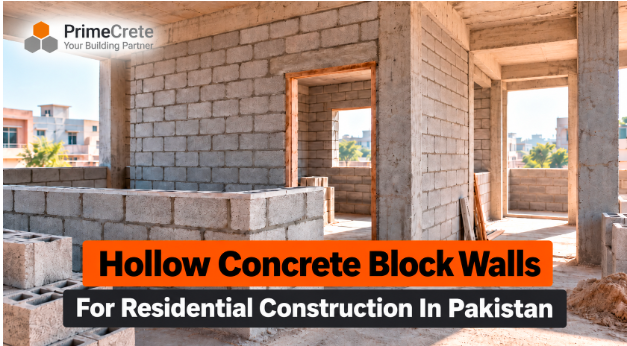
Ask any Pakistani homeowner about building a house, and two complaints show up within five minutes: cost and time. Walls eat a big share of both. That explains why hollow concrete block walls now appear on more residential sites, from 5 marla homes in Rawalpindi to kanal houses in Lahore.
At PrimeCrete, our team manufactures in Hattar Industrial Estate, about 25 km from Islamabad, and we hear the same questions every week. So this guide answers them plainly. What are these walls? Where do they work? Where are they? And how do you build them right?
What Are Hollow Concrete Block Walls?
A hollow concrete block is a factory-made masonry unit with open cells, or cores, running through it. Manufacturers shape these units through precision molding and vibration-compaction, and the engineered cores cut weight while keeping structural performance intact.
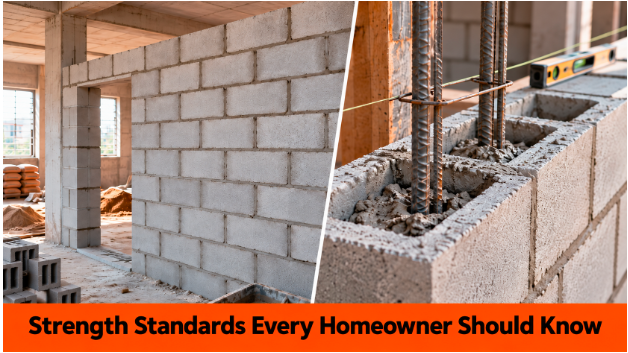
Those cores do two jobs. First, they make the block lighter. Second, they leave room for steel bars and grout when a wall needs extra strength.
Most Pakistani sites use the standard 8 × 8 × 16 inch unit. That’s a nominal size. The actual block is slightly smaller, so the mortar joint brings it back to a neat module.
Hollow Blocks vs Traditional Red Bricks
One block covers the same wall face as several clay bricks. So masons lay fewer units, handle fewer joints, and finish courses faster.
Bricks still have loyal fans, and that’s fine. Grandfathers love them. But if you want the full numbers on cost, speed and heat, read our detailed comparison: Hollow Blocks vs Bricks in Pakistan: Cost, Speed and Heat.
Why Homeowners in Pakistan Are Switching
Faster Masonry Work
Bigger units mean fewer lifts, fewer joints and less time per square foot. Your contractor won’t need to invent new excuses for delays. Well, not for the walls, anyway.
Lower Dead Load on the Structure
Empty cores mean less concrete per block. Lighter walls put less load on beams, columns and footings. In a multi-storey home, that adds up quickly.
Less Mortar
Hollow blocks usually get mortar only on their face shells. According to the National Concrete Masonry Association, typical block construction uses about 8.5 cubic feet of mortar per 100 square feet of wall, assuming 3/8-inch joints, face-shell bedding and a 10% waste allowance. That’s a useful benchmark when you check your contractor’s estimate.
Comfort and Durability
The cores hold air, and air slows heat transfer. PrimeCrete lists thermal insulation, better sound absorption and lower material use among the main benefits. The same page highlights fire and weather resistance, which matters in both Karachi’s humidity and Quetta’s winters.
Strength Standards Every Homeowner Should Know
Don’t buy blocks based on looks. A nice grey finish tells you nothing about strength.
The global benchmark is ASTM C90, the standard for load-bearing concrete masonry units. In 2014, ASTM raised the minimum unit compressive strength under C90 from 1,900 psi (13.1 MPa) to 2,000 psi (13.8 MPa). The Concrete Masonry and Hardscapes Association explains these limits clearly in its CMU specifications guide.
Good producers aim higher than the minimum. Structure Magazine notes that block makers typically produce units 20 to 30% stronger than the 2,000 psi requirement.
Seismic Safety: The Non-Negotiable Part
Pakistan sits in an active seismic zone. Nobody here needs a reminder of October 2005.
After the 2005 Kashmir earthquake, Pakistan developed its first building code with seismic provisions in 2007, and the updated BCP 2021 recognises high seismicity across many regions. You can read the code through the NDMA’s published copy of the Building Code of Pakistan.
One rule speaks directly to hollow block walls. Any anchors required in masonry walls made of hollow units must sit inside a reinforced, grouted element of the wall. In plain words: steel goes into cells, and grout fills those cells completely.
Research from Pakistan backs this up. In one full-scale test on an unreinforced concrete block building typical of northern areas, retrofitting with ferro-cement overlay and grout injection lifted lateral load capacity to more than double the original strength. The lesson? Unreinforced block walls are a gamble. Properly detailed ones perform far better.
Your structural engineer should decide bar sizes, spacing and band locations. Don’t let the site munshi decide. He’s great with receipts, not with rebar.
Where to Use Hollow Blocks in a Pakistani House
Hollow blocks suit several parts of a typical home:
- External walls: 8-inch blocks give good thickness and room for reinforcement.
- Internal partitions: 4-inch or 6-inch blocks save space and weight.
- Boundary walls: Quick to build and easy to reinforce at intervals.
- Infill walls: They fill RCC frames without adding heavy dead load.
Need to choose between wall types? Our page on load-bearing and non-load-bearing blocks explains the difference. For spots where your engineer prefers a dense unit, solid concrete blocks do the job.
Building It Right: Practical Site Tips
Good blocks can still make a bad wall. These habits keep your concrete block walls straight and strong:
- Keep blocks dry before laying. Clay bricks get soaked. Concrete blocks don’t. Wet blocks shrink as they dry and can crack joints.
- Check plumb and level every few courses. The BCP requires walls and structural framing to go up true and plumb as per the design.
- Grout steel cells properly. Use proper grout, not leftover mortar scraped off the floor.
- Add RCC bands at plinth, lintel and roof level, as your engineer specifies.
- Cure the mortar and plaster. Skipping curing is like skipping chai at a Pakistani wedding. Technically possible, deeply unwise.
Common Mistakes to Avoid
- Buying the cheapest blocks without test reports
- Skipping vertical steel at corners and openings
- Cutting deep chases for wiring after the wall goes up
- Mixing block brands with different sizes in one wall
Frequently Asked Questions
Are hollow concrete block walls strong enough for houses in Pakistan?
Yes, when blocks meet recognised strength standards and engineers detail the walls for seismic loads. Reinforcement and grouting make the real difference.
Which block size works best for external walls?
Most builders use 8-inch blocks for external walls. Some use 6-inch blocks for lighter infill. Your engineer should confirm the choice.
Do hollow blocks need plaster?
Most homes plaster them for finish and weather protection. Plaster also helps with moisture control on exposed faces.
Final Thoughts
Hollow concrete block walls offer Pakistani homeowners a smart mix of speed, lighter loads and solid performance. The formula stays simple: buy tested blocks, follow the Building Code, reinforce where it counts, and supervise the site properly.
Planning a new home? Explore PrimeCrete’s hollow concrete blocks and talk to our team about sizes, strength and delivery for your project.
