
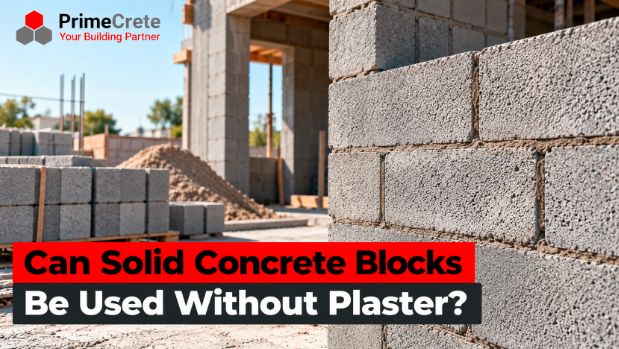
A contractor finishes a boundary wall in Rawalpindi and suggests leaving the concrete blocks exposed to save plastering costs. The homeowner likes the industrial appearance but worries about rainwater, cracks, and maintenance. Can solid concrete blocks without plaster deliver a durable wall, or will skipping the finish create expensive problems later? The answer depends on block quality, joint workmanship, exposure, and protection. Choosing suitable PrimeCrete solid concrete blocks is an important starting point.
PrimeCrete, a concrete-products brand of Pak Dream (Pvt) Ltd, manufactures construction materials at Hattar Industrial Estate, Haripur, using automated MASA Germany equipment. For contractors, architects, and homeowners across Pakistan, understanding when plaster is optional can help control construction costs without sacrificing long-term performance.
Can Solid Concrete Blocks Be Left Without Plaster?
Yes, solid concrete blocks can be used without plaster when the wall has suitable structural design, sound mortar joints, an appropriate exposed finish, and adequate moisture protection. However, leaving concrete masonry unplastered does not automatically make it waterproof or maintenance-free.
An exposed concrete block wall uses the masonry itself as the visible architectural finish rather than covering it with cement-sand plaster.
This approach can work for:
- Interior feature walls
- Industrial buildings and warehouses
- Architectural boundary walls
- Covered corridors and utility rooms
- Selected commercial façades
- Outdoor landscape features
The decision becomes more complicated for walls exposed to wind-driven rain, soil moisture, or frequent wetting.
For example, an exposed internal partition in a dry commercial building has much lower moisture risk than an unplastered boundary wall facing monsoon rainfall.
What Makes Solid Concrete Blocks Suitable for Exposed Walls?
Solid concrete blocks contain cementitious binder, aggregates, and water and have a substantially solid cross-section. Their performance depends on the concrete mixture, manufacturing process, curing, and verification testing.
Unlike hollow units, solid blocks have no large open cores. However, this does not mean every solid block is stronger than every hollow block. Strength must come from testing the specified units.
Compressive Strength and Structural Performance
Compressive strength measures the pressure a block can withstand under a standardized compression test.
ASTM C90 covers loadbearing concrete masonry units, including both hollow and solid units. A commonly referenced minimum average net-area compressive strength in current C90 editions is 2,000 psi (13.8 MPa), with additional individual-unit requirements.
That figure is a specification benchmark, not a verified PrimeCrete product test result.
The ASTM C90 specification for loadbearing concrete masonry units provides the relevant standards framework, although the linked edition is historical. Projects should use the edition required by their contract or approving authority.
A concrete block can meet structural strength requirements yet still have a porous, uneven surface. Structural strength and surface weather resistance are separate properties.
Dimensional Consistency
Machine-made concrete blocks can provide consistent dimensions that support neat exposed masonry.
When block dimensions vary, masons compensate with irregular mortar joints. Those variations may remain hidden beneath plaster but become highly visible on an exposed wall.
For a professional finish, contractors should check:
- Block length, height, and thickness
- Edge straightness and corner integrity
- Visible cracks and chips
- Surface texture and colour variation
- Mortar joint consistency
PrimeCrete’s guide to solid concrete block specifications before buying explains the key purchasing checks.
Does an Unplastered Concrete Block Wall Absorb Water?
Yes. Concrete masonry can absorb and transmit moisture even when the blocks appear dense and the joints look intact. Properly designed exposed walls need measures that limit water entry and allow moisture to escape.
Water commonly penetrates through mortar joints, shrinkage cracks, porous surfaces, poorly sealed openings, and junctions between masonry and structural concrete.
In Pakistan, moisture protection becomes especially important during monsoon rainfall.
Why Monsoon Rain Changes the Decision
An exposed boundary wall in Islamabad or Rawalpindi can experience repeated wetting from heavy rainfall.
If rainwater enters the masonry, several problems may develop:
- White salt deposits, known as efflorescence
- Interior damp patches where the wall encloses occupied rooms
- Discoloration and surface staining
- Deterioration of weak mortar joints
- Increased risk of corrosion where moisture reaches embedded steel
A dense block alone cannot solve these problems.
How to Protect Exposed Concrete Block Walls
A suitable waterproofing concrete block wall strategy may include a compatible water-repellent treatment, properly sealed joints, wall copings, flashing, drainage, and a damp-proof course.
A breathable penetrating silane/siloxane treatment may reduce liquid-water absorption while permitting water vapour transmission. Its effectiveness depends on the substrate, application rate, and product suitability.
For below-grade walls or structures retaining water-bearing soil, surface water repellents alone are not sufficient. Those conditions require a dedicated waterproofing and drainage design.
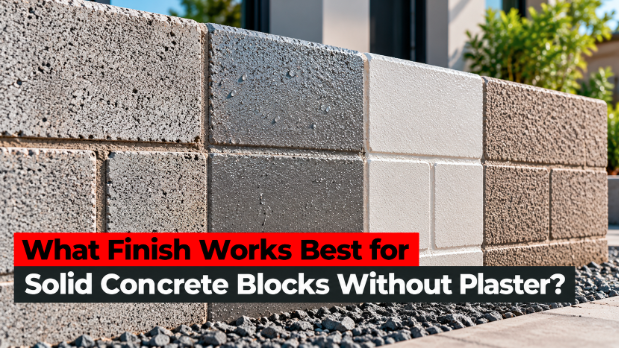
What Finish Works Best for Solid Concrete Blocks Without Plaster?
The best concrete block wall finishing approach depends on appearance, exposure, and maintenance expectations.
| Finish | Appearance | Main consideration |
| Natural exposed block | Industrial, textured | Requires good masonry workmanship |
| Penetrating water repellent | Little visible change | Helps reduce rain absorption |
| Masonry paint | Uniform colour | Requires surface preparation and compatible coating |
| Cementitious coating | More uniform, protected finish | Can hide the original block texture |
| Clear decorative sealer | Natural or enhanced texture | Check UV resistance and vapour permeability |
Natural Exposed Block Finish
A natural finish provides a contemporary appearance, particularly in warehouses, offices, and architectural feature walls.
However, the mason must maintain consistent joint thickness, alignment, and surface cleanliness.
Once mortar stains harden on exposed blocks, removing them without affecting the surface appearance becomes difficult.
Painted Concrete Block Walls
Masonry paint can improve appearance and provide protection when specified as part of a compatible coating system.
The contractor must account for moisture, alkalinity, curing, primer selection, and manufacturer application requirements.
Painting a damp wall can trap moisture or lead to blistering and peeling.
Is Plaster Necessary for Load-Bearing Concrete Block Walls?
Plaster is not automatically required for the structural capacity of every load-bearing concrete block wall. The load-bearing performance primarily depends on the engineered masonry assembly, including unit strength, mortar, reinforcement, grout where specified, support conditions, and structural detailing.
However, plaster or another surface finish may serve important purposes beyond appearance.
For example, a project may require a particular finish to satisfy water-resistance, durability, hygiene, fire-resistance, or architectural requirements.
An unplastered wall should not be assumed to have the same fire-resistance rating or rain penetration resistance as a tested plastered assembly.
Engineers must confirm the actual wall design and project specifications before deleting the plaster layer.
How Much Money Can You Save by Skipping Plaster?
Skipping plaster can eliminate some material and labour costs, but the savings depend on the finishing system and the quality of exposed masonry work.
Consider a hypothetical boundary wall with:
- Length: 30 metres
- Height: 2.4 metres
- One-face wall area: 72 m²
- Both-face wall area: 144 m²
If the original specification requires 12 mm plaster on both sides, the nominal geometric plaster volume is:
1440.012=1.728m3
This equals 1.728 m³ of theoretical plaster volume, before allowances for waste and variations in thickness.
Removing plaster could reduce cement, sand, mixing, application, curing, and related labour quantities.
However, the revised wall may still need:
- Better-looking face blocks
- More careful mortar joint finishing
- Surface cleaning
- Water-repellent treatment
- Additional detailing around the wall top and openings
The correct comparison is the total installed cost of a finished plastered wall against a fully detailed exposed-block wall.
What Are the Most Common Mistakes With Unplastered Concrete Blocks?
1. Assuming Solid Means Waterproof
Solid blocks can still contain interconnected pores. Contractors must assess the entire wall, not simply the block shape.
2. Leaving Mortar Joints Incomplete
Poorly filled head joints and recessed, unsealed gaps create opportunities for water entry.
A properly tooled joint profile improves the quality of exposed masonry.
3. Ignoring Control Joints
Concrete masonry can undergo drying shrinkage and thermal movement.
Long, restrained walls may require engineered control joints to accommodate movement and reduce uncontrolled cracking.
4. Forgetting Wall Copings
Rainwater entering from the top can damage even carefully built masonry.
Use suitable copings, drainage falls, and drip details where the design requires them.
5. Choosing Blocks Based Only on Price
An inexpensive block with inconsistent dimensions or poor surface quality may increase labour and finishing costs.
PrimeCrete’s guide to solid concrete block prices, grades, and delivery costs in Pakistan provides additional procurement context.
How Should Contractors Check Exposed Block Quality?
Before approving unplastered concrete blocks, contractors should inspect a sample wall rather than relying on a single loose block.
A practical inspection should cover dimensional consistency, mortar joint quality, colour variation, chipped edges, moisture detailing, and surface finish.
The ASTM C140/C140M test methods cover relevant testing procedures for concrete masonry units, including dimensions, compressive strength, absorption, and density.
A supplier’s laboratory results should identify the tested unit type, test date, method, and reported values.
For a load-bearing application, the structural engineer must also approve the unit grade and completed masonry system.
Frequently Asked Questions
Can solid concrete blocks be used outside without plaster?
Yes, but exterior exposed masonry requires suitable joint detailing, moisture protection, and maintenance. Rain-exposed walls should not rely on block density alone.
Are unplastered concrete block walls cheaper?
They can be cheaper when plaster labour and materials cost more than the added expense of exposed masonry workmanship and protective finishing.
Will solid concrete blocks crack without plaster?
They can crack because of settlement, shrinkage, restraint, structural movement, or poor construction. Plaster does not prevent the underlying causes.
Do concrete block walls need waterproofing?
Many exposed exterior walls need some form of water-management detailing. The appropriate system depends on exposure and whether the wall is above or below ground.
Can solid concrete blocks be painted directly?
Yes, provided the masonry is sufficiently cured, clean, dry, and prepared for a compatible masonry coating system.
Conclusion
Solid concrete blocks without plaster can create practical, durable, and visually attractive walls when the project incorporates appropriate material selection, joint workmanship, movement detailing, and moisture management.
The most important decision is not simply whether to skip plaster. It is whether the completed wall can meet structural, weather-resistance, and appearance requirements without it.
For residential boundary walls, commercial structures, and industrial applications, PrimeCrete can help contractors and procurement teams discuss suitable concrete block sizes, grades, and supply requirements.
Contact PrimeCrete to request product specifications and a project-based quotation.
