
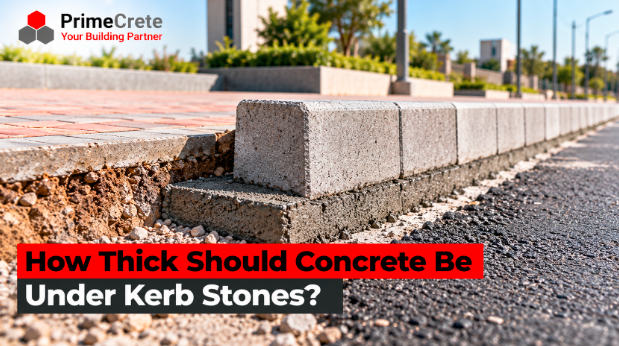
Kerb stones may appear simple to install, but insufficient foundation support can cause settlement, outward movement, cracking, and drainage problems. These failures are particularly costly along housing-society roads, commercial parking areas, and driveways carrying repeated vehicle loads. Before installing concrete kerb stone blocks, contractors should understand how concrete bed thickness, ground conditions, and rear haunching affect the stability of the completed kerb line.
At PrimeCrete, the concrete-products brand of Pak Dream (Pvt) Ltd, precast kerb stones are manufactured using automated MASA Germany equipment. For infrastructure and landscaping projects across Pakistan, specifying suitable kerb stone concrete bedding thickness and installation details helps reduce premature failure and unnecessary maintenance.
How Thick Should Concrete Be Under Kerb Stones?
For many conventional road and parking-area kerb installations, 150 mm (6 inches) of concrete bedding is a commonly referenced construction detail. However, the correct thickness depends on the kerb profile, traffic loading, ground conditions, approved drawings, and applicable construction specification.
Smaller landscape edging units may use different foundation details. Heavy-duty kerbs may require more substantial support.
A preliminary comparison is:
| Kerb application | Indicative concrete support |
| Light garden edging | Detail determined by landscape design; lighter support may be acceptable |
| Small precast edging units | Some standard details use around 75–100 mm |
| Conventional road kerbs | 150 mm is a common reference thickness |
| Heavy-traffic kerbs | Engineered bed, haunch, and possible additional reinforcement |
These are examples of construction practice, not universal minimum requirements.
What Is the Difference Between a Kerb Bed, Haunch, and Sub-Base?
A stable concrete kerb stone installation normally consists of three supporting components.
1. Prepared Subgrade and Granular Sub-Base
The subgrade is the natural or prepared ground beneath the construction.
A granular sub-base provides a compacted foundation layer where required by the design.
Its purpose is to distribute loads, support the concrete foundation, and limit differential settlement.
The required depth depends on soil-bearing conditions and the pavement design.
2. Concrete Bedding
The kerb concrete bed, sometimes called the concrete race or foundation, sits directly beneath the precast kerb.
It supports the unit continuously and transfers forces into the material below.
An insufficient or irregular bed can leave individual units unsupported, increasing the risk of cracking or movement.
3. Concrete Haunching
Kerb stone haunching is the concrete backing placed behind the kerb to resist outward rotation and lateral displacement.
It becomes particularly important where vehicle tyres may strike the kerb or where paving requires strong edge restraint.
The size and shape of the haunch should follow approved construction details.
What Standards Apply to Concrete Kerb Stones?
The BS EN 1340 standard for concrete kerb units specifies product requirements and test methods for precast concrete kerbs, channels, and related units used in paved areas.
It addresses product characteristics and conformity, but it does not establish one universal concrete foundation thickness for every installation.
Engineers should distinguish between:
- Product standards: Requirements for the precast kerb itself.
- Installation specifications: Requirements for bedding, backing, joints, and workmanship.
- Pavement design: Requirements arising from loads, ground conditions, and drainage.
For example, published UK highway details use 150 mm concrete foundations for certain standard kerb installations. Such details demonstrate established practice, but they must not automatically replace approved Pakistani project drawings.
Does Concrete Bed Thickness Change With Traffic Loads?
Yes. Kerb stone foundation requirements can change considerably depending on the expected traffic.
Residential Driveways
A residential driveway generally carries passenger cars and occasional service vehicles.
The designer should consider vehicle turning and braking forces, particularly near gates and kerb returns.
The supporting bed and haunch must be suitable for these loads.
Housing-Society Roads
Housing-society roads may carry cars, delivery vans, garbage trucks, and occasional construction vehicles.
Kerbs along road curves and intersections often experience repeated lateral loading.
A conventional concrete bed and properly placed haunch may be suitable where the approved design confirms adequate support.
Commercial Parking Areas
Commercial parking areas may experience frequent vehicle movements and occasional larger vehicles.
The required kerb foundation depends on the expected loading and how the kerb interacts with the surrounding pavement.
Wheel stops, safety barriers, and kerbs perform different functions and should not be treated as interchangeable products.
Heavy-Duty Industrial Areas
Truck yards, industrial entrances, and heavy-vehicle routes can impose much greater impacts.
These applications may require specially designed kerb profiles, reinforced foundations, dowels, or other protective details.
The structural and pavement designer should establish those requirements.
How Much Concrete Is Needed for a Kerb Stone Foundation?
A kerb stone concrete quantity calculation should separately estimate the supporting bed and any additional concrete used for haunching.
Consider a hypothetical installation with:
- Kerb run: 100 m
- Concrete bed width: 300 mm
- Concrete bed thickness: 150 mm
- Triangular rear haunch: 150 mm base width and 150 mm height
These dimensions are illustrative and must be replaced by the project’s approved drawing dimensions.
Step 1: Calculate Concrete Bedding Volume
Convert dimensions to metres.
Bed volume:
100 × 0.30 × 0.15
= 4.50 m³
Step 2: Calculate Haunching Volume
Assuming a triangular haunch:
Cross-sectional area:
0.5 × 0.15 × 0.15
= 0.01125 m²
Haunch volume:
100 × 0.01125
= 1.125 m³
Step 3: Calculate Total Concrete
Total theoretical concrete volume:
4.50 + 1.125
= 5.625 m³
If the estimator applies a hypothetical 10% allowance for quantity variation and construction losses:
5.625 × 1.10
= 6.1875 m³
The preliminary quantity is approximately 6.19 m³, or about 6.2 m³ per 100 m of kerb.
This estimate does not include additional concrete for unusual geometry, special crossings, or other foundation details.
For related estimation guidance, see PrimeCrete’s How Much Concrete Support Do Kerb Stones Need?.
How Should Concrete Kerb Stones Be Installed?
Step 1: Establish the Correct Line and Level
Use survey controls, string lines, or appropriate setting-out equipment.
Confirm the top-of-kerb elevations and road drainage profile.
Incorrect setting-out can create ponding even when the kerb units themselves are strong.
Step 2: Excavate the Foundation Trench
Excavate to the dimensions required for the specified concrete bed and supporting layers.
Remove organic material, unstable soil, and unsuitable fill.
Allow sufficient working width for placing and consolidating concrete.
Step 3: Compact the Supporting Ground
Prepare the subgrade and any specified granular foundation.
Where laboratory compaction control is appropriate, ASTM D698 soil compaction testing may provide the reference moisture-density relationship for suitable materials.
The project specification should define the acceptance criteria.
Step 4: Place the Concrete Bed
Place concrete of the specified grade and consistency.
Provide continuous support along the kerb line.
Do not rely on isolated lumps of mortar or concrete to support individual units.
If the kerbs are installed on hardened concrete, the design may call for a separate mortar bedding layer.
Step 5: Set the Kerb Stones
Position each unit accurately and adjust it to the required line and level.
Use appropriate handling methods to avoid chipping the edges.
Maintain the specified joint arrangement.
For curved sections, select suitable curved kerbs or engineered cut arrangements.
Step 6: Install Concrete Haunching
Place the concrete backing according to the approved detail.
Where the design requires a monolithic or bonded bed-and-haunch arrangement, coordinate placement so the supporting concrete and backing develop the intended connection.
An undersized haunch can allow kerbs to lean outward under traffic or soil pressure.
Step 7: Cure and Protect the Concrete
Fresh bedding and haunching concrete need proper curing and protection.
In Pakistan’s summer heat, rapid moisture loss can interfere with strength development.
During rainy periods, protect fresh concrete from washout and erosion.
Do not permit construction vehicles to strike or load the kerb line before the supporting concrete has developed adequate strength.
Why Do Kerb Stones Settle or Lean After Installation?
Kerb stone settlement often results from inadequate support rather than defects in the precast unit.
Common causes include:
- Poorly compacted subgrade
- Weak or variable ground conditions
- Inadequate concrete bedding thickness
- Missing or undersized haunching
- Insufficient concrete strength
- Poor drainage
- Incomplete backfill compaction
- Repeated vehicle impacts
- Premature loading during construction
How Does Monsoon Rainfall Affect Kerb Foundations?
Heavy rainfall can soften exposed soil and erode poorly protected edges.
Where runoff enters behind the kerb, it may wash fine material away from the supporting layers.
Once support becomes uneven, repeated vehicle loading can accelerate cracking and settlement.
Contractors should check surface falls, drainage outlets, sub-base condition, and the continuity of edge support.
PrimeCrete explains these problems further in How to Install Kerb Stones Without Settlement.
What Should Contractors Check Before Buying Kerb Stones?
A reliable kerb stone procurement checklist should include:
- Confirm the required kerb dimensions and profile.
- Review the expected traffic and exposure conditions.
- Verify the applicable product standard.
- Request available strength and dimensional test documentation.
- Confirm the approved concrete bedding and haunching details.
- Calculate kerb quantities from actual lengths and curves.
- Include cutting, breakage, and delivery allowances.
- Plan drainage and foundation preparation before installation.
For budgeting, compare the complete installed kerb cost rather than the precast unit price alone.
Frequently Asked Questions
Is 100 mm of concrete enough under kerb stones?
It may be suitable for certain small edging details, but it should not be assumed adequate for standard road kerbs or vehicle-impact applications without engineering approval.
Is 150 mm concrete bedding sufficient for road kerbs?
A 150 mm foundation is commonly used in some standard road-kerb details. Its suitability depends on the approved design, soil, kerb profile, and expected loading.
Can kerb stones be installed directly on soil?
Light decorative edging can use different methods, but road and parking kerbs generally need designed foundation support and appropriate lateral restraint.
Do kerb stones need concrete behind them?
Many vehicle-area installations require concrete haunching to resist outward movement. The detail depends on the kerb application and supporting pavement system.
Which concrete grade is suitable for kerb bedding?
The correct grade comes from the project specification. Contractors should not substitute a generic site mix without confirming the required strength and installation properties.
Conclusion
For many conventional installations, 150 mm concrete bedding under kerb stones provides a useful reference point, but it is not a universal requirement.
The complete foundation must account for soil conditions, traffic loading, sub-base preparation, kerb dimensions, concrete strength, and haunching.
PrimeCrete manufactures precast kerb stone products for roads, parking areas, landscaping, and infrastructure projects across Pakistan.
Contractors, consultants, and procurement teams should verify product specifications and approved construction details before calculating quantities and requesting project quotations.
