
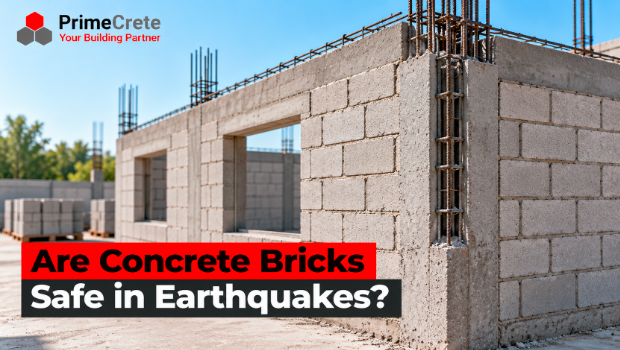
Pakistan’s history of damaging earthquakes makes masonry selection an important structural decision. Contractors sometimes assume that dense concrete bricks are safer than red clay bricks, while others believe that lightweight masonry is inherently weak. Neither assumption is sufficient. Engineers evaluating masonry options should also examine products such as PrimeCrete lightweight concrete masonry units, which can reduce wall dead load when their strength and detailing meet project requirements.
At PrimeCrete, the concrete-products brand of Pak Dream (Pvt) Ltd, manufactured concrete masonry products support a variety of structural and nonstructural applications. For houses and commercial buildings across Pakistan, earthquake-resistant masonry construction depends on the complete structural system, not merely the type or strength of an individual brick.
Are Concrete Bricks Safe During an Earthquake?
Concrete bricks can form part of an earthquake-resistant building when the masonry and its connections are properly engineered. However, unreinforced or poorly connected masonry remains vulnerable to cracking and collapse during strong ground shaking.
An earthquake generates inertial forces as the ground accelerates.
Masonry generally performs well under compression but has comparatively limited tensile capacity unless structural reinforcement or confinement provides additional resistance.
During an earthquake, a wall may experience:
- Horizontal forces acting along its length
- Out-of-plane bending
- Diagonal shear cracking
- Repeated load reversals
- Movement between masonry and the surrounding structure
The wall’s response depends on reinforcement, mortar, construction quality, openings, connections, and support conditions.
What Is the Difference Between Concrete Bricks and Concrete Masonry Units?
A concrete brick is a relatively small masonry unit manufactured from cementitious materials and aggregates.
A concrete masonry unit (CMU) is typically a larger block that may be solid or hollow.
Concrete bricks and CMUs can both contribute to structural or nonstructural walls, but different product specifications may apply.
Relevant Product Standards
ASTM C55 — Standard Specification for Dry-Cast Concrete Building Brick covers concrete building bricks intended for masonry construction.
ASTM C90 addresses dry-cast loadbearing concrete masonry units, including solid and hollow block products.
These specifications address material properties. They do not independently establish that a completed wall or building is earthquake-resistant.
A manufacturer supplying units for structural work should identify the applicable specification and provide appropriate test evidence.
What Makes a Concrete Masonry Building Earthquake-Resistant?
Earthquake resistance depends on a continuous and appropriately designed path for seismic forces to travel through the structure into the foundations.
1. Structural Reinforcement
Reinforced masonry uses steel reinforcement with grout or other engineered detailing to develop tensile and shear resistance.
Reinforcement may appear vertically within masonry cores and horizontally within bond beams or specified joints.
Its location and quantity must follow structural calculations.
Adding random steel bars after wall construction does not produce a reliable reinforced masonry system.
2. Confined Masonry Construction
Confined masonry generally uses masonry wall panels with reinforced concrete confining elements, including vertical tie-columns and horizontal tie-beams.
When designed and constructed as a complete system, confinement can improve wall integrity and seismic behaviour.
Confined masonry is not the same as adding isolated concrete columns to an otherwise unengineered wall.
The sequence of construction, connections, geometry, and reinforcement details all influence the resulting structural performance.
3. Proper Wall Connections
Walls must connect appropriately to surrounding structural elements.
Where masonry forms part of the lateral-load-resisting system, connections must transfer the required forces.
Where masonry acts as nonstructural infill within an RCC frame, engineers must address frame movement and the wall’s in-plane and out-of-plane behaviour.
4. Sound Foundations and Structural Configuration
Even strong masonry cannot compensate for inadequate foundations.
Irregular floor plans, large unsupported openings, weak ground-storey arrangements, and inconsistent wall layouts can create seismic vulnerabilities.
Engineers should evaluate the complete building, especially where owners plan later vertical extensions.
Does Lightweight Concrete Masonry Perform Better in Earthquakes?
Lightweight concrete masonry can reduce structural mass and associated inertial forces, but reduced weight alone does not guarantee better seismic performance.
Seismic force is related to structural mass and acceleration. However, actual building response also depends on stiffness, vibration characteristics, ductility, ground motion, and structural configuration.
Understanding Masonry Density
Concrete masonry density is commonly classified as:
| Density class | Approximate oven-dry density |
| Lightweight CMU | Below 1,680 kg/m³ |
| Medium-weight CMU | 1,680 to below 2,000 kg/m³ |
| Normal-weight CMU | 2,000 kg/m³ and above |
These are broad material classification thresholds, not minimum strength requirements or specific PrimeCrete test results.
PrimeCrete’s pumice-based lightweight CMU product information describes a typical density range of approximately 800–1,600 kg/m³, depending on the product.
The exact density and strength of the proposed units require verification through the relevant product documentation.
Why Does Lower Weight Matter?
Consider two hypothetical wall assemblies:
- Wall A mass: 2,000 kg
- Wall B mass: 1,200 kg
For the same assumed horizontal acceleration of 0.20g, a simplified inertial-force calculation gives:
Wall A: approximately 3.92 kN
Wall B: approximately 2.35 kN
This simplified illustration shows the effect of mass under equal acceleration. It is not a seismic design calculation and does not predict actual building performance.
Lightweight masonry may reduce imposed dead loads, but its strength, stiffness, connections, and suitability must still be assessed.
For more detail, see PrimeCrete’s guide to lightweight CMUs and roof loads.
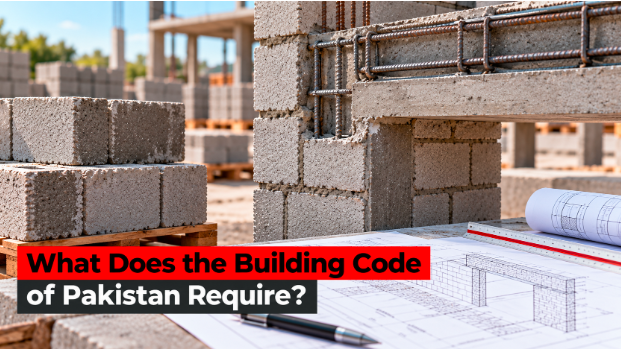
What Does the Building Code of Pakistan Require?
Earthquake-resistant buildings must meet the seismic design provisions applicable to the project.
The Pakistan Engineering Council’s building-code resources identify the Building Code of Pakistan 2021 and the earlier Seismic Provisions 2007 among its published codes.
Engineers should establish which code edition and local authority requirements govern their specific project rather than assuming the same requirements apply everywhere.
For masonry structures, critical design considerations include:
- Site seismic hazard and soil conditions
- Building importance and occupancy
- Structural system selection
- Wall thickness, height, and layout
- Material strengths
- Vertical and horizontal reinforcement
- Connections and anchorage
- Openings and diaphragm behaviour
Material certification supports this process but cannot replace structural design.
Are Concrete Bricks Better Than Red Clay Bricks in Earthquakes?
Neither material is automatically superior in every seismic application.
A correctly engineered and constructed masonry system can perform better than a poorly detailed system made from stronger individual units.
| Comparison factor | Concrete bricks | Red clay bricks |
| Manufacturing | Often machine-produced | Kiln-fired, with production methods varying |
| Unit strength | Must be tested | Must be tested |
| Dimensional accuracy | Depends on production control | Depends on production control |
| Mortar compatibility | Requires specified mortar | Requires specified mortar |
| Seismic performance | Depends on complete wall design | Depends on complete wall design |
| Quality verification | Product-specific test reports | Product-specific test reports |
Uniform dimensions may help workers maintain consistent mortar joints.
However, compressive strength alone does not establish lateral-load resistance.
PrimeCrete discusses another important distinction in Do Concrete Bricks Crack Under Heavy Loads?, which explains why wall design matters alongside material properties.
What Common Masonry Mistakes Increase Earthquake Risk?
Unreinforced Tall Boundary Walls
Boundary walls can fail out of plane when they lack suitable foundations, supports, or reinforcement.
Their design should consider wall height, wind, seismic loads, openings, and soil conditions.
Poor Mortar Workmanship
Irregular, weak, or incompletely filled joints can reduce wall performance.
The engineer should specify suitable mortar materials, proportions, and joint requirements.
Unsupported Openings
Doors and windows interrupt the flow of forces through masonry.
Engineers must detail lintels, jambs, reinforcement, and adjacent wall sections accordingly.
Heavy Unsecured Masonry Infill
Nonstructural walls can pose a life-safety hazard if they collapse during shaking.
Appropriate anchorage, separation, or other engineered details may be necessary to accommodate building movement.
Unauthorized Structural Changes
Removing walls, widening openings, or adding storeys can change the building’s load paths.
Such changes require structural review before construction.
What Should Buyers Check When Selecting Concrete Bricks for Seismic Areas?
A reliable earthquake-resistant masonry procurement checklist should include:
- The wall’s intended structural function.
- Applicable building-code provisions.
- Product dimensions and density.
- Laboratory compressive strength results.
- The relevant ASTM or Pakistani product standard.
- Mortar and grout specifications.
- Reinforcement and connection drawings.
- Requirements for site inspection and testing.
For structural use, the manufacturer should provide material documentation while the engineer determines suitability for the building.
Frequently Asked Questions
Can a house built with concrete bricks survive an earthquake?
It may withstand the design earthquake demands when the complete building has appropriate structural design, materials, and workmanship. No brick type guarantees survival of every possible earthquake.
Are lightweight CMUs safer than heavy concrete bricks?
Lower wall mass can reduce some seismic demands, but suitability depends on the strength, reinforcement, connections, and overall structural design.
Do concrete brick walls need reinforcement?
Some applications require structural reinforcement or confinement. The exact requirements depend on the building’s structural system and seismic design.
Are RCC-frame buildings with concrete infill walls earthquake-proof?
No building is earthquake-proof. RCC-frame buildings require proper frame design and appropriate treatment of masonry infill to achieve the intended performance.
Conclusion
Concrete bricks can be used safely in earthquake-resistant construction, but safety results from engineering, not material selection alone.
Verified units, appropriate reinforcement, dependable connections, proper foundations, and compliance with relevant Pakistani building-code requirements are essential.
PrimeCrete offers concrete masonry options, including lightweight pumice-based CMUs, for contractors and developers evaluating masonry solutions in Pakistan.
Product selection should follow an approved structural design, supported by verified material test reports and appropriate quality control during construction.
