
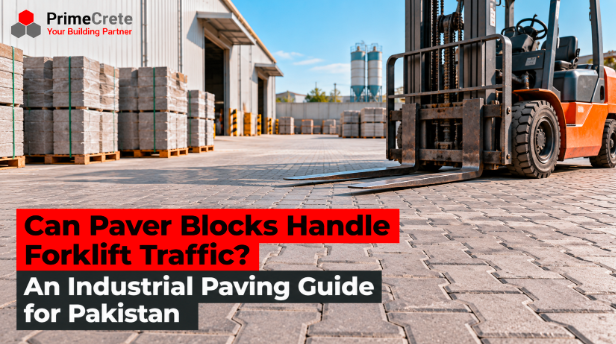
Industrial warehouses, loading yards, and distribution centres require surfaces that can withstand repeated vehicle movement, concentrated wheel loads, and heavy material handling. One common question among contractors and facility managers is whether paver blocks can handle forklift traffic without cracking, rutting, or settlement. The answer depends on the complete pavement design, including the concrete pavers, bedding layer, compacted base, subgrade, and edge restraints. PrimeCrete’s kerb stone blocks can form part of an appropriately designed edge-restraint system for industrial paving installations.
For project managers evaluating industrial paving solutions, PrimeCrete manufactures concrete paving-related products through Pak Dream (Pvt) Ltd at Hattar Industrial Estate, Haripur. Selecting an appropriate industrial interlocking paver system requires more than choosing the thickest available unit.
This guide explains forklift loading, paver thickness, compressive strength, pavement construction, and the common causes of industrial paving failures in Pakistan.
Can Interlocking Paver Blocks Support Forklift Traffic?
Yes, appropriately designed concrete interlocking paver systems can support certain forklift operations. However, the pavement must be engineered for the actual forklift wheel loads, tyre characteristics, operating frequency, turning movements, and supporting ground conditions.
Not every conventional driveway paver is suitable for a warehouse or industrial loading yard.
The structural demands of forklifts can be substantially different from those of passenger cars.
A forklift may carry concentrated loads through a relatively small tyre contact area, creating significant local stresses.
Frequent braking, turning, and reversing can also impose horizontal forces on the pavement.
Therefore, an industrial pavement must resist vertical loading, lateral movement, rutting, and repeated traffic-induced deterioration.
Why Are Forklift Loads Different From Car Loads?
Forklifts can impose high concentrated wheel loads because their weight and carried loads are distributed across relatively small contact areas.
Industrial forklift loading depends on several factors:
- Operating weight of the forklift
- Rated lifting capacity
- Actual carried load
- Wheel and axle configuration
- Tyre material and inflation characteristics
- Load-centre position
- Travel speed
- Braking and turning behaviour
- Number of load repetitions
Forklift Lifting Capacity Is Not the Wheel Load
A forklift with a rated lifting capacity of 3,000 kg does not impose only 3,000 kg on the pavement.
The pavement must carry the forklift’s own weight plus its load.
Furthermore, the loaded front axle may support a much greater portion of the combined weight than the rear axle.
Designers should obtain maximum axle and wheel loads from the forklift manufacturer, rather than estimating them from lifting capacity alone.
Why Does Tyre Contact Area Matter?
Tyre contact area influences pavement stress distribution.
A relatively small contact patch can produce high local contact pressure.
For an illustrative example, suppose a forklift wheel carries a vertical force of 20 kN through a nominal contact area of 0.01 m².
The average contact pressure would be:
20,000 N ÷ 0.01 m² = 2,000,000 Pa = 2 MPa
This is a simplified calculation, not a verified forklift loading condition or allowable paver stress.
Real pavement design must consider actual tyre contact geometry, load repetitions, dynamic effects, and structural response.
What Paver Block Thickness Is Suitable for Forklift Traffic?
An 80 mm concrete paver may be considered for some industrial paving applications, but 80 mm thickness alone does not establish suitability for forklift traffic.
Greater thicknesses may be needed depending on vehicle loading and pavement conditions.
| Nominal Paver Thickness | General Design Consideration |
| 60 mm | Commonly considered for lighter-duty paving |
| 80 mm | Potential option for selected vehicular and commercial applications |
| 100 mm | May be considered for more demanding pavement designs |
| Above 100 mm | Specialized designs requiring project-specific evaluation |
These thicknesses are selection categories, not universal forklift load ratings or confirmed PrimeCrete stock specifications.
A properly designed 80 mm paver pavement on a strong foundation may outperform a thicker paving surface installed over weak or poorly compacted material.
Engineers should determine the pavement structure from actual loading and ground conditions.
What Compressive Strength Should Industrial Paver Blocks Have?
Industrial paver blocks should meet the compressive strength and other physical performance requirements specified for the project and relevant paving-unit standard.
ASTM C936/C936M -Standard Specification for Solid Concrete Interlocking Paving Units provides a recognized framework for applicable concrete interlocking paving units.
Historically published guidance associated with ASTM C936 specifies an average paver compressive strength of 8,000 psi (approximately 55 MPa), with individual-unit criteria. Requirements should always be checked against the edition adopted by the project.
Does Higher Compressive Strength Guarantee Forklift Performance?
No.
A paver may meet its specified compressive strength and still perform poorly if the supporting pavement structure is inadequate.
For example, soft soil beneath a heavy forklift route can produce settlement even when the concrete units themselves remain intact.
Other potential failure causes include insufficient edge restraint, bedding migration, poorly filled joints, and localized overstressing.
Strength certification is necessary when specified, but it is only one part of industrial pavement acceptance.
How Important Is Sub-Base Compaction for Forklift Paving?
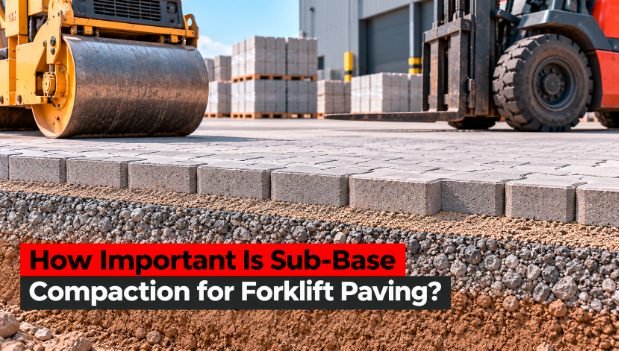
Sub-base compaction is critical because it helps provide stable support, control deformation, and distribute wheel loads through the pavement structure.
The pavement layers work together to transfer loads toward the supporting soil.
A typical flexible interlocking paving arrangement may include:
- Concrete interlocking paver units
- Specified bedding material
- Compacted aggregate base
- Additional sub-base layers where required
- Prepared supporting subgrade
Layer thicknesses and material specifications depend on pavement design.
Why Does a Weak Subgrade Cause Problems?
The subgrade is the underlying soil or prepared formation that supports the pavement.
If the subgrade cannot adequately support repeated wheel loads, the paving surface may develop depressions or ruts.
Water infiltration can further reduce the strength of moisture-sensitive soils.
Before construction, the engineer may need geotechnical information, including suitable measurements of subgrade support and moisture conditions.
For some pavement designs, a California Bearing Ratio (CBR) test helps characterize supporting soil.
The appropriate testing and design methodology should follow the project specification.
Why Do Edge Restraints Matter for Forklift Traffic?
Edge restraints help prevent lateral movement and loss of interlock at pavement boundaries.
Industrial paving depends on confinement and interlock between neighboring units.
When a forklift turns or brakes, its tyres may create forces that encourage pavers to move horizontally.
Without adequate restraint, pavement joints can open and localized displacement can develop.
How Do Kerb Stones Support Industrial Paving?
Concrete kerb stones can act as edge elements where their design and installation provide the necessary restraint.
PrimeCrete’s kerb stone products are intended for applications such as roads, walkways, commercial developments, and landscaping.
However, a kerb’s suitability for an industrial forklift yard depends on its dimensions, foundation, lateral support, and loading conditions.
The engineer should determine whether the selected kerb detail provides adequate confinement.
A kerb product’s compressive strength alone does not establish the lateral restraint capacity of the installed system.
Which Standard Is Relevant to Kerb Stones?
For applicable precast concrete kerb units, BS EN 1340 provides a recognized product specification and test-method framework.
Purchasers should review the relevant BS EN 1340 concrete kerb standard through BSI when preparing project specifications.
As with paving units, product compliance does not replace engineering design of the complete installation.
What Is the Correct Installation Process for Forklift Paver Blocks?
Successful forklift paving requires a stable foundation, correctly specified materials, properly installed pavers, effective edge restraints, and construction quality control.
Step 1: Confirm Forklift Operating Conditions
Identify the actual forklift model and obtain relevant loading information.
Determine whether vehicles will carry loads while traveling, frequently turn in confined areas, or operate continuously.
A pavement for occasional forklift access may require a different design from one supporting heavy daily operations.
Step 2: Assess Ground Conditions
Investigate the supporting soil and drainage.
Identify soft spots, fill material, settlement risks, and areas where water may accumulate.
Do not begin paving over unsuitable ground without corrective treatment.
Step 3: Construct the Designed Base
Install the specified base and sub-base materials in controlled layers.
Compact each layer according to the approved methodology.
Verify field compaction or other acceptance criteria as required by the project.
Step 4: Install Edge Restraints
Construct the designed kerb or edge restraint system before relying on pavement confinement.
Ensure that it has adequate support and follows approved line and level.
Step 5: Lay the Interlocking Pavers
Use the specified paver pattern and joint spacing.
For industrial loading, the laying pattern can influence load transfer and resistance to horizontal movement.
The final pattern should follow the pavement designer’s specification.
Step 6: Fill Joints and Compact the Surface
Use suitable jointing material and specified compaction procedures.
Properly filled joints help the paving units work together.
Inspect the completed surface before opening it to forklift operations.
What Causes Industrial Paver Blocks to Fail?
Industrial paver failures often result from inadequate structural design, poor installation, insufficient ground support, drainage problems, or loading beyond the original design assumptions.
Rutting and Settlement
Rutting appears as repeated depressions along wheel paths.
Potential causes include weak subgrade, inadequate base thickness, poor compaction, and repeated heavy traffic.
Broken or Cracked Pavers
Concrete pavers can crack under excessive stress, impact, or uneven support.
A cracked surface does not automatically identify the root cause.
Contractors should investigate the bedding and underlying layers before replacing units.
Paver Movement
Units may move when joints lose filling material or edge restraint becomes ineffective.
Repeated forklift turning can intensify these problems.
Poor Drainage
Water can weaken susceptible underlying soils and contribute to deformation.
In Pakistan, monsoon rainfall makes pavement drainage particularly important for outdoor loading yards.
Concentrated Industrial Loads
Container handling, heavy machinery, and specialized forklifts may impose loading conditions beyond those used for standard commercial paving.
These applications require individual design assessment.
How Do Paver Blocks Compare With Reinforced Concrete Slabs for Forklift Areas?
Both interlocking paver systems and reinforced concrete slabs can support forklift operations when properly engineered, but their maintenance characteristics and structural behaviour differ.
| Factor | Interlocking Pavers | Reinforced Concrete Slabs |
| Load transfer | Through units, joints, and supporting layers | Through structural slab action and supporting foundation |
| Local repair | Individual units may be lifted and replaced | Repairs may require cutting and reinstatement |
| Underground access | Selected units can be removed | Slab cutting may be required |
| Surface joints | Numerous narrow joints | Fewer but engineered construction/movement joints |
| Forklift suitability | Requires load-specific pavement design | Requires slab-specific structural design |
| Maintenance | Joint, settlement, and surface repairs | Joint, cracking, and surface repairs |
For warehouses using hard-wheeled forklifts and highly controlled floor-flatness requirements, an engineered concrete slab may offer operational advantages.
For selected external yards and access routes, interlocking concrete paving may offer easier localized maintenance.
Neither solution should be selected solely on material price.
How Much Does Forklift Paving Cost in Pakistan?
Industrial paver block costs depend on paver thickness, strength specification, pavement foundation, site conditions, quantity, transport, and installation requirements.
There is no universally applicable installed price for forklift-rated paving in Pakistan.
For preliminary material-cost context, PrimeCrete’s 2026 concrete interlocking paver price guide discusses indicative rates for common paving categories.
However, those published ranges should not be treated as verified prices for a forklift-engineered pavement system.
Industrial projects also require allowances for excavation, subgrade improvements, drainage, heavy-duty edge restraints, and quality testing.
For associated boundary and edge components, PrimeCrete’s kerb stone purchasing and cost guide provides useful procurement background.
Practical Industrial Paving Cost Example
Consider a hypothetical 500 m² loading yard.
Assume a preliminary installed paving budget of PKR 4,000/m², solely for illustration.
Estimated cost:
500 × PKR 4,000 = PKR 2,000,000
This is not a market-verified rate, a structural design estimate, or a PrimeCrete quotation.
Actual costs must reflect the approved pavement section, site investigation, scope of work, and contractor pricing.
What Should Procurement Teams Verify Before Ordering?
An industrial paving quotation should include enough information to support technical evaluation.
Request the following documentation:
- Paver dimensions and thickness
- Applicable material specification
- Laboratory compressive strength reports
- Sampling and test standard
- Surface and dimensional tolerances
- Base and bedding requirements
- Edge-restraint details
- Expected forklift axle and wheel loads
- Design assumptions and supporting calculations
- Delivery and installation scope
Where ASTM C936 applies, relevant testing should follow ASTM C140/C140M and the requirements of the adopted specification.
Before procurement, confirm that the contractor and manufacturer understand the required industrial traffic conditions.
Frequently Asked Questions
Can 60 mm paver blocks handle forklifts?
A 60 mm paver should not be assumed suitable for forklift traffic without a specific engineered assessment. Forklift wheel loads and pavement construction determine suitability.
Are 80 mm pavers suitable for forklift traffic?
They may be considered in selected engineered installations, but thickness alone does not establish load capacity.
Can forklifts damage interlocking pavers?
Yes. Repeated concentrated loads, hard tyres, tight turning, inadequate edge support, or poor sub-base conditions can contribute to damage.
Are kerb stones necessary for industrial paving?
Appropriate edge restraints are generally important for interlocking paving. The restraint may use engineered kerbs or another approved system.
Which is better for a forklift yard: pavers or concrete?
The preferred solution depends on wheel loads, operational frequency, required surface tolerances, drainage, maintenance needs, and total project cost.
Conclusion
Concrete paver blocks can handle forklift traffic when engineers design the complete pavement system for actual industrial loading conditions.
The most important factors include unit strength, paver geometry, structural thickness, sub-base support, drainage, joint performance, and properly designed edge restraints.
Simply installing thicker paving units over weak soil does not create a reliable industrial pavement.
For warehouses, loading yards, and industrial projects in Pakistan, PrimeCrete offers concrete paving-related products that can be evaluated as part of a complete engineered surface system.
Before ordering, contractors should verify forklift loading requirements, obtain relevant product documentation, and finalize the pavement design with a qualified engineer.
