

Planning a green driveway, garden parking area, or landscaped commercial entrance requires more than selecting an attractive paving pattern. Property owners and contractors need to understand the grass pavers price in Pakistan, installation costs, drainage requirements, and long-term maintenance. Grass pavers combine an open-grid concrete structure with grass or suitable aggregate-filled openings, creating a surface that can support selected traffic while maintaining landscaped spaces.
For buyers comparing conventional paving with green alternatives, PrimeCrete offers concrete grass paving products manufactured through Pak Dream (Pvt) Ltd’s production operations in Hattar Industrial Estate, Haripur. The final project cost depends on unit dimensions, thickness, strength, quantity, soil preparation, installation, and delivery location.
This guide explains how to estimate concrete grass paver costs for residential, commercial, and landscaping projects in Pakistan without relying on misleading fixed-price quotations.
What Is the Grass Pavers Price in Pakistan in 2026?
There is no single verified nationwide grass paver price in Pakistan for 2026. Rates vary according to product dimensions, concrete grade, opening design, thickness, order quantity, transport distance, and whether the quotation includes installation.
PrimeCrete’s published grass paver product page describes applications and product characteristics but does not provide a publicly confirmed, fixed per-unit price.
Therefore, buyers should request a current quotation rather than treating general interlocking paver rates as a confirmed grass paver price.
What Determines the Price of Grass Pavers?
| Cost Factor | Effect on Price |
| Paver dimensions | Changes unit count and production requirements |
| Thickness | Influences material volume and suitability for traffic |
| Concrete specification | Higher specified performance may affect manufacturing cost |
| Grid opening design | Affects material quantity and filling requirements |
| Colour and finish | Special finishes may increase cost |
| Order volume | Larger orders may offer economies of scale |
| Delivery distance | Freight affects total landed cost |
| Installation | Excavation, foundation preparation, bedding, and labour add cost |
A project in Islamabad may have different transportation expenses from one in Lahore or Peshawar.
For meaningful supplier comparisons, request the same technical specification from every bidder.
What Are Concrete Grass Pavers?
Concrete grass pavers, also called concrete grid pavers, are precast paving units containing openings intended for vegetation or suitable granular filling.
They help distribute surface loads through a concrete grid while preserving spaces for landscaping or infiltration.
Common applications include residential driveways, overflow parking areas, garden paths, landscaped commercial sites, and selected low-intensity vehicle access routes.
However, grass pavers should not automatically be treated as suitable for heavy industrial traffic.
Their performance depends on the unit specification, supported loads, bedding, base preparation, and underlying soil.
How Are Grass Pavers Different From Interlocking Concrete Pavers?
Conventional interlocking paver blocks generally provide a mostly solid paved surface with narrow joints.
Grass pavers contain substantially larger openings.
| Feature | Grass Pavers | Conventional Interlocking Pavers |
| Surface | Open concrete grid | Predominantly solid concrete |
| Vegetation | Can accommodate grass | Usually not intended for turf growth |
| Drainage | May support infiltration | Depends on joint and base system |
| Maintenance | Grass care or filling replacement | Joint and surface maintenance |
| Typical purpose | Green parking and landscaping | Walkways, driveways, and paved yards |
A grass paver system can provide environmental benefits, but infiltration depends on the complete pavement structure and underlying soil.
If the installation uses an impermeable base or poorly draining subgrade, water may still accumulate.
Which Standard Applies to Concrete Grass Pavers?
ASTM C1319 is a relevant specification for applicable concrete grid paving units, while ASTM C140/C140M provides standardized testing procedures.
ASTM C1319: Concrete Grid Paving Units
ASTM C1319-23a -Standard Specification for Concrete Grid Paving Units covers concrete grid paving products for applications including parking areas, vehicular trafficways, and soil stabilization.
The standard provides a recognized basis for specifying the concrete grid unit itself.
Purchasers should confirm whether the proposed product meets the applicable edition rather than assuming compliance from appearance.
ASTM C1319 addresses unit properties, not the complete structural or hydraulic design of the pavement.
ASTM C140/C140M: Paver Testing
ASTM C140/C140M -Sampling and Testing Concrete Masonry Units and Related Units includes procedures relevant to concrete grid paving units.
The standard addresses physical measurements and testing methods.
Buyers should request appropriate laboratory reports when specifications require documented compliance.
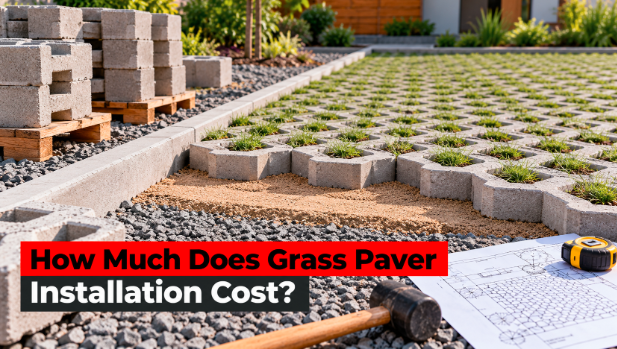
How Much Does Grass Paver Installation Cost?
Grass paver installation cost depends primarily on site preparation, pavement structure, labour, drainage requirements, and the amount of excavation or imported aggregate needed.
The concrete paver unit price represents only one component.
A complete estimate may include excavation, disposal of unsuitable material, subgrade preparation, geotextile where specified, sub-base aggregate, bedding, edge restraints, paver units, opening fill, grass establishment, and transportation.
Practical Cost Calculation for a 1,000 sq ft Area
Consider a hypothetical project with 1,000 sq ft of grass paving.
Assume, for illustration only:
| Component | Assumed Cost |
| Grass paving units | PKR 180/sq ft |
| Sub-base and bedding | PKR 70/sq ft |
| Installation labour | PKR 45/sq ft |
| Soil/grass filling | PKR 25/sq ft |
| Delivery and miscellaneous | PKR 20/sq ft |
| Illustrative total | PKR 340/sq ft |
Total estimated cost:
1,000 × PKR 340 = PKR 340,000
This is a hypothetical estimating example, not a verified PrimeCrete quotation or a published market average.
The example excludes any separately required major excavation, drainage infrastructure, tax, engineering design, and contingency.
Actual site costs may differ substantially.
Should Grass Pavers Be Purchased Per Piece or Per Square Foot?
Both quotation methods are possible.
To compare prices fairly, convert them to a common area basis.
For example, suppose a hypothetical grass paver has a plan size of 400 × 400 mm.
Its nominal plan area is:
0.4 × 0.4 = 0.16 m²
Ignoring joint allowances, the theoretical quantity is:
1 ÷ 0.16 = 6.25 units/m²
For a 100 m² project:
100 × 6.25 = 625 units
Adding a hypothetical 5% allowance gives approximately 657 units after rounding up.
Actual quantities depend on the manufacturer’s dimensions, joint layout, edge cutting, site geometry, and recommended wastage allowance.
How Should Grass Pavers Be Installed?
Grass pavers require a properly prepared foundation, controlled bedding thickness, edge restraint, and an opening-fill material suitable for the intended traffic and drainage conditions.
Step 1: Evaluate the Existing Ground
Inspect the site for weak soil, standing water, unsuitable fill, and drainage restrictions.
For parking areas, a geotechnical assessment may be necessary to establish subgrade support.
Removing weak material or improving drainage before paving can prevent expensive settlement repairs.
Step 2: Design the Sub-Base
The sub-base distributes loads and provides a stable foundation.
Thickness and material selection depend on vehicle loads, soil bearing characteristics, drainage, and design requirements.
A fixed 100 mm or 150 mm layer should not be prescribed universally for all grass paving applications.
Heavy traffic, weak soil, or saturated conditions may require a substantially different pavement structure.
Step 3: Compact the Supporting Layers
Adequate sub-base compaction reduces settlement and helps maintain a stable paving surface.
Compaction requirements should follow the project specification and appropriate field verification procedures.
Contractors should avoid using visual appearance alone to judge density.
Step 4: Place Bedding Material
Use bedding material compatible with the selected paver system and drainage design.
Control bedding thickness and surface level.
Irregular bedding can create localized support differences and paver rocking.
Step 5: Install Grass Paver Units
Lay the units in the specified pattern.
Maintain alignment, required joints, and suitable edge restraints.
Avoid damaged products with significant cracks or broken load-bearing sections.
Step 6: Fill Openings and Establish Grass
Fill the grid openings using the specified material.
Where turf is intended, select a suitable soil mixture and grass species for the expected sunlight, climate, and traffic.
Protect new grass from excessive vehicle movement during establishment.
Are Grass Pavers Suitable for Pakistan’s Monsoon Climate?
Grass pavers can support effective surface-water management when designers provide a properly draining pavement structure and a suitable route for excess water.
Pakistan’s monsoon rainfall can create flooding and surface runoff problems around driveways, parking lots, and landscaped developments.
Open-grid paving can allow water into the pavement structure, but infiltration capacity depends on soil permeability, drainage layers, clogging, and maintenance.
A successful installation should account for:
- Local rainfall intensity
- Soil infiltration characteristics
- Subgrade drainage
- Groundwater conditions
- Overflow routes
- Surface slopes
- Potential sediment clogging
Grass pavers alone cannot guarantee flood prevention.
Are Grass Pavers Cheaper Than Conventional Pavers?
Grass pavers are not necessarily cheaper than conventional concrete pavers when total installed cost and maintenance are considered.
The answer depends on unit pricing, pavement foundation, filling material, drainage, and maintenance requirements.
Grass may require watering, trimming, reseeding, and protection from excessive traffic.
Solid pavers may need joint maintenance, surface cleaning, and localized replacement.
For pricing context, read PrimeCrete’s 2026 interlocking paver block cost guide.
Where the paved area connects to roads or parking lanes, additional edge restraints may be needed. PrimeCrete’s kerb stone pricing and selection guide explains related cost considerations.
What Should Buyers Ask Before Ordering Grass Pavers?
Before placing a bulk order, request a written quotation that identifies the exact product and scope.
Check the unit dimensions, thickness, quantity per square metre, material specification, available colours, strength-test documentation, and proposed delivery schedule.
Confirm whether the supplier’s price includes loading, unloading, transportation, and taxes.
For parking applications, tell the supplier about the expected vehicle types and traffic frequency.
Do not assume a landscaping product is suitable for frequent truck movement or industrial lifting equipment.
Frequently Asked Questions
What is the current grass pavers price in Pakistan?
Prices depend on supplier, unit design, thickness, specification, and delivery. A confirmed PrimeCrete rate requires a current project quotation.
Are grass pavers suitable for car parking?
They can be suitable for selected car parking applications when the complete pavement system meets the required loading and site conditions.
Do grass pavers help rainwater drainage?
They can, provided the openings, underlying layers, and soil or drainage system allow water to move away effectively.
Can grass pavers be installed directly on soil?
Simply placing them on unprepared soil is generally unsuitable for vehicle-bearing applications. Proper foundation preparation is important.
Do grass pavers require maintenance?
Yes. Grass establishment, irrigation, debris removal, drainage upkeep, and occasional unit replacement may be necessary.
Conclusion
The grass pavers price in Pakistan depends on more than the cost of individual concrete units.
Contractors and homeowners should evaluate the full installed system, including sub-base preparation, drainage, traffic requirements, filling material, labour, and transportation.
A technically appropriate grass paving system can combine landscaped appearance
