
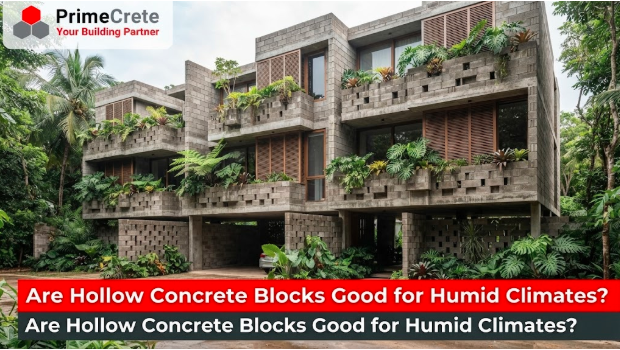
Building envelope performance in humid, high-rainfall regions poses major challenges for architects, civil contractors, and developers across Pakistan. From the intense monsoon downpours of Islamabad and northern Punjab to the coastal humidity of Karachi, selecting the right building envelope directly affects indoor air quality, mold resistance, and energy costs.
High-performance cellular hollow concrete blocks feature internal air cavities that deliver distinct thermal and moisture-management advantages over conventional dense masonry when designed with proper waterproofing detailing.
Produced on automated German MASA machinery at Hattar Industrial Estate, PrimeCrete building products provide consistent cellular geometries and controlled water-absorption metrics. By examining vapor diffusion pathways, thermal boundary performance, and external plaster systems, engineers can leverage hollow block masonry to design resilient, energy-efficient structures suited for high-humidity climates.
Direct Answer: Are Hollow Concrete Blocks Good for Humid Climates?
Yes, hollow concrete blocks perform exceptionally well in humid climates, provided exterior facades receive an engineered waterproof plaster or breathable hydrophobic coating. Their internal air cavities create a reliable thermal break that cuts heat transfer by 30% to 40% compared to solid red clay brick walls, preventing interior condensation (sweating) when warm, humid air meets air-conditioned indoor spaces. Furthermore, unlike organic or clay materials that foster fungal growth and efflorescence, inorganic concrete masonry units naturally resist mold, rotting, and salt weathering.
The Physics of Humidity, Dew Points, and Vapor Diffusion
In humid climates, building envelopes must manage moisture vapor moving from hot, humid exterior air toward cooler, dehumidified interior spaces, driven by vapor pressure differentials across the wall assembly.
Eliminating Condensation and Sweating
Interior wall sweating occurs when the temperature of an inside surface drops below the ambient dew point of indoor air. In dense, solid clay brick walls, heat transfers quickly across the wall, creating cold surface spots where moisture condenses and feeds mold colonies.
In contrast, hollow blocks introduce stagnant air chambers within their cores. Air has a very low thermal conductivity, significantly increasing the overall thermal resistance (R-value) of the assembly. The interior surface stays above the dew point, preventing condensation.
For more on thermodynamic wall behavior, review our analysis of the thermal insulation benefits of hollow block construction.
Material Comparison in High-Humidity Environments
| Performance Metric | Machine-Cast Hollow Concrete Blocks | Traditional First-Class Red Clay Bricks |
|---|---|---|
| Equilibrium Moisture Content | Very Low (1.5% to 3.0% by weight) | High (8.0% to 14.0% by weight) |
| Thermal Resistance (8″ wall) | R ≈ 1.90 to 2.50 hr-ft²-°F/Btu (ASTM C129 nonloadbearing standards) | R ≈ 1.10 to 1.30 hr-ft²-°F/Btu |
| Mold & Fungus Spore Growth | Inorganic (Zero fungal nourishment) | Moderate (Traps organic dust in pores) |
| Drying Potential (Post-Monsoon) | Rapid (Air chambers vent moisture) | Extremely Slow (Saturated core retains water) |
| Deterioration from Salt (Shora) | Nil (Washed, controlled aggregate mix) (Building Code of Pakistan energy guidelines) | Severe (Surface delamination) |
Critical Engineering Details for Monsoon-Resistant Facades
- Two-Coat Exterior Plaster with Crystalline Additives: Apply a 15 to 18 mm exterior plaster in two coats (1:4 cement-sand mix). Integrate a crystalline waterproofing admixture or micro-polypropylene fibers (0.9 kg/m³) into the base coat to stop shrinkage cracks.
- Vapor-Permeable Exterior Finishes: Never coat exterior humid facades with impermeable, plastic-film elastomeric paints that trap migrating moisture inside the block cells. Instead, specify vapor-permeable silicone-resin paints or breathable silane-siloxane water repellents that let moisture escape while shedding rain. For detailed application steps, see our technical guide to monsoon waterproofing techniques for masonry walls.
- Concave or Weather-Struck Mortar Tooling: Never leave horizontal mortar joints flush or raked on exterior walls exposed to driving rain. Tool all exterior mortar joints to a smooth, dense concave profile using an oval jointer tool to shed rainwater downward.
- Through-Wall Flashing and Weep Vents at Slab Junctions: At floor lintel beams and slab-to-wall transitions, install 0.5 mm thick flexible flashing sloping toward the outside face, accompanied by vertical weep-hole inserts spaced every 32 inches to vent accumulated moisture safely outside.
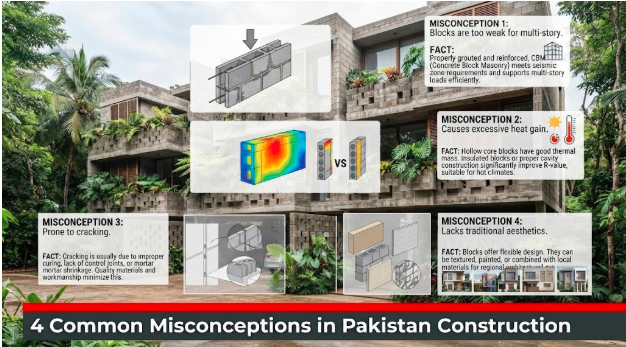
4 Common Misconceptions in Pakistan Construction
- “Hollow blocks trap moisture inside the walls permanently.”
- Reality: The internal air cavities actually promote air circulation and moisture evaporation. As long as exterior surfaces are protected with breathable plaster, hollow blocks dry out much faster than dense, saturated clay bricks after heavy rains.
- “Hollow blocks make homes feel damp and humid inside.”
- Reality: By insulating against rapid temperature swings, hollow blocks keep interior surfaces warmer in winter and cooler in summer, preventing interior surface condensation and dampness.
- “Water will seep through the block cavities directly into rooms.”
- Reality: Liquid water penetrates walls through cracked mortar joints and unsealed plaster, not through the block material itself. Properly applied cement plaster stops wind-driven rain long before it reaches the block face.
- “High humidity degrades the structural strength of concrete blocks.”
- Reality: High humidity actually supports the ongoing hydration of Portland cement. Unlike timber or clay masonry, fully cured concrete blocks maintain structural capacity indefinitely under humid conditions.
Architectural & Procurement Submittal Checklist
Standard Compliance: Tested to ASTM C90 (for loadbearing units) or ASTM C129 (for non-loadbearing partitions).
Minimum Compressive Strength: At least 1,900 PSI gross area for loadbearing; at least 1,000 PSI for infill walls.
Maximum Water Absorption: Capped at less than or equal to 8% by dry weight per ASTM C140.
Shell & Web Thickness: Face shells at least 32 mm (1.25 inches); webs at least 25 mm (1.0 inch).
Exterior Finishing Specification: 2-coat waterproof plaster with tooled concave joints.
Frequently Asked Questions
Q: Do hollow blocks help reduce air conditioning electricity costs in humid summer weather?
A: Yes. The trapped air cores provide thermal insulation that cuts solar heat gain through west- and south-facing walls, reducing indoor cooling loads and cutting monthly HVAC electricity consumption by 20% to 30%.
Q: Should the air cores of hollow blocks be filled with insulation materials like EPS foam beads?
A: In very hot and humid climates, filling the hollow cores with expanded polystyrene (EPS) beads, vermiculite, or hydrophobic mineral wool increases wall R-values from roughly R-2.0 to over R-4.5, further lowering heat gain without compromising moisture performance.
Q: Can mold grow on interior plaster over hollow concrete block walls?
A: Mold requires moisture, warmth, and an organic food source. Because hollow blocks prevent cold-surface condensation, using anti-fungal paint on clean cement-sand plaster virtually eliminates interior mold growth
