
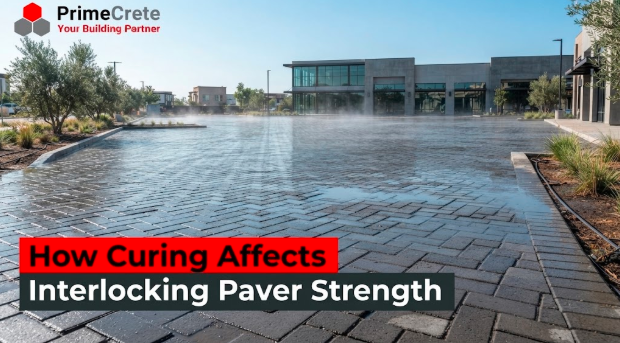
Exterior pavements across Pakistan face severe service conditions, from heavy truck axle loads on industrial driveways to scorching summer heat exceeding 45°C. When paving projects experience premature surface dusting, edge spalling, or cracking, civil engineers and municipal contractors routinely ask how curing affects interlocking paver strength. Skipping or cutting curing short to speed up production is the primary cause of premature paver failure.
Supplying precision, dry-cast heavy-duty interlocking paver blocks requires controlled hydration environments to reach high compressive strength, low water absorption, and high abrasion resistance.
Manufactured with automated German MASA technology at our Hattar Industrial Estate facility, PrimeCrete precast concrete solutions undergo rigorous, climate-controlled curing protocols. Understanding the chemistry of cement hydration, curing methods, and durability gains helps procurement officers, landscape architects, and civil contractors install resilient pavements across Lahore, Rawalpindi, Islamabad, and Peshawar.
Direct Answer: How Curing Affects Interlocking Paver Strength
Curing directly governs ultimate compressive capacity, surface hardness, and long-term durability by sustaining the hydration of Portland cement. Without proper moisture and temperature control, dry-cast concrete loses up to 40% to 50% of its potential compressive strength, leaving the surface layer prone to spalling, aggregate raveling, and tire abrasion. Fully cured pavers achieve compressive strengths of 5,000 to 8,000+ PSI (35 to 55+ MPa) per ASTM C936 standards, whereas under-cured units frequently fail below 3,000 PSI, absorbing excessive water and failing under heavy wheel loads.
The Chemistry of Curing in Dry-Cast Concrete
Interlocking pavers are formed from zero-slump, dry-cast concrete compacted under high-frequency vibration and multi-ton hydraulic pressure. Because dry-cast mixes have a very low water-cement ratio (w/c approximately 0.28 to 0.36), every drop of water is essential for chemical hydration.
Calcium Silicate Hydrate (C-S-H) gel acts as the micro-crystalline adhesive binding sand and stone aggregate particles together. If newly pressed green pavers are exposed to dry air, ambient wind, or hot sunshine, surface water evaporates instantly. Hydration halts, leaving unhydrated cement particles, open capillary pores, and fragile microstructures along the wear layer.
Technical Performance Metrics: Cured vs. Uncured Paver Blocks
| Performance Metric | Accelerated Steam / Mist Cured (14–28 Days Eq.) | Poorly Cured Pavers (Air-Dried 3–5 Days) | Test Standard / Reference |
|---|---|---|---|
| 28-Day Compressive Strength | 5,500 to 8,000+ PSI (38 to 55 MPa) | 2,800 to 3,500 PSI (19 to 24 MPa) | ASTM C936 solid concrete interlocking paving units |
| Cold Water Absorption | Less than or equal to 5.0% by weight | 9.0% to 14.0% by weight | ASTM C140 compressive testing procedures |
| Surface Abrasion Depth | Less than 15 mm volume loss | Greater than 35 mm severe aggregate pitting | ASTM C936 |
| Flexural / Tensile Splitting | At least 3.8 to 5.0 MPa | Less than or equal to 1.8 to 2.2 MPa | EN 1338 / ASTM C140 |
| Resistance to Heavy Wheel Loads | Excellent (Resists 100+ kN axle loads) | Poor (Cracking under delivery trucks) | Field Wheel Load Assessment |
4 Industrial Curing Methods Used in Pakistan
1. Automated Chamber Curing (Steam / Temperature Controlled)
The gold standard for modern precast manufacturing. Freshly pressed paver pallets enter insulated curing chambers maintained at 35°C to 50°C and 95%+ relative humidity for 12 to 24 hours. Heat accelerates initial strength gain, while saturated air prevents surface evaporation. Blocks reach 70% of 28-day target strength within 24 hours, ready for palletizing without micro-cracking.
2. Fogging and Micro-Mist Spraying
Pallets are stored under sheltered sheds and misted with high-pressure micro-nozzles. Unlike harsh hose streams that pit green concrete surfaces, fine fog droplets keep exposed surfaces moist without washing away the surface paste.
3. Submerged Water Bathing
Immersing cured green blocks in water tanks for 7 to 14 days ensures full hydration. While effective for small batches, this labor-intensive approach often leaves surface mineral deposits (lime bloom) if wash water is high in dissolved salts.
4. Open-Air Sun Drying (Major Quality Pitfall)
Common in roadside casting yards across Pakistan. Green blocks sit directly under hot summer sunlight with only occasional hose spraying. Surface water evaporates within minutes, stopping hydration and producing weak, chalky pavers that crumble under heavy commercial traffic.
For foundation and sub-base best practices that complement high-strength pavers, read our technical overview of sub-base preparation for heavy-load interlocking pavers.
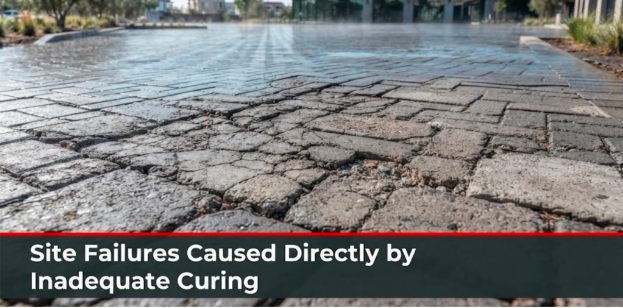
Site Failures Caused Directly by Inadequate Curing
- Surface Dusting and Raveling: Tire friction from low-speed maneuvering shears the weak, under-hydrated top cement matrix. Aggregate particles dislodge, turning the clean paver surface into loose gravel within months of handover.
- Edge Chipping Along Chamfers: Un-cured chamfers crack under the high dynamic stresses generated during joint sand compaction with heavy vibratory plates (15 to 20 kN).
- Rapid Staining and Oil Absorption: Under-cured pavers develop open, porous capillary systems. Motor oil, diesel, and muddy monsoon runoff penetrate deep into the paver body, causing permanent discoloration that power-washing cannot remove. Read more about testing these properties in our guide to abrasion resistance testing for commercial paving.
Quality Assurance & Testing Checklist
Compressive Testing Frequency: 1 sample set per 5,000 units tested per ASTM C140.
Minimum Crushing Strength: Individual units at least 7,000 PSI for industrial, at least 5,000 PSI for pedestrian/light traffic.
Maximum Water Absorption: Average less than 5% dry weight; no individual unit greater than 7%.
Chamfer Durability: No micro-fissuring visible under 5x magnification along top wear edges.
Density Verification: High-density unit matrix exceeding 2,200 kg/m³.
Frequently Asked Questions
Q: Can watering pavers on-site make up for missed factory curing?
A: No. Once dry-cast concrete dries out during the initial 48 hours, the C-S-H hydration process halts permanently. Adding surface water to dried units later will not restore lost internal bond strength.
Q: How many days must interlocking pavers cure before handling heavy traffic?
A: Factory steam-cured pavers can handle heavy traffic after 7 days of warehouse aging. Naturally mist-cured pavers must cure for a full 28 days to safely support heavy axle loads.
Q: Why do some poorly cured pavers turn white and powdery?
A: This white haze is primary efflorescence (shora). When under-cured, highly porous concrete dries, unreacted calcium hydroxide leaches to the surface and reacts with atmospheric CO2 to form calcium carbonate crusts.
